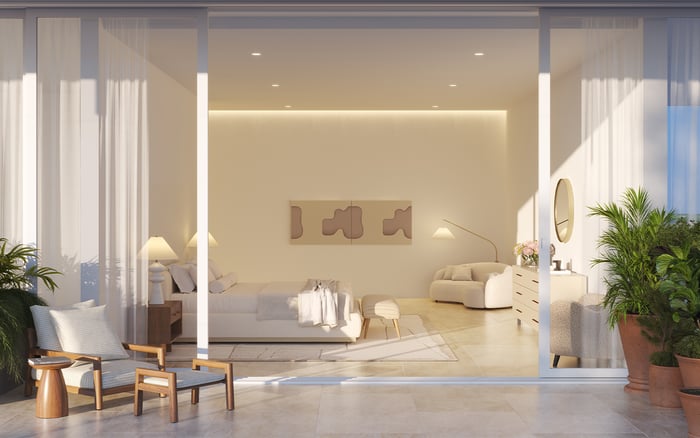
For golf-oriented South Florida buyers, the guest suite is a lifestyle instrument, not leftover square footage. This editorial explains how to read privacy, circulation, family use, club weekends, resale logic, and condominium rules before committing to a luxury residence.

For the South Florida buyer whose life is organized around Golf, the guest suite is rarely incidental. It is the pressure valve for a residence expected to perform during long weekends, family overlap, club events, visiting friends, adult children, and the occasional professional or wellness support staff. Before signing, the question is not simply whether a home has enough bedrooms. The more exacting question is whether the residence can host gracefully without interrupting the owner’s rhythm.
In ultra-premium real estate, privacy is a form of luxury. A guest suite that opens too directly into the main living room may read as convenient on paper and feel exposed in practice. A secondary bedroom with a beautiful finish package can still fall short if guests must cross the primary living path at awkward hours. A residence designed for golf-oriented living should allow early tee times, late dinners, and quiet recovery to coexist without friction.
This matters even more for the Second-home buyer. The residence may be used intensely during concentrated windows rather than evenly throughout the year. Those windows can bring guests, luggage, golf bags, drivers, shoes, club attire, and a social calendar that changes by the day. The suite strategy should anticipate peak use, not average use.
The most disciplined buyers begin by defining who will actually use the guest space. A visiting couple needs a different level of privacy than a single friend in town for a golf weekend. Adult children may want independence. Parents may need easier access and a calmer room location. A nanny, chef, trainer, or caregiver requires another kind of separation altogether.
Once that profile is clear, the plan becomes easier to read. A proper guest suite should offer a sense of arrival, a bath arrangement that does not feel borrowed, a closet that holds more than a weekend bag, and a path to the kitchen, terrace, or elevator that does not turn every movement into a social interruption. Buyers comparing residences such as Alina Residences Boca Raton should evaluate how the secondary rooms would live during a full house, not just how they photograph when empty.
The best guest suites are not necessarily the largest. They are the ones placed with intent. A slightly smaller suite with better separation can be more valuable than a larger room set too close to the primary bedroom or directly off the main entertaining zone.
A simple test can reveal a great deal: imagine two guests arriving on a Thursday evening with luggage and golf gear, then leaving before sunrise for an early round while the owners remain asleep. Can they come and go without passing the primary suite? Can they access coffee, the elevator, parking, or a service area without waking the entire residence? Is there a natural place for shoes and bags without compromising the foyer?
This is where circulation matters. Hallways, vestibules, service entries, laundry access, and secondary baths are not merely technical details. They determine whether a residence feels serene or crowded. For golf-oriented buyers, elegance is measured by how little the home must be rearranged when guests arrive.
In Hallandale, a buyer considering Shell Bay by Auberge Hallandale might ask a practical question before falling in love with the broader lifestyle proposition: where do guests sleep, dress, gather, and retreat after a long day outside? That answer will often matter as much as the view or finish palette.
Many buyers think first about guest privacy, but owner privacy is equally important. A finely planned guest suite protects the host from feeling displaced in the home. The primary suite should remain a sanctuary, the main bath should remain private, and the owner’s closets should not become overflow storage for visitors.
The reverse is also true. Guests should not feel as if they are occupying a decorative room with no autonomy. A suite should allow them to close a door and disengage. If every call, shower, or late return is audible, the space is not truly guest-ready.
For buyers exploring island or club-oriented settings such as The Links Estates at Fisher Island, the conversation should move beyond prestige and into daily choreography. Where does a guest begin and end the day? How close is the suite to social areas? Can multiple generations occupy the residence without the home losing its composure?
In a condominium, a guest-suite strategy is not only architectural. It is operational. Buyers should understand the building’s guest policies, access procedures, parking protocols, service elevator practices, delivery rules, pet rules if relevant, and any restrictions that affect extended stays. These details can change the practical value of a suite.
A residence may seem ideal for hosting until the owner realizes that visitor access is cumbersome, parking is limited, or staff coordination is more formal than expected. In the luxury market, formality can be a virtue, but only when it aligns with how the owner intends to live. The right building should support the owner’s hospitality style rather than complicate it.
This is particularly relevant when comparing urban residences, waterfront condominiums, and low-density enclaves. A buyer looking at The Residences at Mandarin Oriental Boca Raton should consider the residence and the building experience together. The guest suite is only one part of the hosting equation.
The language of floor plans can be seductive. Den, media room, staff room, family room, office, and guest room may all suggest flexibility. Yet not every flexible room can function as a guest suite. Ceiling height, bath proximity, closet depth, acoustic separation, and natural light all matter. A room that works beautifully as a study may not work for a visiting couple.
Buyers should resist counting every enclosed room as equal. A true guest-suite strategy distinguishes occasional overflow from dignified hospitality. The difference is not cosmetic. It affects daily comfort, resale appeal, and the owner’s ability to use the home without compromise.
In Palm Beach Gardens, a buyer evaluating The Ritz-Carlton Residences® Palm Beach Gardens should ask whether flexible rooms support the intended lifestyle or merely increase the room count. The most elegant homes are honest about what each space can do.
A thoughtful guest-suite strategy can make a residence easier for the next buyer to understand. Luxury purchasers often respond to clarity: where the owners live, where guests stay, where staff can operate, where family gathers, and where privacy begins. When those answers are intuitive, the home feels more resolved.
This does not mean every buyer needs the maximum bedroom count. In some cases, a smaller number of better-planned suites will outperform a larger plan that feels congested. The key is alignment. A golf-oriented buyer should seek a home that supports hospitality without turning hosting into a logistical exercise.
Before signing, walk the plan as if the guests have already arrived. Picture luggage in the hall, wet shoes after a humid morning, coffee before a tee time, a late dinner, and a quiet Sunday departure. If the home still feels composed, the suite strategy is working.
Why should a golf buyer prioritize guest suites before contract? Golf-oriented ownership often includes visiting friends and family. The suite plan determines whether hosting feels effortless or intrusive.
Is bedroom count the most important factor? No. Separation, bath access, circulation, storage, and privacy can matter more than the raw number of bedrooms.
What is the golf-weekend test? It is a practical review of how guests arrive, store gear, sleep, leave early, and return without disrupting the owner’s routine.
Should a den be treated as a guest suite? Only if it has the privacy, comfort, bath access, and storage needed for real overnight use. A den label alone is not enough.
How does a Second-home buyer evaluate guest space? The buyer should consider peak-use periods, when family and friends may overlap. Average occupancy can understate the need for flexibility.
Do condominium rules affect guest-suite value? Yes. Access, parking, service procedures, and stay policies can shape how comfortably guests use the residence.
What makes a guest suite feel luxurious? A quiet location, an intuitive bath arrangement, adequate storage, and a sense of independence create a more gracious experience.
Can too many guest rooms be a disadvantage? Yes, if they compromise owner privacy, living space, or overall flow. Quality of planning is more important than excess capacity.
Should staff use be part of the plan? If the owner expects household support, wellness services, or caregiving, the floor plan should account for discreet movement and rest space.
When is the right time to review guest-suite strategy? Before signing, while plan selection, due diligence, and contract terms can still be evaluated with lifestyle fit in mind.
For a discreet conversation and a curated building-by-building shortlist, connect with MILLION.
If branded residences are on your mind — as a home or as an allocation — we would be glad to share what we are seeing, privately.
Begin a quiet conversation