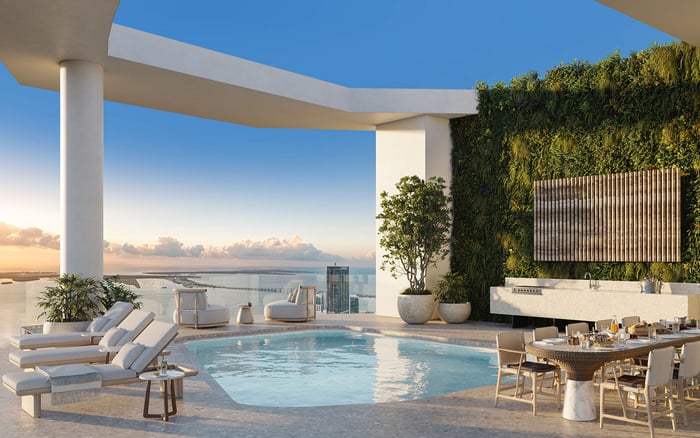
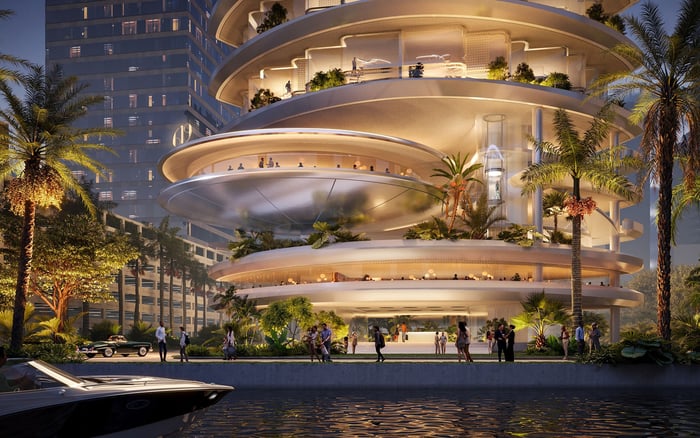
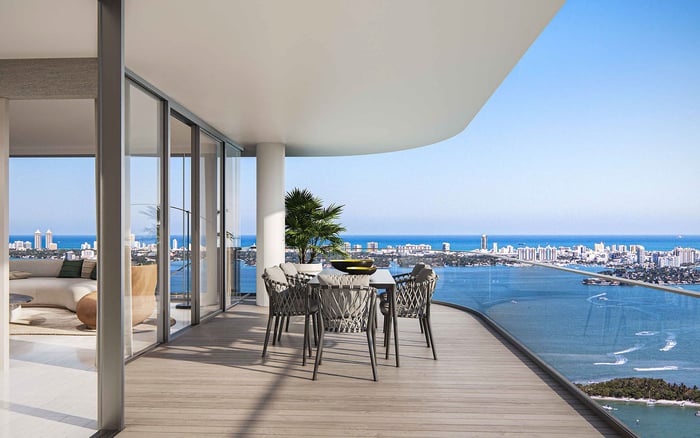
In Miami’s top-tier condo market, “the view” is not a single commodity. It is a composition shaped by siting, tower geometry, terrace depth, and the foreground a resident lives with every day. Casa Bella Residences by B&B Italia, Faena Residences Miami on the Miami River, and Waldorf Astoria Residences Miami each promise dramatic outlooks, but they deliver distinct visual experiences: bay and skyline spectacle, riverfront theater, or a park-framed horizon.
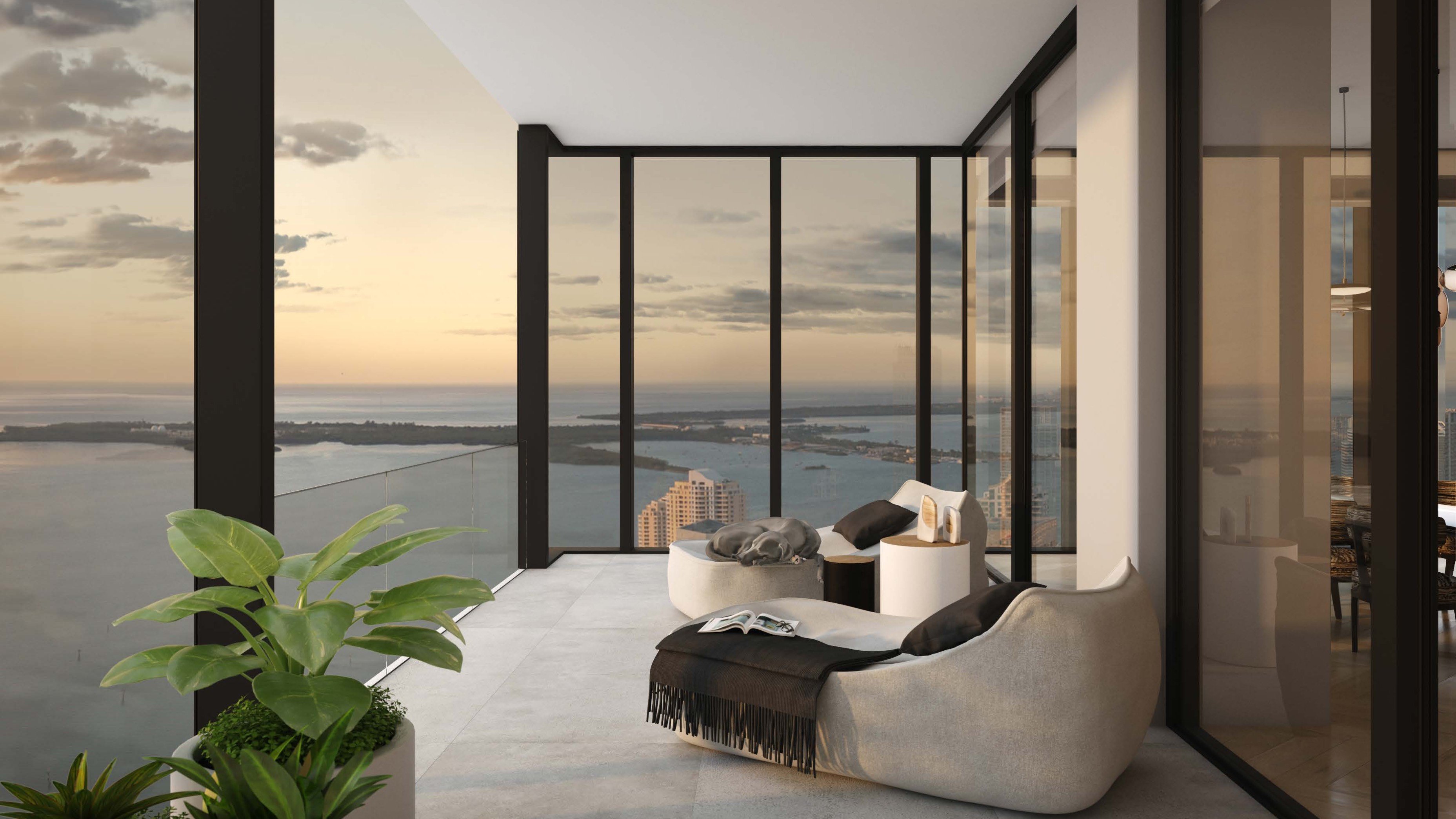
In South Florida luxury, view value is rarely a simple water-versus-city equation. The most durable premiums come from a predictable, livable corridor: how the sightline moves from interior to glass, across a terrace or balcony edge, and into a foreground that feels deliberate rather than incidental.
That corridor is shaped by three factors buyers often underweight. First, placement: whether you face the openness of Biscayne Bay, the activity of the Miami River, or a broad public green space that preserves visual breathing room in the core. Second, massing: how a tower’s form bends, stacks, or offsets your perspective from floor to floor. Third, the indoor-outdoor interface: terrace depth, balcony curvature, and floor-to-ceiling glazing that either sharpens the horizon or softens it.
Casa Bella Residences by B&B Italia, Faena Residences Miami, and Waldorf Astoria Residences Miami are each conceived to deliver a signature outlook. The distinction is in how differently they compose it.
Casa Bella Residences by B&B Italia is a 56-story luxury condo tower in Miami’s Arts & Cultural District, with architecture by Arquitectonica and interior design by Piero Lissoni. It is marketed at 1444 Biscayne Blvd, directly across from the Adrienne Arsht Center-an address that naturally pulls many sightlines toward Biscayne Bay while keeping the downtown skyline corridor close enough to feel kinetic after dark.
What makes Casa Bella’s view experience distinctive is its rippling façade and curved, undulating balconies. The curvature is not merely aesthetic. It can produce slightly different angles by stack, meaning two residences with the same general “direction” can still register the bay and the skyline with subtly different weighting. For buyers who value nuance, this is where diligence becomes visual, not just numerical: the strongest corridor is the one where balcony geometry frames the water without giving up skyline depth.
The tower is also marketed with 10-foot ceilings (with select higher-ceiling collections) and floor-to-ceiling glass. In practice, that pairing tends to elevate the sense of horizon, particularly when the balcony line reads as an extension of the interior rather than a hard stop.
If your priority is to live close to Downtown and Edgewater’s cultural gravity while maintaining a pronounced bay presence, Casa Bella reads as a composed panorama rather than a single focal point. It’s the kind of view that holds in daytime clarity and strengthens in nighttime lighting.
For buyers comparing nearby options, the Arts & Cultural District conversation often includes Aria Reserve Miami and Villa Miami, but Casa Bella’s identity leans into the interplay of design pedigree and a façade that deliberately shifts sightlines.
Faena Residences Miami is planned as two towers connected by a large sky bridge above the Miami River, effectively turning the bridge into a central view platform and amenity level. That single move signals the project’s point of view: the river is not a backdrop-it’s the main event.
Unlike bayfront towers where the water can feel distant, the Miami River delivers a closer visual narrative: boat traffic, shifting light off the channel, and the daily rhythm of a working waterfront. Publicly marketed materials emphasize expansive, unusually deep terraces of about 10 feet, intended to function as true outdoor living rooms. In a climate where outdoor space is used year-round, terrace depth isn’t a throwaway detail; it determines whether you will actually dine outside, entertain outside, or simply step out and inhabit the view.
Faena also highlights floor-to-ceiling impact-resistant sliding glass doors, reinforcing a continuous indoor-outdoor horizon line. When the doors are open, a deep terrace can read as a second living area, and the view corridor becomes something you occupy rather than observe.
Because the project sits directly on the river, lower-to-mid-floor residences are more likely to privilege riverfront activity and near-field texture. Broader Biscayne Bay visibility is more likely at higher elevations, but the defining character remains river-integrated living.
For buyers weighing river adjacency against the broader Brickell-to-Downtown skyline stage, it can be useful to compare the feeling of a vertical city address such as Aston Martin Residences Downtown Miami or a waterfront-leaning Brickell icon like Una Residences Brickell. The essential difference is that Faena’s most compelling corridor is the river itself: close, animated, and designed to be lived from the terrace.
Waldorf Astoria Residences Miami is a planned hotel-and-residences supertall at 300 Biscayne Blvd in Downtown Miami, directly facing Bayfront Park and the Biscayne Bay edge. Its form is widely described as stacked glass cubes, a massing strategy that can shift view corridors and terrace placement from one section to another.
That matters because Downtown’s density makes view outcomes more sensitive to exact line-of-sight. A tower can be well oriented and still deliver materially different experiences depending on how a particular cube segment frames the skyline, the bay, and the surrounding buildings.
What differentiates this address is the foreground. Bayfront Park is a major public waterfront park in Downtown Miami, and its open space can help preserve visual breathing room for nearby towers that face it. Instead of looking immediately onto private waterfront grounds, some sightlines carry a wide, green swath in the near view, with the bay beyond. For many luxury buyers, that’s a quieter form of value: the park absorbs visual noise and introduces a sense of distance from the street grid.
The residences are marketed with floor-to-ceiling glass and large window walls intended to capture bay, park, and skyline vistas at elevation. In a stacked-cube tower, it’s especially important to think in three dimensions-not only “what direction,” but “what segment,” and what the terrace relationship is to the glass.
Within the broader Downtown and Brickell orbit, some buyers also cross-shop statement vertical living like 888 Brickell by Dolce & Gabbana, but Waldorf Astoria’s signature is the park-to-bay corridor: an unusually public, open foreground that reads as calm.
Luxury buyers often start with floor height and direction, then discover the lived experience is dictated by details that rarely surface in a typical listing description.
Start with balcony or terrace geometry. Casa Bella’s curved balconies and rippling façade can create nuanced, slightly rotated perspectives by stack. In a tower like this, “same line, different stack” can be decisive.
Next, evaluate the outdoor room as a real room. Faena’s about-10-foot-deep terraces are designed to be used, not merely styled. If you intend to live outside, depth is non-negotiable.
Then, buy the foreground you want to live with. Waldorf Astoria’s relationship to Bayfront Park is a clean example of foreground luxury: open space that protects the view corridor psychologically, even in a dense core.
Finally, be precise about the type of water you prefer. Biscayne Bay reads as expansive and reflective. The Miami River reads as cinematic and active. Neither is inherently better, but each sets a different tone for daily living.
Miami’s newest luxury towers increasingly treat view as a design problem, not a marketing line.
Casa Bella’s undulating balconies suggest a façade that intentionally modulates exposure. Your view is not only forward; it’s slightly wrapped, which can feel more immersive and can also change how neighboring towers register in peripheral vision.
Faena’s sky bridge is a bolder thesis: elevate the communal viewpoint and make the river a shared stage. It’s a reminder that in luxury, amenities aren’t only services-they’re vantage points.
Waldorf Astoria’s stacked-cube massing introduces a vertical zoning of perspective. Some segments may emphasize the park plane, others the bay horizon, and others the skyline depth. The building’s form becomes a lens.
A discreet way to evaluate value is to match the corridor to how you actually live.
If you entertain with the city as backdrop, Casa Bella’s Arts & Cultural District setting and bay-skyline composition often reads as “Miami at night,” especially when floor-to-ceiling glass is paired with a balcony that frames rather than flattens.
If you collect experiences and prefer an address with daily movement and a terrace you will genuinely use, Faena’s riverfront identity and deep outdoor living rooms align with a more tactile lifestyle.
If you want a sense of openness in the Downtown core, Waldorf Astoria’s park-facing orientation can deliver a calmer, longer sightline, with Bayfront Park acting as a visual buffer before the bay.
Across all three, the most sophisticated purchase is not the biggest view. It’s the most controlled one.
Which project is most bay-forward in its outlook? Casa Bella and Waldorf Astoria are positioned to emphasize Biscayne Bay, with Waldorf often pairing it with a park foreground.
Which project delivers the most animated, close-up water view? Faena Residences Miami is directly on the Miami River, so riverfront activity becomes a defining part of the outlook.
Do building shapes really change views if the direction is the same? Yes; curved balconies at Casa Bella and stacked-cube massing at Waldorf Astoria can shift sightlines by stack and segment.
Why does Bayfront Park matter for Waldorf Astoria views? The park creates open space in the foreground, helping preserve visual breathing room before the bay.
Is terrace depth a meaningful value driver? It can be, especially when terraces are designed as true outdoor living rooms, as marketed at Faena.
What should buyers ask about floor-to-ceiling glass? Confirm how window walls and sliding doors align with terraces and balcony edges to maintain a clean view corridor.
Are higher floors always better for views? Not always; lower elevations can offer richer near-field texture, while higher floors typically broaden horizon lines.
How does the Arts & Cultural District influence Casa Bella’s view feel? Proximity to major venues adds a recognizable cityscape character and nighttime energy alongside bay sightlines.
Can Downtown density affect Waldorf Astoria’s sightlines? Yes; in a dense core, exact line-of-sight varies more by stack and building segment even with strong orientation.
What is the most important first step in choosing between these three? Decide whether you want bay panorama, riverfront theater, or park-framed openness as your daily visual priority.
For a discreet conversation and a curated building-by-building shortlist, connect with MILLION Luxury.
If branded residences are on your mind — as a home or as an allocation — we would be glad to share what we are seeing, privately.
Begin a quiet conversation