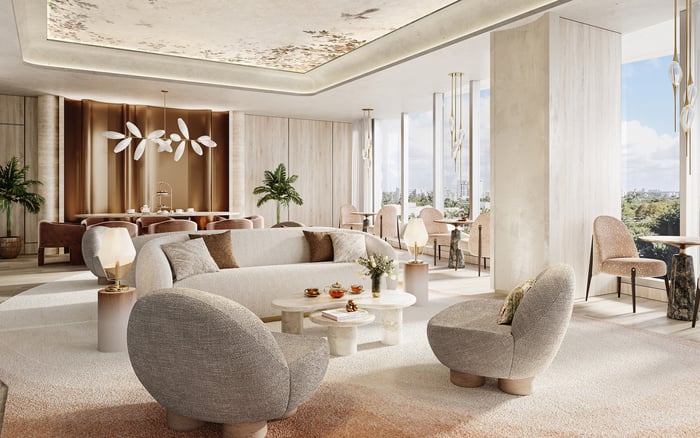
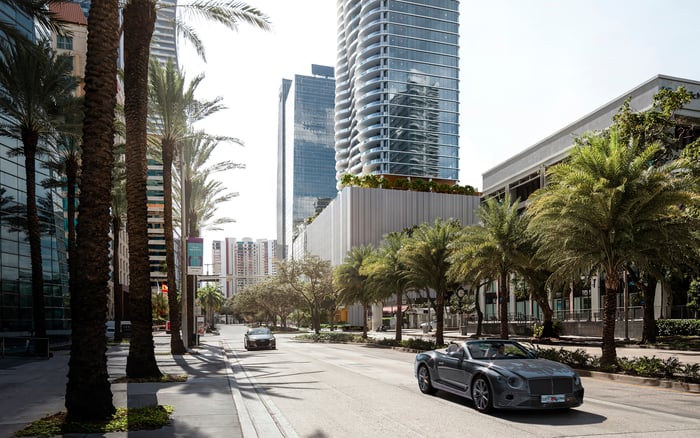
Brickell and Miami Beach can both read as “urban,” yet they deliver two fundamentally different versions of luxury: one calibrated to a financial-district cadence, the other to a coastal, hospitality-forward lifestyle. For buyers weighing a primary residence, a pied-à-terre, or a long-hold investment, the decision often comes down to how you want your mornings to feel, how you want your building to serve you, and what you believe the next cycle will reward.
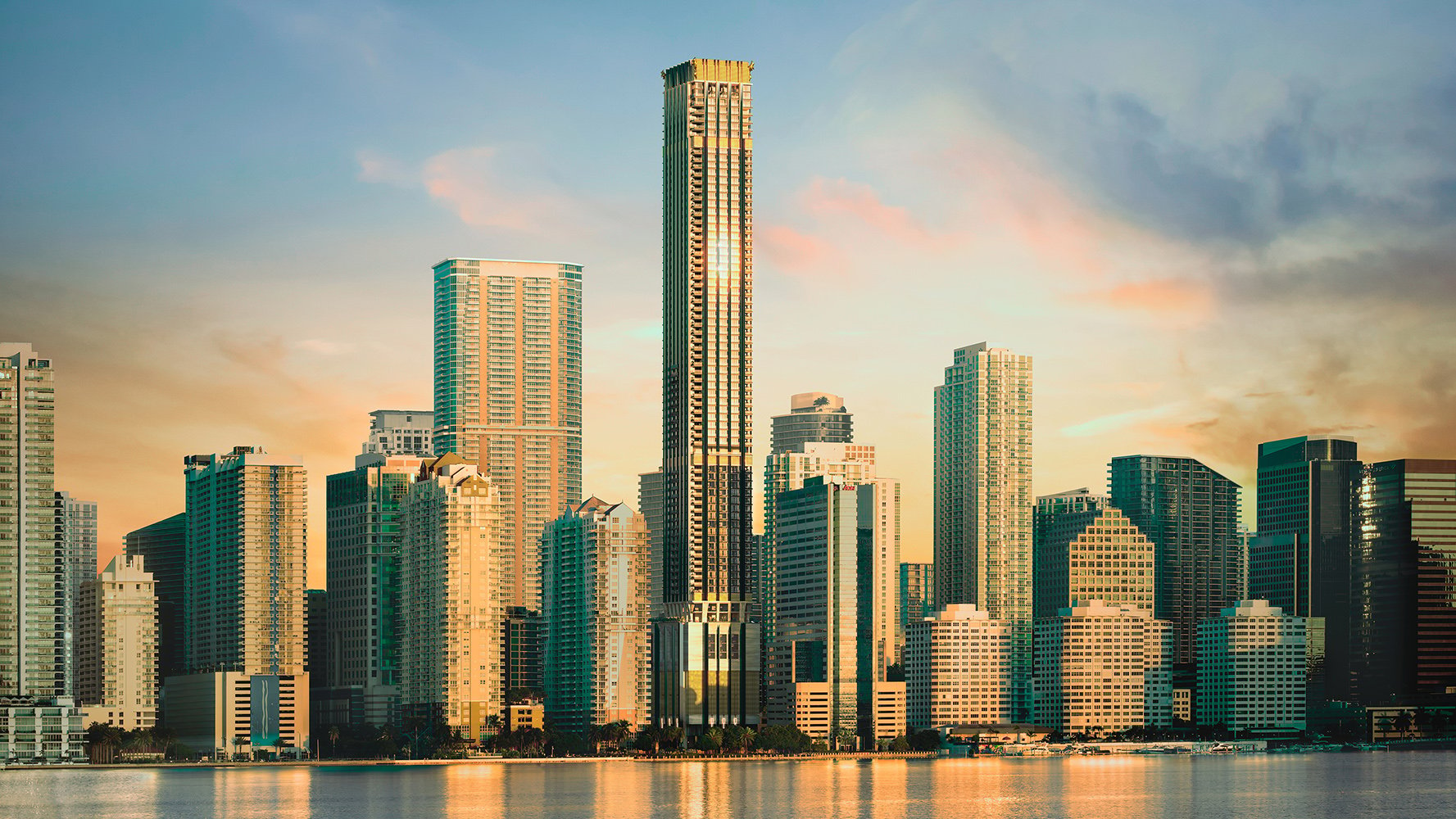
South Florida’s luxury market is often discussed as one destination made up of distinct micro-worlds. Few decisions prove that more clearly than choosing between Brickell and Miami Beach. Both present as global, vertical, and design-forward. Both draw second-home buyers and internationally mobile owners. Yet the lived experience, and the way luxury “functions” day to day, is meaningfully different.
Brickell is widely positioned as the heart of Miami’s financial-district identity: dense high-rise development, a day-to-night rhythm tied to offices and restaurants, and a version of convenience that rewards walkability. Miami Beach, by contrast, is a separate coastal destination composed of multiple neighborhoods and shaped by a tourism-driven brand. Even if you rarely step onto Ocean Drive, the island’s hospitality DNA still shows up in the practicalities: arrivals, valet culture, beach access, and the sense that your building operates as both residence and private club.
For buyers prioritizing privacy, service, and asset quality, the goal is not to declare a winner. It is to choose the environment that matches your daily cadence and your tolerance for market movement.
In practical terms, Brickell is “city first.” It appeals when you want to step out for coffee without planning your day around parking, when a skyline view feels like home, and when proximity to Downtown Miami’s broader business ecosystem matters.
That identity has become a luxury feature of its own. Niche characterizes Brickell as having an “urban feel,” a description that aligns with how many affluent renters and owners use the neighborhood: lock-and-leave, high frequency travel, and a preference for buildings that reduce friction. The value proposition is density and access, paired with a building culture that often emphasizes concierge logistics, coworking-ready lounges, and fitness programming built around weekday routines.
Miami Beach can also read as “urban,” but its urbanity is filtered through a resort lens. It is coastal and bay-and-ocean facing, and it is organized across multiple neighborhoods that each carry a distinct mood. The result is a luxury experience that tends to be more sensory: salt air, morning walks that can include sand, and a social calendar that is never entirely private, even when your own residence is.
In buyer conversations, the cleanest distinction is this: Brickell optimizes for time, Miami Beach optimizes for texture.
South Florida pricing is never a single story, especially at the luxury end. Serious buyers should avoid treating broad-market indicators as a proxy for trophy condos. Still, segment-level signals can help frame expectations around momentum, liquidity, and the kind of scarcity each market offers.
CondoBlackBook’s Q3 2025 reporting suggested that South Beach pricing rose from $1,123 per square foot in Q3 2024 to $1,538 per square foot in Q3 2025, a 37% year-over-year increase. In the same Q3 2025 market summary, Fisher Island was cited at $2,708 per square foot, a figure that underscores how wide the top end of the Miami Beach luxury ecosystem can be.
By comparison, CondoBlackBook reported the “Greater Downtown” submarket, which includes Brickell, around $995 per square foot in Q3 2025 with about 2.7% year-over-year gains. For liquidity-minded buyers, the activity matters as much as the pricing: that same reporting noted 152 closed sales in the $2M+ segment for Greater Downtown in Q3 2025, up 15.2% year-over-year. Market depth can influence resale options, the ease of a clean exit if plans change, and the likelihood of finding a buyer profile aligned with your building.
Broad-market snapshots tell a different story and should be used carefully. Zillow’s “typical home value” metrics showed Miami Beach at $512,646 with a -5.4% year-over-year change and Brickell at $593,055 with a -4.3% year-over-year change. These numbers are not luxury-only measures, but they do reinforce a useful point: the broader market can cool even while prime, limited-supply product behaves differently.
The practical takeaway is not that one market is “up” and the other is “flat.” Miami Beach can show sharper pricing moves when beachfront scarcity and global demand converge. Brickell can offer a different form of stability rooted in volume, urban utility, and a deep buyer pool.
Luxury in South Florida is often decided in the small frictions: how you arrive, how guests arrive, and how your building handles the moments you prefer not to manage.
Brickell tends to reward buyers with structured weeks. It is a neighborhood where you can build a routine around walkability, restaurant density, and quick access to the mainland’s professional network. For renters who want to test the neighborhood before purchasing, Apartments.com publishes “Luxury Apartments” inventory and rent ranges that can help quantify the cost of living in the center of the action without owning.
Brickell’s newer generation of branded residences adds another layer. Projects such as Mercedes-Benz Places Miami reflect a continued shift toward hospitality-style living in the city core, pairing design branding with amenity programming intended to make a tower feel like a self-contained ecosystem. For frequent travelers, the service envelope can matter as much as the view, because it supports consistency and ease across unpredictable schedules.
Miami Beach is less about shaving minutes off your day and more about shaping the day itself. It is where mornings can start with a beachfront walk, where the lobby is often designed as a curated arrival sequence, and where social energy can sit just outside your front door, sometimes as close as the pool deck.
Oceanfront projects take this sensibility to its logical conclusion. Shore Club Private Collections Miami Beach illustrates how Miami Beach luxury often expresses itself through a hotel-adjacent mindset: privacy, staff, and the feeling that your address participates in the area’s broader cultural narrative.
For buyers who want their residence to function as a true coastal retreat, 57 Ocean Miami Beach signals the limited, ultra-luxury positioning that tends to define the top end of the island’s inventory: fewer neighbors, more emphasis on quiet, and an architecture-to-water relationship that is fundamentally different from the mainland.
Both Brickell and Miami Beach have leaned into branding, but they often deploy it for different ends.
In Brickell, branding is frequently used to elevate a dense urban environment into something more experiential. The appeal is not only aesthetic. It is also the promise of consistency: staff training, resident programming, and a service culture that aligns with high-frequency travel and a city schedule.
In Miami Beach, branding more often reinforces legacy and hospitality. Many of the island’s best buildings borrow the language of private clubs and iconic hotels because the location itself suggests that standard. Casa Cipriani Miami Beach fits that pattern: a name associated with service and social ritual, translated into a residential format where owners expect discretion as a baseline.
The same holds in the Faena-area context, where Miami Beach’s cultural magnetism tends to attract a particular buyer profile: design-literate, globally engaged, and willing to pay for a building that feels like part of a curated district. Faena House Miami Beach speaks to that sensibility, positioning architecture, art, and beach adjacency as a cohesive lifestyle proposition rather than a simple condo purchase.
For an ultra-premium buyer, branding is not merely marketing. It can influence resale velocity, rental desirability, and long-term perception among peers. The practical move is to evaluate the operator mindset behind the name: whether you believe the service culture will be maintained, and whether the amenity mix matches how you actually live.
Most indecision between Brickell and Miami Beach fades when you separate status from function.
Define your primary use-case. If you are here for weeknights, business, and convenience, Brickell usually wins. If you are here for weekends, decompression, and coastal ritual, Miami Beach tends to feel inevitable.
Decide what scarcity means to you. Beachfront is a form of scarcity the mainland cannot offer. Brickell’s scarcity is different: high floors, protected views, and a building’s position in the broader urban map.
Read the market through the right lens. Segment-level condo data can highlight momentum, while broad-market “typical value” metrics can serve as macro temperature checks. Treat them as complementary, not interchangeable.
Underwrite service, not just finishes. In both neighborhoods, the next decade of luxury is likely to be defined by how well a building runs, not only by how it photographs.
For many households, the most sophisticated outcome is not choosing one over the other, but building a two-address strategy over time: Brickell for the week, Miami Beach for the reset. Even if you execute that gradually, it is a useful way to clarify which environment you want first.
Is Brickell considered beachfront living? No. Brickell is a mainland, high-rise district often framed as a city alternative to Miami Beach, with bay and skyline views rather than direct oceanfront living.
Is Miami Beach only South Beach? No. Miami Beach includes multiple neighborhoods such as South Beach, Mid-Beach, and North Beach, each with its own feel and building inventory.
What did 2025 luxury pricing signals suggest? Reported Q3 2025 data showed sharper year-over-year gains in South Beach pricing, while Greater Downtown, including Brickell, showed more moderate gains alongside strong $2M+ sales activity.
Do Zillow “typical home values” reflect luxury condos? Not precisely. They are broad-market indicators and can diverge meaningfully from new-construction, branded, or oceanfront trophy product.
Discover your best-fit address with MILLION Luxury.
If branded residences are on your mind — as a home or as an allocation — we would be glad to share what we are seeing, privately.
Begin a quiet conversation