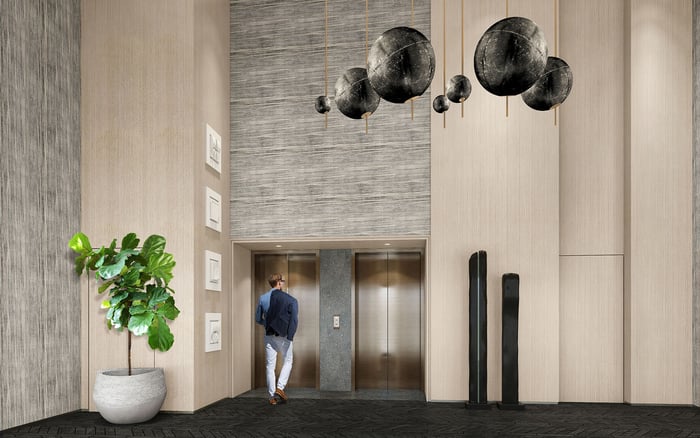
For serious collectors, a Surfside residence should be evaluated as both a private home and a controlled environment for art. The strongest candidates are those that can support discreet circulation, calibrated lighting, secure installation, and residence-specific technical planning.

For an art collector, the best residence is not necessarily the one with the most glass or the most dramatic first impression. It is the home that reconciles privacy, controlled illumination, secure movement, and gracious daily living without making those systems visible.
That distinction matters in Surfside, where oceanfront living naturally places light and outlook at the center of the architectural experience. A collector must ask a more exacting question: Can the residence preserve the emotional value of the view while creating stable, controllable conditions for paintings, works on paper, photography, textiles, and sculpture?
Among branded residences, service culture can be relevant, but the name alone is no substitute for technical review. Staffing protocols, access procedures, construction rules, loading arrangements, insurance requirements, and the residence’s physical condition all warrant independent examination.
For buyers seeking a fashion-branded address, Fendi Château Residences Surfside is an immediate candidate for a collection-led property search. Its relevance begins with the address and brand proposition, but buyers should still assess the specific residence for usable wall planes, solar exposure, ceiling conditions, delivery paths, and permitted alterations. No two exposures or interior configurations should be considered interchangeable.
Hospitality-minded collectors will also want to examine The Surf Club Four Seasons Surfside. Again, the decisive issue is not prestige in the abstract. It is whether a particular home, together with the building’s operating framework, can support the owner’s privacy threshold, installation calendar, household staff, conservators, and specialist vendors.
A serious search should include design-led comparables. Arte Surfside provides a useful point of comparison when evaluating design and architecture, while The Delmore Surfside can broaden the conversation around current Surfside choices. These comparisons help distinguish the value of branding from the practical qualities of an individual residence. Around Art Basel season, that discipline becomes especially valuable, as collecting activity can intensify attention to display, entertaining, and discreet movement.
Privacy is not merely a matter of tinted glass or a guarded entrance. For collectors, it begins at arrival and extends through every route used by family, guests, staff, installers, crates, and service providers.
Ask how a large work travels from vehicle to residence. Review loading access, elevator dimensions, turning radii, door clearances, corridor-protection rules, scheduling procedures, and the point at which outside vendors enter controlled areas. A beautiful lobby does not reveal whether an oversized canvas can arrive without unnecessary visibility or handling risk.
Inside the home, study sightlines from entry doors, neighboring buildings, terraces, and shared approaches. A successful plan can welcome guests while keeping private rooms, storage, security controls, and less frequently displayed works beyond casual view. Collectors who entertain should also consider whether public and private circulation can be separated without making the residence feel defensive.
South Florida light is a design asset, but collection care demands moderation. The buyer’s review should distinguish among glare control, solar heat management, ultraviolet mitigation, and true blackout capability. These measures are related, but they are not identical.
Map direct and reflected light throughout the day rather than relying on a single showing. Note the orientation of every potential display wall and the relationship among glazing, mirrors, pale stone, water, and adjacent façades. Works on paper and other light-sensitive pieces may require a more protected internal zone than sculpture or less sensitive material.
Window treatments should be considered as an integrated system. Sheers, shades, lined drapery, pockets, controls, and sensors can shape ceiling design and wall composition. Lighting should likewise be planned around the collection, with adaptable placement and precise aiming rather than a decorative fixture plan alone. Before purchase, confirm which modifications are permitted and whether existing conditions can accommodate the intended solution.
The strongest security strategy combines building procedures with systems inside the residence. Buyers should evaluate access control, visitor handling, service-entry protocols, camera coverage, alarm integration, communications resilience, and digital-credential management. The goal is not conspicuous fortification, but controlled access with clear accountability.
Collection security also depends on information discipline. Floor plans, installation dates, storage locations, vendor lists, and images of the home should be shared selectively. Smart-home systems, remote viewing, climate controls, and wireless networks warrant specialist review because convenience can create exposure when permissions are poorly managed.
Physical measures remain essential. Confirm whether walls can support anticipated loads, valuable objects can be anchored appropriately, and a secure internal room is feasible. Insurance, conservation, security, and art-handling advisers should coordinate before alterations begin-not after the collection arrives.
Before comparing finishes, prepare a confidential schedule of the collection’s needs. It can identify approximate dimensions, weights, sensitivities, preferred groupings, storage requirements, and installation constraints without disclosing unnecessary ownership details.
Bring the right advisers into the residence early. An architect can test layouts and ceiling coordination. A lighting designer can model display conditions. Security and technology specialists can assess system architecture. An art handler can verify the complete delivery route. A conservator can identify environmental concerns appropriate to the works involved.
The final decision should be residence-specific. Request applicable building rules, alteration procedures, vendor requirements, access policies, and technical drawings, then verify them with qualified professionals. The best Surfside home for a collector is one in which architecture and operations can be tuned to the collection while preserving the ease expected of an exceptional coastal residence.
Which Surfside branded residences should art collectors consider first? Fendi Château Residences Surfside and The Surf Club Four Seasons Surfside are logical starting points, subject to residence-specific technical review.
Is a branded address automatically more secure? No. Buyers should independently examine building procedures, in-residence systems, staffing protocols, and digital access.
Can ocean views coexist with museum-minded light control? Yes, if glazing exposure, shading, window treatments, lighting, and artwork placement are planned as one coordinated system.
What should be measured before buying? Measure elevators, doorways, corridors, turns, ceiling conditions, wall planes, and the complete route from vehicle to display location.
Are all works equally sensitive to daylight? No. Conservation requirements vary by medium, condition, materials, and intended exposure, making specialist guidance essential.
When should a lighting designer become involved? Ideally, before purchase or alteration approval, while ceiling infrastructure, controls, display walls, and shading can still be coordinated.
What privacy issue is most often overlooked? Service circulation is critical because installers, crates, household staff, and vendors may use different routes and access procedures.
Should collectors plan dedicated storage inside the residence? It depends on the collection, available space, environmental needs, security strategy, and the building’s alteration rules.
Why compare non-branded or design-led residences? Comparables help buyers determine whether they value the brand itself or the residence’s architecture, operations, and adaptability.
What should happen before a collection is moved in? Complete installation planning, security testing, environmental review, insurance coordination, and a supervised rehearsal of the delivery route.
If you'd like a private walkthrough and a curated shortlist, connect with MILLION.
If branded residences are on your mind — as a home or as an allocation — we would be glad to share what we are seeing, privately.
Begin a quiet conversation