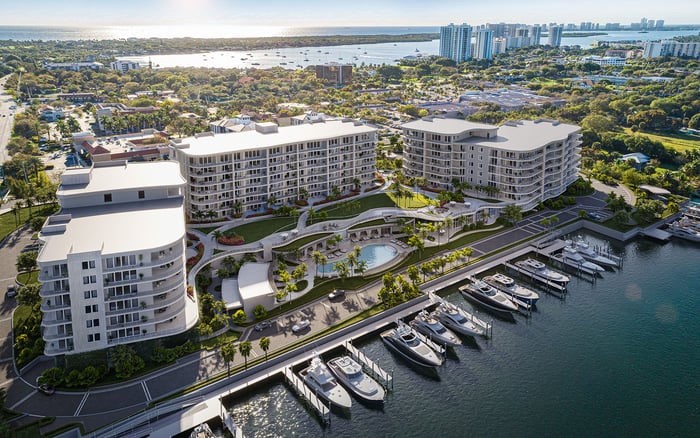
A precise ownership budget separates condominium assessments from personal services, club obligations, and gratuities. Here is how to read the documents, interpret advertised amenities, and compare West Palm Beach residences without mistaking availability for inclusion.

In West Palm Beach, a luxury condominium’s appeal may begin with attentive service and beautifully considered shared spaces. Financial clarity begins elsewhere: with the distinction between what ownership requires and what a resident chooses to use.
The advertised HOA fee is not a complete lifestyle budget. Regular assessments, separate club obligations, personal services, and gratuities belong in distinct categories, even when they support one seamless residential experience.
For buyers considering Alba West Palm Beach, the starting point is a unit-specific cost schedule-not an assumption about what an amenity description includes. Apply that discipline to every residence under consideration.
Start with the current association budget and governing documents. Identify which common expenses the regular assessment covers, how the residence’s share is calculated, and when payments are due.
Review the budget’s treatment of maintenance, repairs, replacement work, and reserve funding. Keep reserves within the association-budget analysis rather than treating them as an optional personal-service expense. Ask counsel to clarify any reserve requirements applicable to the building.
Request both the current assessment and its payment schedule. An advertised monthly amount does not, by itself, establish the association’s billing frequency.
Distinguish ordinary assessments from special assessments and any additional association charges. A manageable recurring figure should not obscure separate obligations or pending assessments. The objective is to understand both the regular commitment and the potential capital demands of ownership.
For each West Palm Beach residence on your shortlist, record the date and scope of any advertised fee. Then obtain current written confirmation rather than treating the listing as a complete ownership budget.
An amenity list does not establish whether individual purchases are included. A restaurant, concierge desk, or valet offering should prompt a billing question, not an assumption that every use is covered by regular dues.
Confirm the specific residence’s assessment and scope of coverage. An insurance inclusion, for example, is a reason to investigate what remains uncovered-not to eliminate personal insurance from the budget. Ask your insurance adviser to identify any coverage you need separately.
The key question is not simply whether a service exists. It is whether the assessment funds its availability, its use, or both.
When evaluating The Ritz-Carlton Residences® West Palm Beach, request the applicable service schedule and written confirmation of how each offering is funded and billed. Do not extend an inclusion stated for one service to every advertised amenity.
Do not base a purchase decision on an unconfirmed preconstruction fee estimate. Request the applicable proposed budget and clarify which figures are projections rather than established assessments.
A useful written inquiry separates staffing from transactions: What is included? What is charged by use? Are there guest charges or service charges? A collectively funded concierge function does not, by itself, establish how an individual purchase or arranged service will be billed.
Do not assume a separately billed club membership is optional. Where a club arrangement applies, ask the condominium documents and club agreement to establish whether membership is required, who is eligible, and which charges attach to the residence.
Look beyond initiation payments and annual dues. Ask about capital dues, food-and-beverage minimums, lessons, lockers, guest charges, and transfer or application fees wherever relevant. Record only confirmed obligations in the mandatory-cost column.
For an unfamiliar common-amenity charge, ask counsel to review its basis in the governing documents and applicable law. Keep the question of whether a charge is authorized separate from whether it fits your household budget.
Personal services need their own allowance, distinct from mandatory ownership costs. Request the current service menu and identify which purchases depend on frequency of use. Keep parking, storage, and dock charges separate wherever they apply, rather than presuming they are included.
Gratuities require a different inquiry. Do not assume a building-wide tipping convention or budget a supposedly standard percentage. Ask whether tips are discretionary, pooled, included in service charges, or collected through a holiday fund.
Clarify whether a service charge includes gratuity before adding another allowance. The aim is a considered household budget, without double-counting or an invented tipping rule.
Whether evaluating Mr. C Residences West Palm Beach or another candidate, use the same worksheet. Keep five categories visible:
Regular condominium assessments and any master-association charges.
Mandatory club dues, capital obligations, and applicable minimums.
One-time initiation, application, transfer, or other entry charges.
Optional memberships, personal services, and discretionary gratuities.
Separate ownership expenses, including uncovered utilities, insurance, parking, storage, or dock charges.
Record special assessments separately, including amounts and payment timing when confirmed. Annualize recurring obligations for comparison, but preserve the actual cash-payment schedule. Do not blend a one-time initiation payment into recurring dues without labeling it.
Before committing, request the declaration and amendments, current budget, financial statements, reserve studies, applicable inspection reports, estoppel certificate, and any separate club agreement. Obtain written clarification wherever an amenity description and a fee schedule leave different impressions.
The better comparison is not simply the lowest HOA figure. It is the clearest relationship between mandatory cost, reserve funding, included service, and the way you intend to live. Financial precision allows the pleasures of ownership to remain pleasures rather than recurring surprises.
Explore your next West Palm Beach residence with MILLION.
If branded residences are on your mind — as a home or as an allocation — we would be glad to share what we are seeing, privately.
Begin a quiet conversationReview the current association budget and governing documents. Request written confirmation of the specific residence’s assessment and included expenses.
Not necessarily. Confirm the actual payment schedule rather than relying on the listing’s monthly presentation.
No; keep reserve funding within the association-budget analysis. Ask counsel to clarify the requirements applicable to the building.
An amenity description alone does not establish billing treatment. Obtain written confirmation distinguishing collectively funded staffing from separately charged services or purchases.
Review the applicable condominium documents and club agreement. Do not assume membership is optional merely because it is billed separately.
Where applicable, ask about initiation payments, capital dues, food-and-beverage minimums, guest charges, lockers, lessons, and transfer or application fees.
Ask counsel to review the charge’s basis in the governing documents and applicable law. Obtain written confirmation of its amount and payment schedule.
Do not assume a uniform policy. Ask each building whether tips are discretionary, pooled, included in service charges, or handled through a holiday fund.
Treat it as a snapshot for the specified residence, not a universal building charge. Confirm the current unit assessment, payment frequency, additional charges, and pending special assessments.
Request the declaration and amendments, current budget, financial statements, reserve studies, applicable inspection reports, estoppel certificate, and any separate club agreement. Seek written clarification of service charges and inclusions.