A buyer-focused comparison of Auberge Beach Residences and Four Seasons Hotel & Private Residences Fort Lauderdale, centered on ocean views, unit exposure, glazing, terraces, and the difference between view-led living and branded hospitality.
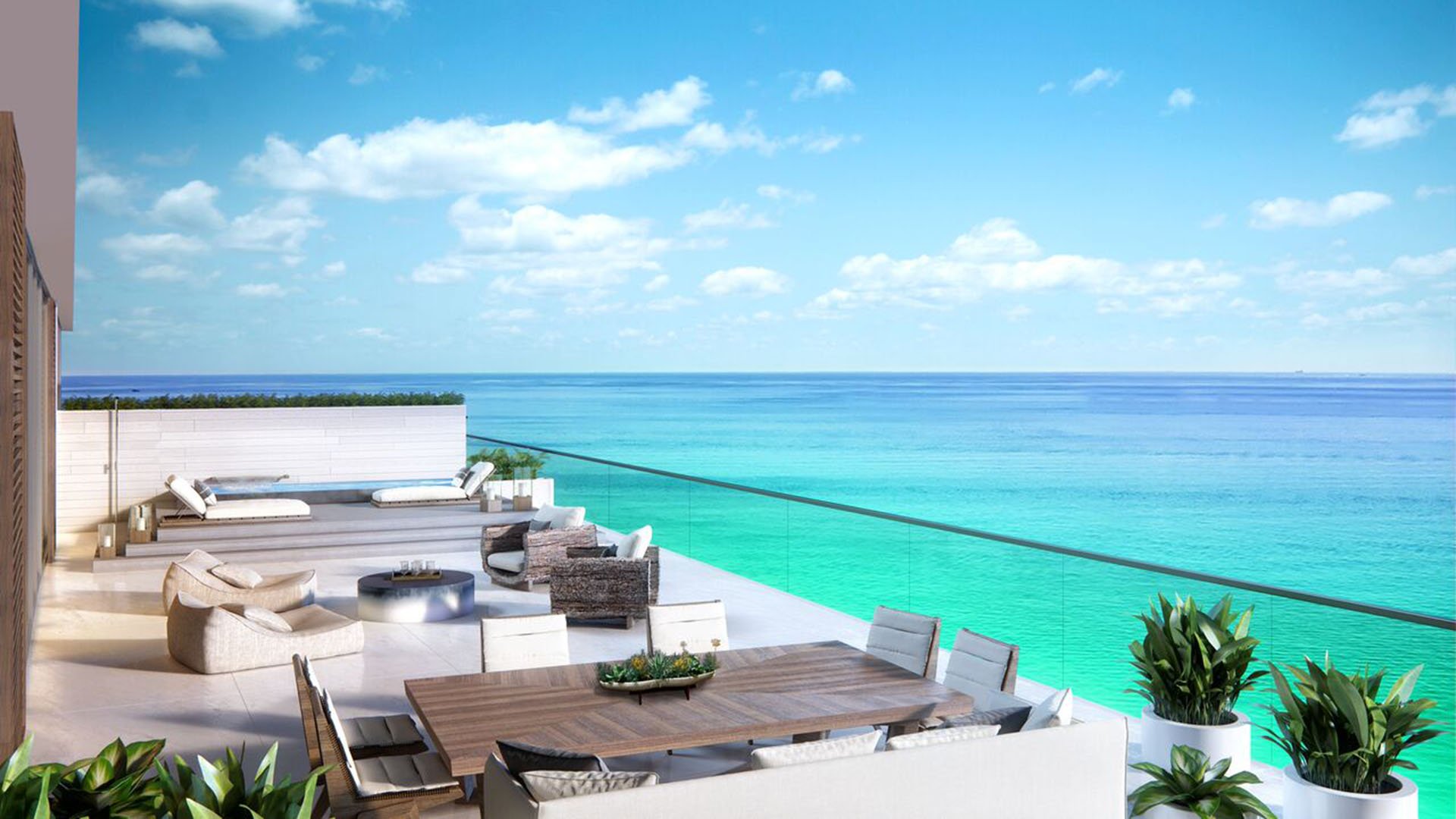
In Fort Lauderdale, true oceanfront inventory is not judged by address alone. Sophisticated buyers look at frontage, line orientation, glazing, terrace depth, and the character of the exposure itself. In that context, Auberge Beach Residences and Four Seasons Hotel & Private Residences Fort Lauderdale belong in the same rare conversation: both sit directly on the sand, both are designed around outward-facing living, and both treat the Atlantic as the primary visual event.
The distinction is more nuanced than a simple better-or-worse comparison. Auberge presents the residence and its beachfront placement as the central luxury proposition. Four Seasons places its view story within a broader branded-residence framework, where outlook and hospitality are intended to reinforce one another.
For buyers in Broward and Fort Lauderdale who are selecting with exposure in mind, that difference matters. One speaks more directly to private residential immersion in the coastline. The other layers the visual privilege of the beach into a more service-oriented lifestyle.
At the most defensible level, the two developments begin from the same strength: both are true beachfront properties on the same Fort Lauderdale coastal corridor. That immediately places them in a superior category relative to projects that are nearby but not fully oceanfront, including Andare Residences Fort Lauderdale, Riva Residenze Fort Lauderdale, and St. Regis® Residences Bahia Mar Fort Lauderdale, where the residential appeal is substantial but the direct Atlantic relationship is expressed differently.
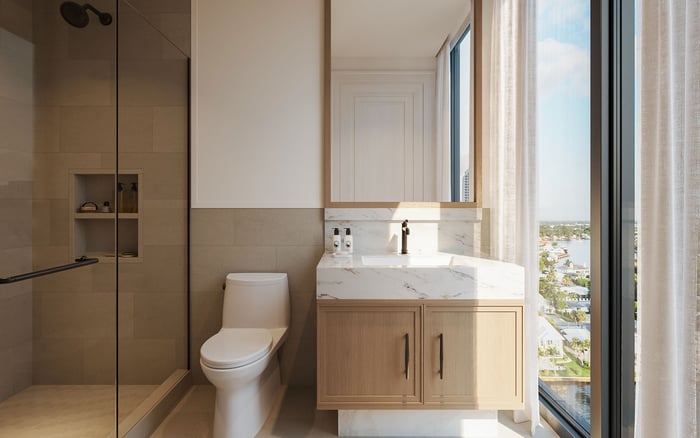
Both Auberge and Four Seasons also use floor-to-ceiling glazing and private terraces, which is critical in any meaningful conversation about water-view quality. In luxury residential design, a view is not simply what is visible from the interior. It is the way interior architecture dissolves into outdoor space, the way morning light enters the main rooms, and the way the horizon remains present even when one is seated rather than standing at the glass.
That means neither property should be underestimated on the fundamentals. If your baseline requirement is ocean-facing exposure, indoor-outdoor continuity, and a residence that prioritizes visual openness, both deliver the essential ingredients.
Auberge reads as the more view-centric proposition. Its residential identity is closely tied to the beachfront itself, with a clearer emphasis on panoramic water outlooks and sightline-driven living. The feeling is less about arriving at a hotel-serviced address and more about occupying a home conceived around the Atlantic as a permanent backdrop.
That emphasis becomes especially relevant when considering larger-format residences and penthouses. Auberge offers a broader large-residence profile, which naturally supports the possibility of a wider visual sweep, especially in corner layouts where buyers often prioritize multiple exposures rather than a single frontal ocean line. In practical terms, larger footprints can create a more layered experience of oceanfront living, with sunrise exposure, angled coastline views, and a stronger sense of spatial drama from principal entertaining rooms.
For buyers who place a premium on the private experience of the residence itself, Auberge therefore holds a persuasive position. It belongs to the same broader conversation as Shell Bay by Auberge Hallandale, where the real estate identity is allowed to take center stage rather than functioning merely as an extension of a hospitality brand.
Four Seasons approaches the same ocean exposure from a different angle. Here, the view is still central, but it is framed as part of a branded residential experience. The Atlantic outlook, floor-to-ceiling windows, and private terraces are not isolated talking points. They sit within a service-driven proposition where ownership is meant to feel seamless, polished, and supported.
That distinction will appeal to a different type of buyer. Some owners do not want the residence to feel purely contemplative or architectural in its priorities. They want the confidence of a globally recognized hospitality structure, and they want the view to arrive with that same assurance. In that sense, Four Seasons is not necessarily competing on a raw panorama argument alone. It is competing on the totality of living with the ocean in front of you and a branded operations culture behind you.
The most refined buyers know that exposure is not a building-level judgment alone. It is often a line-level and floor-level judgment. Publicly, these projects describe their views qualitatively rather than through quantified unit-by-unit metrics. That means a prudent comparison should focus on what can be assessed conceptually: direct beachfront placement, glazing strategy, terrace integration, and the likely breadth of outlook supported by each project’s residence mix.
For Auberge, the larger-format lineup suggests that certain homes may better support multi-directional exposure, particularly where broader plans and corner placements come into play. For Four Seasons, the one- to four-bedroom range suggests a more compact spread overall, which may make the top and best-positioned residences feel especially curated within the inventory.
That does not make one universally superior. It simply clarifies the buyer profile. If you want a residence-first statement with the possibility of broader spatial drama, Auberge may feel more aligned. If you want ocean exposure attached to a hospitality-rich ownership model, Four Seasons holds a powerful advantage.
If the question is pure legitimacy of beachfront exposure, both developments qualify without hesitation. Each sits directly on the beach. Each uses floor-to-ceiling glass and private terraces to amplify the Atlantic setting. Each is part of the elite oceanfront segment that continues to define Fort Lauderdale’s rise as a serious luxury market.
If the question is positioning, the split becomes clearer. Auberge emphasizes the residence, the panorama, and the beachfront setting as the luxury object itself. Four Seasons emphasizes the view as part of a more expansive branded-lifestyle package.
For a buyer who values silence, horizon, and the residential experience of living inside the view, Auberge may feel more exact. For a buyer who values the same oceanfront exposure but wants it delivered with a highly legible hospitality identity, Four Seasons may feel more complete. In either case, the best purchase is likely not the building in the abstract, but the exact residence line, height, and orientation that most precisely fits your way of living.
Which project is more directly oceanfront? Both are directly on the Fort Lauderdale beach, so each offers true oceanfront positioning.
Does Auberge focus more on views than services? Its positioning is more residence-first, with stronger emphasis on panoramic water outlooks and view-led design.
Does Four Seasons connect views to hospitality? Yes. Its ocean exposure is framed within a broader branded service and amenity experience.
Do both buildings have terraces and large glass walls? Yes. Both feature floor-to-ceiling glazing and private terraces designed to open the residences outward.
Which is better for pure exposure? On the core facts alone, both are strong because each is beachfront and designed to maximize ocean-facing living.
Is Auberge likely to have broader multi-directional views in some homes? It can in larger-format and corner residences, where broader layouts may support more than one exposure.
Does Four Seasons have a smaller residence range? Yes. Its publicly described mix runs from one- to four-bedroom residences.
Are exact view percentages publicly detailed for either project? No. Public descriptions emphasize qualitative oceanfront and water-facing language rather than quantified metrics.
Why does line selection matter so much? Because the best view experience depends on the exact residence orientation, floor, and corner or center placement.
Who should choose Auberge over Four Seasons? Buyers who prioritize a view-centric residential identity may lean Auberge, while service-driven buyers may prefer Four Seasons.
When you're ready to tour or underwrite the options, connect with MILLION Luxury.
If branded residences are on your mind — as a home or as an allocation — we would be glad to share what we are seeing, privately.
Begin a quiet conversation