In Downtown Miami, the most compelling design battles are often invisible: wind, motion, and the engineering decisions that turn height into livability. For buyers weighing **Aston Martin Residences Downtown Miami** against **Waldorf Astoria Residences Downtown Miami**, the conversation is less about postcard views and more about how each tower manages aerodynamics and structural sway at elevation. This MILLION Luxury editorial looks at what “comfortable motion” means in a modern supertall, why façade geometry and setbacks matter on Biscayne Bay, and how to translate technical language into practical due diligence. We also place these towers in the broader context of Miami’s next-generation skyline, where adjacent projects in Brickell and Downtown are pushing similar performance standards.
Supertalls sell an idea: altitude as privacy, panorama as permanence. Yet in Miami, height is never just height. A tall, slender tower behaves like a tuned instrument, responding to wind in ways occupants may actually register. That sensation is not a defect; buildings are engineered to move. The buyer question is whether that movement stays below the threshold of distraction-and whether secondary effects such as façade noise, elevator behavior, or door rattle have been designed out of the living experience.
In a comparison like Aston Martin Residences Downtown Miami versus Waldorf Astoria Residences Downtown Miami, the visible differences are branding, lifestyle, and how each tower frames the water and the city. The subtler differences live in massing, structural-system decisions, and wind-response strategies. For buyers targeting upper floors, these “invisible” choices can shape everyday quiet, perceived solidity, and long-term satisfaction.
Downtown sits on a boundary condition: Biscayne Bay creates a long, open fetch where winds can build, while the surrounding high-rises introduce turbulence and channel gusts between towers. As the skyline densifies, one building’s form can influence another’s wind environment-especially at pedestrian level and across terraces. For supertalls, the central comfort variable is often wind-induced acceleration, which is what people tend to feel more than the absolute drift shown in structural diagrams.
Wind engineering is not only about withstanding extreme storms. It is also about serviceability in typical conditions. The best buildings aim to make motion unremarkable and to reduce wind “tone” around edges and corners where vortices form. That is where architecture and structure converge-and where two towers in the same neighborhood can perform differently despite similar prestige.
At supertall scale, geometry becomes a performance tool. The objective is to disrupt organized vortex shedding-the rhythmic wind phenomenon that can amplify motion. Common strategies include tapering, setbacks, sculpted corners, and façade articulation that breaks up airflow.
A tower with a more varied silhouette can, in some cases, “confuse” the wind-reducing vortex coherence and lowering peak accelerations. A simpler, prismatic form may be more straightforward to execute and can still perform at a high level when paired with the right stiffness and damping, but it may lean more heavily on structural solutions to offset aerodynamic demands.
For buyers, the translation is practical: a profile and setbacks are not just an aesthetic signature; they can be part of why a high-floor residence reads as calm on a gusty evening. On tour, pay attention to exposed corners, large glazing spans, and terrace geometry. These are the zones where wind tends to announce itself through sound and pressure changes, even when overall motion is well controlled.
All tall buildings move. The most useful way to think about sway is to clarify what “comfortable” means in real life. Design targets protect both the structure and the occupant experience. But perception varies: some residents never notice motion, while others are more sensitive-particularly in bedrooms or when standing near window lines during sustained winds.
From a buyer perspective, you are evaluating a holistic comfort package:
Stiffness and redundancy that keep drift modest.
Damping strategies that reduce acceleration, which is the sensation people feel.
Façade and interior detailing that prevents secondary noise or vibration.
Operational quality in elevators and building systems under wind load.
The strongest towers treat motion as a design parameter to be curated-much like acoustics in a concert hall.
You do not need a wind-tunnel report to ask intelligent questions. In practice, the most valuable diligence is experiential and operational.
When possible, tour during breezier conditions. Stand quietly at a corner window line. Listen for whistling, clicking, or cyclical creaks. These can be benign, but consistency and patterns matter.
A residence that “feels solid” is usually the outcome of structure, glazing, and interior assemblies working together. Notice how doors close, how cabinetry sits, and whether any elements seem prone to tolerance shifts.
In luxury buildings, a management team’s familiarity with high-floor comfort topics is informative. The best-run properties anticipate minor serviceability concerns and address them proactively.
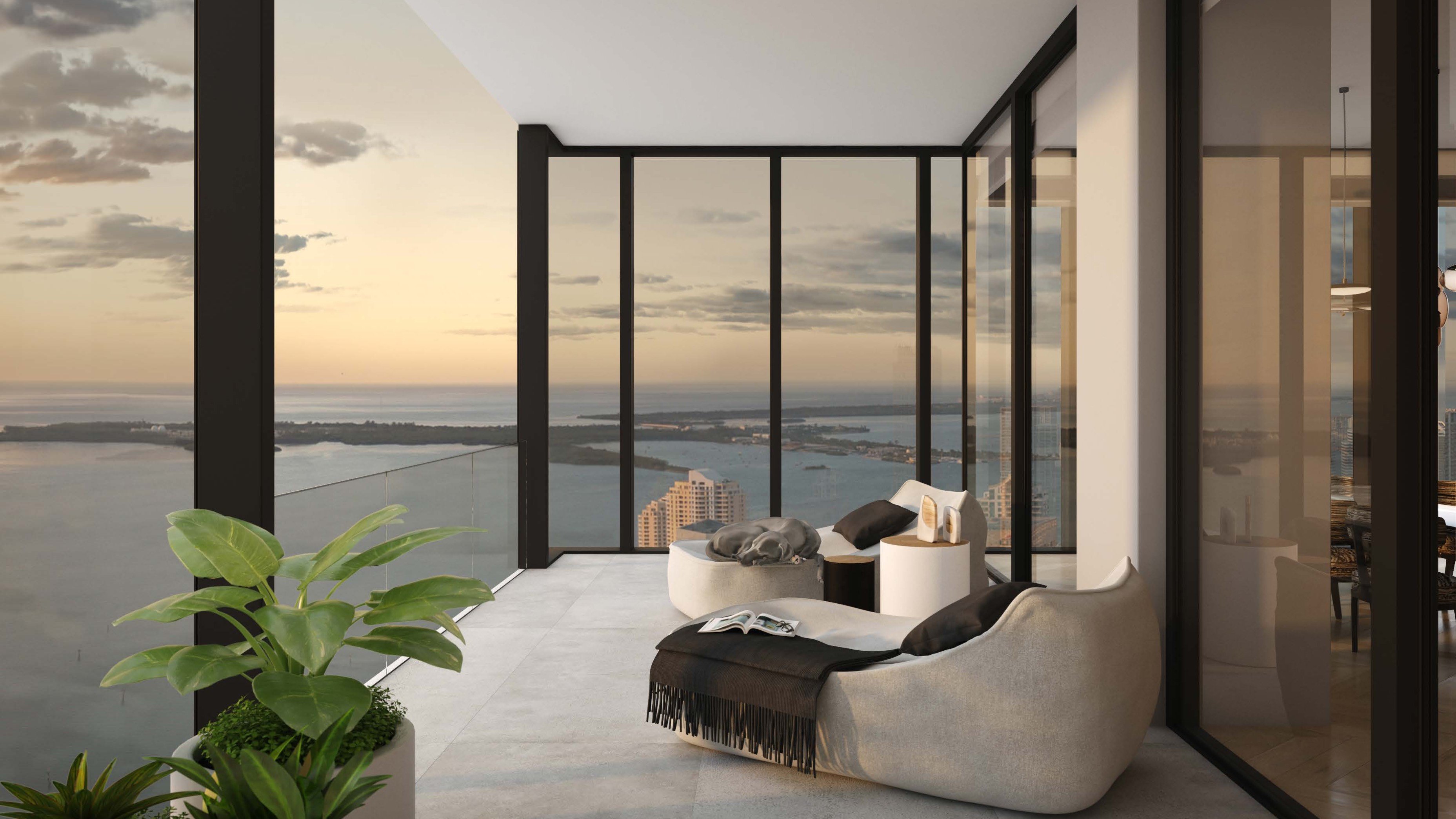
Outdoor space is a premium in Downtown, but terraces can amplify wind. A well-shaped tower paired with thoughtful balcony detailing can improve usability, especially on upper levels.
This is not a contest of “which one moves” and “which one does not.” Both are positioned as world-class towers in the Downtown core. The real question is: how does each building’s design philosophy manage wind and motion while protecting the lifestyle promise?
With Aston Martin Residences Downtown Miami, the brand expectation leans toward sleekness, precision, and a crafted experience. Buyers often respond to engineered refinement: clean lines, deliberate detailing, and a residential sensibility that reads as performance-oriented.
With Waldorf Astoria Residences Downtown Miami, the expectation is hospitality-calibrated living: service, arrival sequences, and an overall sense that comfort is integrated the way it is in a great hotel. In a supertall, that hospitality promise includes quiet interiors, smooth vertical transportation, and predictable indoor environments on upper floors.
In both cases, the differentiator is alignment between architecture and engineering. A striking silhouette that neglects aerodynamics can force downstream compromises. A more conservative form, paired with sophisticated damping, can deliver a calmer interior reality than the skyline suggests. Treat the tour as a sensory inspection-not only a visual one.
Downtown’s supertall engineering is not happening in isolation. The performance bar it sets influences how new towers are marketed and, more importantly, how they are designed. Brickell’s pipeline, for example, is increasingly framed around livability at elevation-not just amenity density.
In Brickell, projects like The Residences at 1428 Brickell and 888 Brickell by Dolce & Gabbana reflect a citywide shift in which engineering, façade performance, and occupant comfort sit at the core of the luxury narrative. As towers rise closer together, wind effects can become more complex-making aerodynamic shaping and structural tuning even more valuable.
For buyers weighing Downtown versus Brickell, the “sway conversation” is also a neighborhood conversation. Downtown brings bay exposure and a rapidly evolving cluster of tall buildings; Brickell brings canyon effects and density. In both, the quietest luxury is often the one you do not notice: a steady glass line, a calm night’s sleep, an elevator ride that feels effortless.
A premium floor should feel like an upgrade in serenity-not a trade-off for a more dramatic view. As you compare Downtown towers, prioritize these decision points:
Corner residences can read as more exposed to wind cues and may be more sensitive to façade acoustics.
A terrace is only truly livable if wind conditions and detailing support everyday use.
High floors benefit from thoughtful layouts that avoid tall, lightly anchored pieces near glazing, where perceptible motion can read as instability.
If you want a design-forward, performance-inflected residential identity, Aston Martin Residences Downtown Miami may align. If you prefer a hospitality-led cadence with a service-first mindset, Waldorf Astoria Residences Downtown Miami may feel more intuitive.
Ultimately, both towers represent the modern Miami proposition: international luxury delivered at altitude, engineered for a coastal environment that demands sophistication.
Will I feel a supertall building sway in Downtown Miami? Some residents may notice gentle motion during sustained winds, particularly on higher floors.
Is building movement a sign of poor construction? No. Tall buildings are designed to move; the aim is to keep motion within comfort limits.
What matters more: drift or acceleration? Acceleration is typically what occupants perceive, making it a key comfort metric.
Do balconies and terraces make wind worse? They can. Geometry and detailing can improve usability, but exposure increases with height.
Are corner units more affected by wind and noise? Often, yes-corners interact strongly with airflow and can transmit more audible cues.
Can nearby towers change wind conditions over time? Yes. As the skyline fills in, wind patterns at certain elevations and street levels can shift.
How can I assess comfort during a tour? Visit on a breezy day, stand near corners, and listen for persistent whistling or rattles.
Do elevator rides change under high winds? Well-designed systems remain smooth, but extreme conditions can influence operations.
Should I avoid the highest floors because of motion? Not necessarily. Many buyers prefer them, but sensitivity varies, so an in-person check helps.
What is the simplest way to compare two supertalls for livability? Evaluate quiet, stillness, and terrace usability in addition to views and amenities.
For a tailored shortlist and next-step guidance, connect with MILLION Luxury.
If branded residences are on your mind — as a home or as an allocation — we would be glad to share what we are seeing, privately.
Begin a quiet conversation