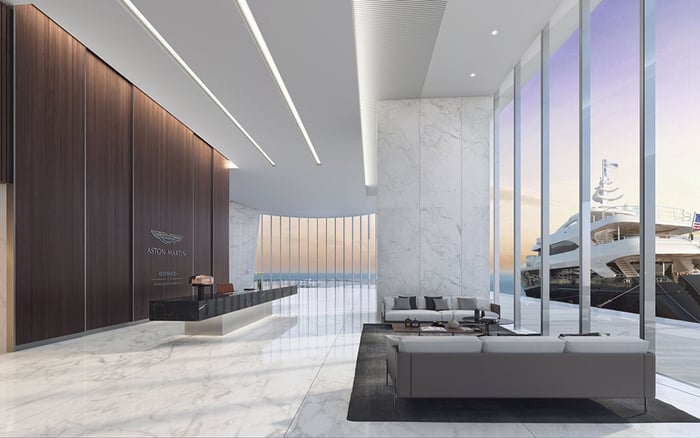
A buyer-oriented comparison of Aston Martin Residences and Waldorf Astoria Residences in Downtown Miami, focused on how each project expresses waterfront identity, service culture, privacy, and daily ownership experience.

In Downtown Miami, proximity to Biscayne Bay is only the starting point. What distinguishes a trophy residence is not simply whether it overlooks the water, but how the building interprets that relationship and how ownership feels once the novelty of the view gives way to daily routine. That is where Aston Martin Residences Downtown Miami and Waldorf Astoria Residences Downtown Miami begin to separate.
Both addresses belong in the Downtown waterfront conversation. Both are designed to register instantly on the skyline. Both are aimed at buyers who expect global branding, architectural identity, and a rarefied level of finish. Yet they are not interchangeable expressions of luxury. One leans toward a more private, residentially controlled relationship with the bay. The other is shaped by a hospitality-forward model in which service sits at the center of ownership.
For the buyer weighing Aston Martin Residences Downtown Miami against Waldorf Astoria Residences Downtown Miami, the real question is less which tower is more prominent and more which lifestyle grammar feels right.
Aston Martin Residences occupies 300 Biscayne Boulevard Way, directly on Biscayne Bay. That placement matters because it gives the building a distinctly bayfront identity rather than a looser association with the waterfront. The project’s orientation, together with its superyacht marina, creates a lifestyle narrative rooted in maritime access, open-water views, and a more immediate connection to the bay itself. In a market where many towers speak to the water, Aston Martin makes it part of its core identity.
Waldorf Astoria Residences Downtown Miami, at 300 Biscayne Boulevard, occupies a nearby but conceptually different position near Biscayne Bay and the Miami River gateway. Its waterfront presence feels more urban than nautical. Rather than presenting itself primarily as a marina-oriented residential enclave, it reads as a grand Downtown address set against a dramatic waterfront backdrop. The distinction is subtle on a map and significant in experience.
This is why buyers drawn to the language of marina culture may also find resonance in other bay-centered projects such as Una Residences Brickell or Villa Miami. Those projects, like Aston Martin, help define a South Florida preference for water as a lived element rather than simply a backdrop. Waldorf Astoria belongs to a different lineage, one where waterfront prestige is inseparable from the urban theater of arrival, staffing, and branded hospitality.
Aston Martin Residences rises roughly 817 feet across 66 stories and contains 391 luxury residences. Designed by Revuelta Architecture, it is notable as Aston Martin’s first real estate project, with interiors and amenity concepts informed by the marque’s design language. That pedigree matters not merely as a branding exercise, but because it gives the tower a specific sensibility: sleek, engineered, controlled, and highly object-driven. The building’s identity is inseparable from the idea of automotive design prestige translated into domestic space.
Waldorf Astoria Miami is planned as a 100-story tower, designed by Sieger Suarez Architects in collaboration with Carlos Ott, and is instantly associated with its stacked-cube silhouette. Its architectural image is more sculptural and civic in spirit. If Aston Martin suggests the bespoke atmosphere of a private grand-touring object, Waldorf Astoria suggests ceremony, recognition, and the confidence of a globally legible hotel name brought into the residential sphere.
In that sense, the comparison is not only between two buildings but between two distinct luxury archetypes. Aston Martin is design-led and residential-first. Waldorf Astoria is service-led and hospitality-shaped.
This is the defining distinction.
Aston Martin’s owner experience centers on a standalone residential model rather than a hotel-branded service structure. That means the project is fundamentally conceived around residents, not around the coexistence of private ownership and hotel operations. For many high-net-worth buyers, that translates into a stronger sense of control, more predictable common-space culture, and a quieter social rhythm. The value proposition is especially clear for those seeking exclusivity without the ambient activity that often accompanies a hospitality flag.
Waldorf Astoria offers the inverse advantage. Its residences are integrated with a luxury hospitality model, and that directly shapes expectations around concierge support, branded service, and the ease of a more comprehensively staffed environment. For some buyers, especially those using the property as a second home or seeking a highly managed lifestyle in Downtown, this is not a compromise but the central attraction. Hotel-adjacent convenience can be as meaningful as square footage when ownership is intended to feel seamless.
This distinction also places Waldorf Astoria in conversation with other hospitality-inflected South Florida offerings such as St. Regis® Residences Brickell, where service culture is integral to the proposition. Aston Martin, by contrast, appeals more to buyers who want the assurance of a branded tower without shifting the center of gravity away from private residential life.
Aston Martin’s amenity profile reinforces its private-use identity. The building includes a full-floor spa and fitness center, multiple pools, lounges, and curated spaces intended for resident use. It also offers more distinctive lifestyle features such as an art gallery, golf simulator, and private movie theaters. These amenities are designed not simply to impress on a tour, but to enrich time spent in the building while preserving an intimate, owner-focused atmosphere.
The superyacht marina is especially significant because it does more than add prestige. It confirms the project’s bay-oriented worldview. Ownership here is tied to the idea of arrival by water, visual proximity to the marina edge, and a relationship to Biscayne Bay that feels active rather than abstract.
Waldorf Astoria’s amenities reflect a different ambition. The amenity environment is tied to the Waldorf brand and includes signature spa, dining, concierge, and resort-style service offerings. Here, the emotional promise is not seclusion in the strictest sense. It is polish, readiness, and a level of attendance that makes everyday needs feel anticipated. The owner experience is defined more by service culture and hotel-adjacent convenience than by a purely private residential identity.
For buyers comparing the broader Downtown landscape, it can be useful to view these towers alongside neighboring expressions of branded and design-driven luxury such as Casa Bella by B&B Italia Downtown Miami. The district is evolving into a collection of highly differentiated luxury propositions, and the most sophisticated decision often comes down to lifestyle alignment rather than headline stature.
Aston Martin Residences Downtown Miami is the clearer choice for the buyer who wants direct bayfront privacy, marina culture, and a residential environment that feels exclusive-use by design. It suits owners who see the waterfront not as scenery but as identity, and who value amenities curated for residents over the social permeability of a hotel ecosystem. The appeal is especially strong in Downtown for those prioritizing marina access, waterview positioning, and a more discreet rhythm of ownership.
Waldorf Astoria Residences Downtown Miami is the clearer choice for the buyer who wants a globally understood luxury flag, hotel-style support, and a daily experience built around service intensity. It suits owners who appreciate a polished residential environment but want hospitality to remain visible in the background of everyday life, from concierge culture to branded wellness and dining.
Neither proposition is inherently superior. Each is simply more precise for a different kind of owner. In a market increasingly defined by brand, form, and service philosophy, that precision matters.
In practical terms, this comparison is less Aston Martin versus Waldorf Astoria and more privacy versus hospitality, marina culture versus urban service culture, bayfront intimacy versus hotel-adjacent convenience. Both projects are landmark statements in Downtown. Both will appeal to buyers seeking a residence that carries identity beyond its floor plan.
The distinction is what you want the building to do for you after you move in. If your ideal home life begins with a stronger sense of separation from the public realm, Aston Martin presents the more convincing waterfront proposition. If your ideal home life is elevated by branded attentiveness and a more service-rich environment, Waldorf Astoria offers the more compelling owner-experience proposition.
For a market as nuanced as Downtown, that is the comparison that matters.
Which project has the stronger direct bayfront identity? Aston Martin Residences has the clearer direct bayfront identity because its setting and marina culture are central to the concept.
Which tower is more hospitality-driven? Waldorf Astoria is more hospitality-driven because its residences are integrated with a hotel-branded service model.
Is Aston Martin Residences a hotel-condo format? No. Its ownership model is centered on a standalone residential environment rather than a hotel structure.
What defines Waldorf Astoria’s owner experience? Service culture is the key differentiator, with concierge, branded amenities, and hotel-adjacent convenience shaping daily life.
Which project is better for buyers who value privacy? Aston Martin is generally better suited to buyers seeking a more exclusive-use residential atmosphere.
Which building is more recognizable architecturally? Both are highly recognizable, but Waldorf Astoria is especially known for its stacked-cube silhouette on the skyline.
Does Aston Martin include marina-oriented features? Yes. Its superyacht marina is a defining part of the project’s waterfront identity.
Are the amenities similar in tone? Not exactly. Aston Martin emphasizes resident-focused private amenities, while Waldorf Astoria emphasizes branded service and hospitality features.
Which project may suit a second-home owner wanting convenience? Waldorf Astoria may feel more intuitive for second-home ownership because of its service-intensive operating model.
How should Downtown buyers choose between them? The clearest framework is to decide whether you value private residential exclusivity or hotel-caliber service more.
If you'd like a private walkthrough and a curated shortlist, connect with MILLION Luxury.
If branded residences are on your mind — as a home or as an allocation — we would be glad to share what we are seeing, privately.
Begin a quiet conversation