A buyer-oriented look at boutique-style walk-in wardrobes and how to evaluate their true footprint, usability, and long-term value within ultra-luxury oceanfront living at Rosewood Residences Hillsboro Beach.
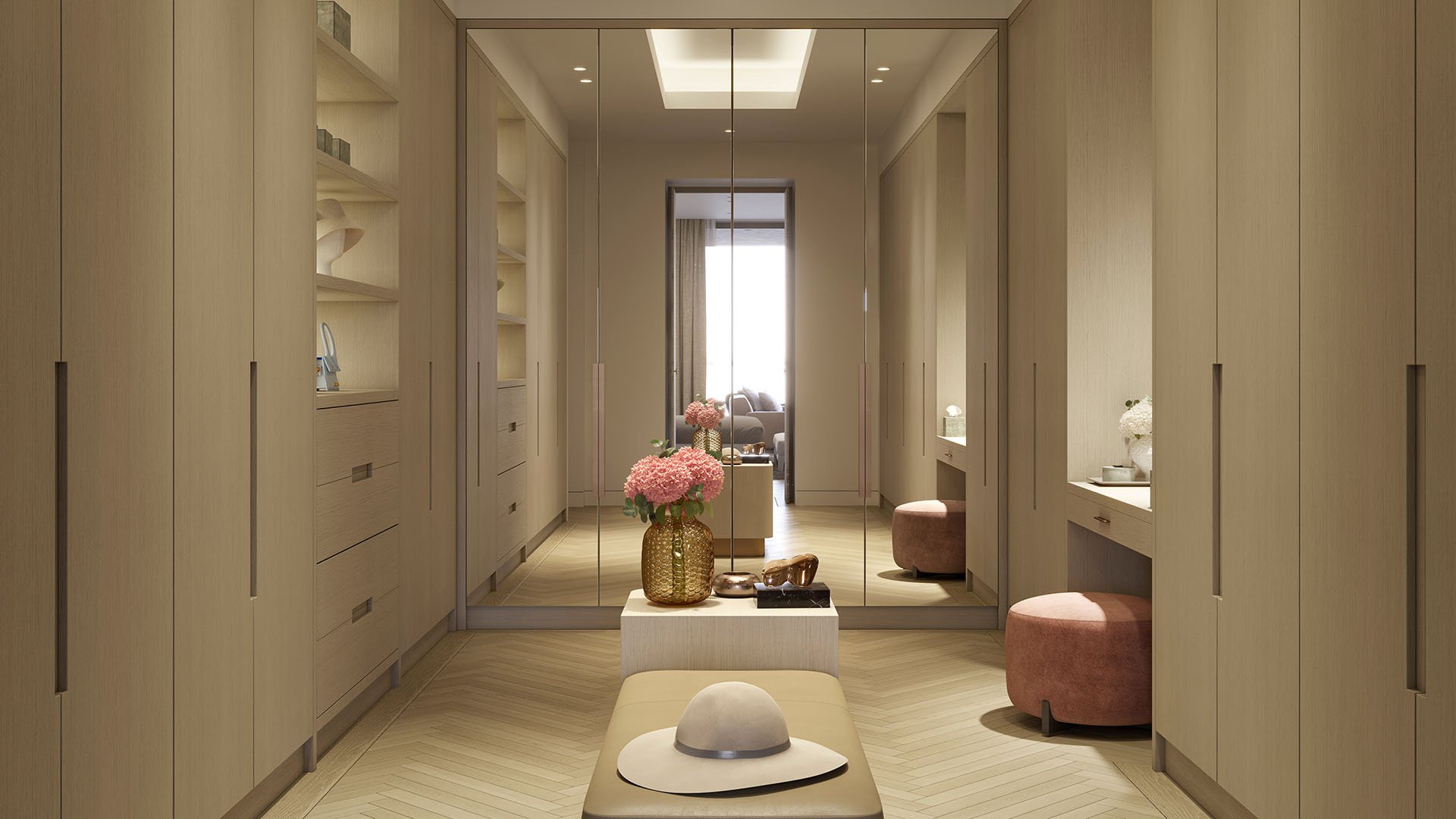
In a market where oceanfront residences compete on discretion and livability, the walk-in wardrobe has quietly become a real decision point. Not because buyers suddenly need more hanging space, but because the wardrobe now carries the same expectations once reserved for a lobby, spa, or private club: clean circulation, impeccable detailing, and a sense of arrival.
At Rosewood Residences Hillsboro Beach, the conversation often centers on how daily life is staged. A boutique-style wardrobe is one of the clearest expressions of that staging. When it is executed well, it elevates a functional zone into a private retail experience, with the psychological benefits of visibility, order, and ease. When it is executed poorly, it reads as a dark storage room wrapped in expensive millwork.
For buyers comparing trophy coastal inventory across Hillsboro-beach and neighboring corridors, the wardrobe is also an honest tell. It reveals whether a plan is truly designed for ownership living, or merely optimized for a quick impression.
“Footprint” sounds like a measurement, but in wardrobes designed as boutiques, it’s better understood as a performance metric. Two closets can occupy similar area and feel radically different. The difference is how the space is allocated across three competing priorities:
Circulation: How you move through it, turn, and access storage without friction.
Display: What is meant to be seen at a glance, like shelving, handbag niches, or a shoe wall.
Capacity: The less glamorous but decisive realities: double-hang lengths, drawer counts, long-garment bays, and safe storage.
A boutique wardrobe typically gives up some raw capacity to gain retail legibility. The better question is not “How big is it?” but “How much of it is usable without feeling tight-and how much is dedicated to what I actually own?”
A boutique wardrobe should operate like a small showroom, with clear aisles and intuitive wayfinding. Buyers can assess this quickly during a walkthrough or by reading plans:
Aisle width: If two people can’t pass comfortably, the closet reads as storage-not boutique.
Turning radius: Islands and benches must allow a natural pivot, especially near drawers.
Door conflicts: Swing doors that collide with drawers or hamper pull-outs are an immediate red flag.
If the wardrobe connects directly to the bath, pay special attention to how circulation aligns with morning routines. The boutique concept only works when it reduces decision fatigue rather than adding obstacles.
The island is the signature boutique move-and also the easiest way to squander footprint. An island that’s too large turns the closet into a maze; one that’s too small becomes a decorative prop.
The best islands function as the center of gravity for daily rituals: watch trays, jewelry drawers, sunglass storage, and a styling surface. Seating works similarly. A bench or ottoman isn’t just for comfort; it helps the space perform like a dressing room rather than a corridor.
For high-net-worth buyers, consider whether the island includes lockable compartments, felt-lined drawers, and charging integration. Boutique wardrobes increasingly serve as a soft-security layer for valuables you want close, but not in a safe.
Lighting is where boutique ambition is either confirmed or exposed. Overhead lighting alone flattens the space and throws shadows inside cabinets. A boutique wardrobe should feel curated, which requires layered illumination:
Ambient lighting to establish an even base
Task lighting at mirrors and islands
Accent lighting within shelving and display niches
Also evaluate color temperature and glare. A space can be bright yet unflattering if the temperature runs too cool, or if reflective finishes create hotspots. In a coastal environment, lighting should read crisp without drifting into clinical.
A boutique wardrobe is essentially millwork-as-architecture. The footprint feels larger when vertical lines are disciplined, corners are resolved cleanly, and hardware is consistent. Buyers should look for:
Consistent reveal lines that keep the eye calm
Drawer action that feels precise, not springy
Ventilated sections for leather goods
A place for long garments that is not treated as an afterthought
In South Florida, materials should be selected with climate reality in mind. Coastal humidity can punish weak finishes, and salt air can accelerate tarnish. A wardrobe that looks perfect on day one but ages poorly isn’t boutique-it’s set design.
A true boutique wardrobe considers the senses, not just storage. Three “invisible” factors drive day-to-day satisfaction:
Climate control: The wardrobe should not trap heat, especially if lighting is substantial.
Odor control and ventilation: Shoes and leather require air movement, not sealed boxes.
Acoustics: Soft-close hardware and thoughtful surfaces keep the room from sounding hollow.
These elements expand the perceived footprint because they make the space comfortable to use at any hour-not merely impressive at a glance.
Even when focusing on Hillsboro Beach, buyers often benchmark against other design-forward residences to calibrate expectations. In Brickell, fashion-adjacent branding has pushed the idea of “dressing as lifestyle,” and that influence shows up in closets through display-first thinking, integrated lighting, and gallery-like finishes. You can see this ethos in towers such as 888 Brickell by Dolce & Gabbana, where lifestyle narratives encourage residents to treat personal spaces like curated environments.
Up the coast, oceanfront residences often favor tranquil minimalism: fewer visual compartments, more concealed storage, and a calmer palette that reads resort-private rather than retail-public. The wardrobe becomes a sanctuary. For buyers who value that restraint, 57 Ocean Miami Beach offers a useful reference point for how beachfront living can shape interior priorities.
In Hallandale, a different lesson emerges: when floorplans prioritize drama and views, the wardrobe must work harder to justify its footprint. A boutique closet can be a smart trade if it improves daily flow and reduces clutter in the bedroom suite. 2000 Ocean Hallandale Beach is a reminder that luxury is often the sum of small private moments rather than a single headline feature.
For those comparing against Fort Lauderdale’s newer inventory, the takeaway is often pragmatism. A wardrobe can feel boutique without being oversized if the storage program is honest and the lighting is right. Four Seasons Hotel & Private Residences Fort Lauderdale can serve as a benchmark for how hospitality-minded living informs private spaces.
These comparisons aren’t about copying a style; they help buyers articulate preferences: showroom glamour versus resort calm, display versus concealment, statement hardware versus quiet precision.
When evaluating Rosewood Residences Hillsboro Beach-or any similarly positioned property-the most reliable method is a simple plan-based audit. Boutique wardrobes can photograph well, so treat imagery as secondary.
Use this checklist:
Count usable walls: A closet with too many openings (doors, passages) loses storage quickly.
Measure the “dead zones”: Corners, sloped ceilings, and awkward columns can erase capacity.
Verify drawer priority: Boutique closets need drawers for accessories; hanging alone is not boutique.
Look for a real mirror moment: Ideally full-length with good lighting, not a hallway compromise.
Ask where luggage lives: If luggage has no home, it will occupy the boutique display areas.
Identify privacy strategy: If the closet is visible from the bedroom, is that desirable to you?
If the residence offers multiple bedroom configurations, compare the wardrobe logic across them. In many luxury buildings, the “best” closet isn’t always in the largest residence, but in the plan with the fewest compromises.
Closets are rarely the headline in a resale listing, yet they shape buyer sentiment during showings. Boutique wardrobes may photograph beautifully, but their deeper value is straightforward: they remove friction from daily life. In the upper tier, that reduction in friction is what makes a home feel truly turnkey.
A properly scaled boutique wardrobe can also protect bedroom serenity. When storage is visible, it must be curated; when it’s hidden, it must be accessible. Either way, the wardrobe’s footprint acts as a proxy for how the entire home was prioritized.
For Hillsboro Beach buyers, this matters because the category is inherently lifestyle-led. If you are choosing Rosewood Residences Hillsboro Beach as a primary or seasonal base, the wardrobe becomes one of the most used rooms in the suite. If it feels like a private boutique, the home reads as more complete.
What makes a walk-in wardrobe feel like a boutique rather than storage? Clear circulation, layered lighting, and display-forward organization create the boutique effect.
Is bigger always better for a boutique-style closet footprint? No. The best closets balance aisle space and storage depth without wasting the center.
Should I prefer open shelving or closed cabinetry in South Florida? A mix is ideal: open display for daily items and closed storage for long-term protection.
Do closet islands actually add value? They add value when they improve function with drawers and surfaces, not just aesthetics.
How important is lighting temperature in a wardrobe? Very. Poor temperature can distort color and make the space feel clinical or dim.
What are common layout mistakes buyers miss on floorplans? Door conflicts, narrow aisles, and too many openings that reduce usable storage walls.
How can I tell if a closet will feel cramped in real life? Focus on turning radius near islands and whether drawers can open without blocking paths.
Does a boutique wardrobe need a seating area? It is not required, but seating helps the space function as a true dressing room.
Are boutique closets harder to maintain? They can be, because visibility encourages curation, but the payoff is daily ease.
Why do closets matter in resale if they are not a listing headline? They influence buyer perception during showings and signal whether the home lives well.
To compare the best-fit options with clarity, connect with MILLION Luxury.
If branded residences are on your mind — as a home or as an allocation — we would be glad to share what we are seeing, privately.
Begin a quiet conversation