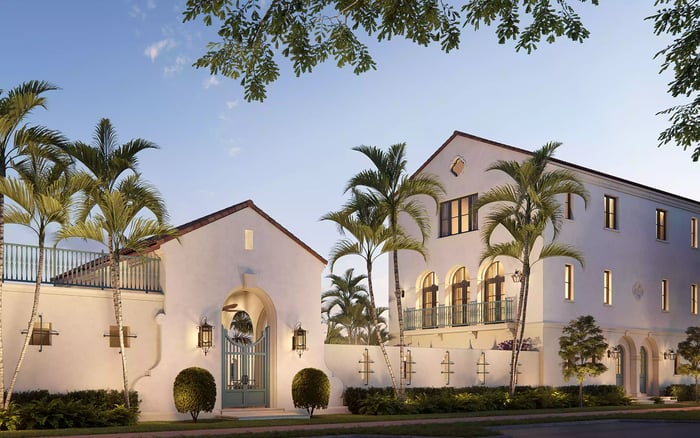
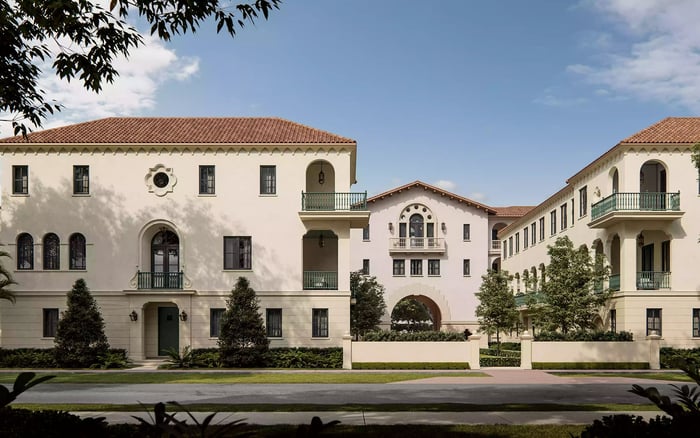
At Gables Estates, the garage is less a utilitarian appendage than a meaningful component of estate planning. In one of Coral Gables’ most tightly controlled single-family enclaves, multi-car storage affects not only square footage, but streetscape, drainage, landscaping, and the architectural balance between house and motor court.
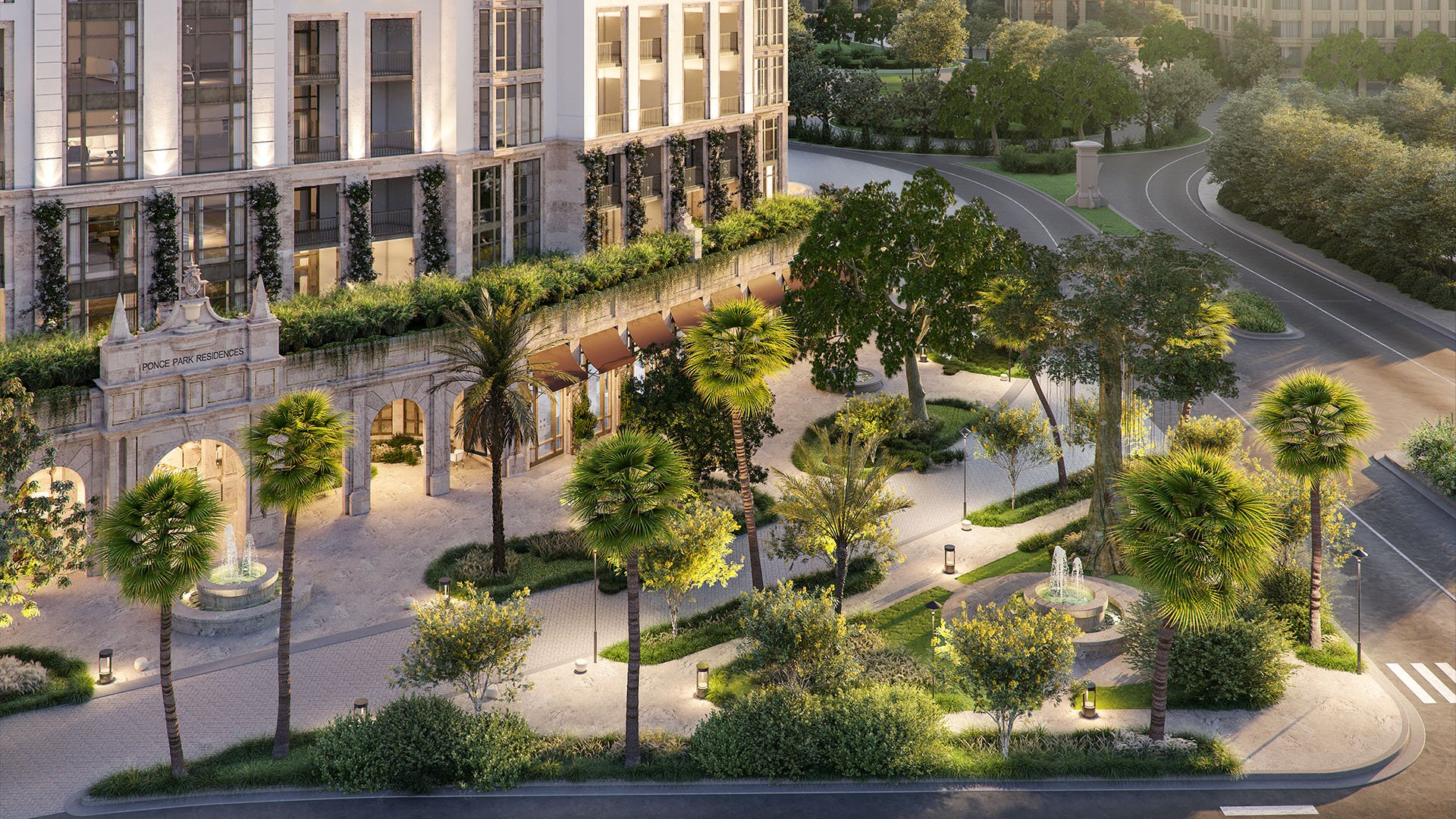
In Gables Estates, assessing a garage is not simply a matter of counting bays. Within this ultra-luxury gated single-family community in Coral Gables, estates occupy unusually generous parcels, and the garage program has become a standard component of top-tier residential design. Yet the true footprint of a multi-car garage extends well beyond the enclosed area behind the doors. It includes storage zones, mechanical support, driveway approach, turnarounds, guest arrival sequences, and the visual strategies required to keep vehicle infrastructure subordinate to the architecture of the house.
That distinction matters because Gables Estates is defined by both scale and discretion. The community spans about 500 acres with roughly 175 estates, and its planning context reflects Coral Gables’ tradition of close oversight on site planning and exterior improvements. In practical terms, a new garage wing or expanded motor court is not simply an amenity decision. It is a design decision that can alter lot composition, impervious coverage, drainage behavior, and the experience of arrival from the street.
For buyers comparing elite residential product across South Florida, from Ponce Park Coral Gables to The Village at Coral Gables, the lesson is familiar: luxury parking is valuable, but its finest expression is often the one least visible at first glance.
A typical multi-car garage footprint in Gables Estates falls in the range of roughly 1,500 to 3,500 square feet when circulation and storage are included. On estates with approximately 15,000 to 25,000 square feet of main living area, that can represent about 5% to 12% of total built square footage.
Even that does not tell the whole story. Large garage compounds often require another 3,000 to 5,000 square feet of hardscape for driveways, turnarounds, and circulation. Add a porte-cochère, guest garage, or service garage, and another 500 to 1,500 square feet can enter the equation. The result is that the auto program can become a substantial land-planning exercise rather than a single accessory room.
This is why sophisticated buyers and design teams evaluate the compound as a sequence. The enclosed garage may appear modest, while the actual footprint is distributed through landscaped motor courts, side approaches, detached pavilions, and service areas concealed from the main facade. In estates of this caliber, the question is rarely whether there is enough room for four cars or more. The sharper question is how elegantly that capacity is absorbed into the grounds.
In high-value Gables Estates inventory, 3- to 6-car garages appear to be the prevailing configuration, whether integrated into the residence or composed as detached structures. Exact community-wide counts are not publicly disclosed, but expansive enclosed parking is clearly a market expectation rather than a rarity. Across the upper end of South Florida, 4-plus-car capacity is routinely treated as a differentiating amenity, especially when paired with carefully designed motor-court arrival.
That expectation has only deepened as luxury garages have become more technical. Climate control, humidity management, and EV-supporting electrical systems increase the planning burden, often requiring additional mechanical space and more thoughtful utility integration. A garage program that looks simple on a floor plan may demand significantly more square footage once storage, systems, detailing, and circulation are properly resolved.
Readers who follow product evolution elsewhere in the region can see parallels in the way automotive lifestyle is folded into luxury identity, from Bentley Residences Sunny Isles to highly branded vertical developments in urban cores such as Mercedes-Benz Places Miami. Gables Estates expresses the idea differently: not as spectacle, but as spatial discretion.
The most successful garage compounds in Gables Estates are often the least obtrusive. Detached or semi-detached garages are used specifically to reduce the visual prominence of vehicle storage and preserve the architectural focus on the main house. Placement is also shaped by internal architectural expectations, including setbacks and street-facing considerations intended to limit visual impact.
This gives the garage a paradoxical role. It is substantial in size, but it should not dominate the estate. Garage doors and visible elevations are generally expected to match the architectural language of the residence so that the streetscape remains calm and coherent. On a large parcel, the design objective is not merely to fit more cars. It is to preserve the procession of landscape, facade, and entry.
This standard distinguishes true estate planning from overbuilding. In a market where lots are often well above one acre, there may be physical room for a large auto compound. But room alone does not make a garage compositionally successful. The higher benchmark is whether the garage reads as an integrated supporting element rather than the property’s primary face.
Because garage programs increase hardscape and impervious surface area, they can carry drainage and stormwater implications under Coral Gables municipal requirements. That may sound technical, but for luxury owners it translates into a practical issue: every additional bay, driveway spur, or turnaround has downstream design consequences for grading, landscape buffers, and water management.
Equally important, Gables Estates appears to preserve substantial open space and landscaped separation through practical design standards, even without a publicly stated community-wide lot-coverage cap in the material available. In other words, the estate ideal still favors breathing room. A large garage may be expected, but not at the expense of the lawns, gardens, and visual setbacks that make the property feel rare in the first place.
This is particularly relevant for buyers comparing single-family compounds with high-service condominium alternatives such as 57 Ocean Miami Beach or Villa Miami. In a condo, parking is largely a managed building function. In Gables Estates, parking is part of the land itself, and the quality of that planning can materially affect both livability and aesthetic value.
At Gables Estates, the footprint of a multi-car garage should be measured as a compound condition, not a room count. A 1,500 to 3,500 square foot enclosed garage may be only the beginning once hardscape, accessory auto structures, and concealed circulation are considered. For that reason, the most meaningful assessment is not whether an estate has four-car or six-car capacity, but how much land and design attention that capacity consumes.
For owners, this makes review and restraint especially important. Exterior modifications and garage expansions are not purely private gestures in this setting. They sit within a planning culture that values controlled streetscapes, architectural harmony, and substantial landscaped presence.
For buyers, the takeaway is clear. The best Gables Estates garage programs deliver abundance without visual noise. They support collectors, family fleets, staff operations, and modern electrical demands while preserving what matters most in an estate environment: proportion, privacy, and the primacy of the residence itself.
How large is a typical multi-car garage footprint in Gables Estates? Typical estimates place the enclosed and functional footprint at about 1,500 to 3,500 square feet.
How many cars do most high-end estates in Gables Estates accommodate? Many luxury properties in this segment are configured for roughly 3 to 6 cars, with larger programs not unusual.
Does the garage footprint include only enclosed parking bays? No. A proper assessment also includes storage, circulation, driveways, turnarounds, and related accessory auto spaces.
How much hardscape can a large garage program add? Driveways and circulation areas can add an estimated 3,000 to 5,000 square feet beyond the enclosed garage itself.
Are detached garages common in Gables Estates? They are often used to reduce visual impact and keep the main residence as the architectural focal point.
Why is garage placement so important in this community? Siting affects streetscape presentation, setbacks, privacy, and how successfully vehicle storage is concealed within the estate.
Can garage expansions be treated as a simple owner upgrade? No. Exterior garage changes are generally subject to architectural review within the broader Coral Gables planning context.
Do larger garages affect drainage planning? Yes. More enclosed area and more hardscape can increase impervious surface and trigger stormwater considerations.
What share of total built area can garage space represent? On very large estates, garage space may account for roughly 5% to 12% of total built square footage.
What matters most to luxury buyers evaluating garage footprint? Capacity matters, but the finer distinction is whether the garage program preserves landscape, discretion, and architectural balance.
If you'd like a private walkthrough and a curated shortlist, connect with MILLION Luxury.
If branded residences are on your mind — as a home or as an allocation — we would be glad to share what we are seeing, privately.
Begin a quiet conversation