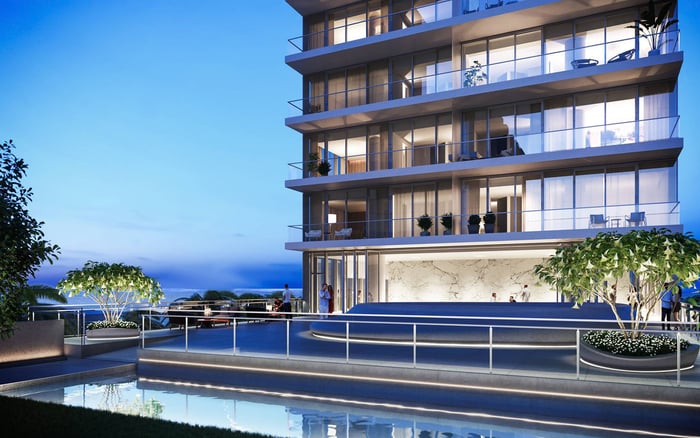
A disciplined framework for evaluating daily walkability, club rights, private dining privileges, and the complete lifestyle proposition of a Hallandale Beach residence.

For a luxury buyer, walkability is not a generic score. It is the ability to move comfortably between a residence and the places that shape an ordinary week: coffee, exercise, dining, the waterfront, personal services, and social engagements. The useful question is not whether Hallandale Beach is walkable in the abstract, but whether a particular address supports your routine without unnecessary friction.
The same precision should govern club and private dining access. A residence may be associated with a compelling hospitality concept, yet the buyer still needs to understand what access means contractually, operationally, and socially. Among MILLION's Buyer's Guides, this distinction is especially important because lifestyle value often depends on privileges that extend beyond the four walls of the home.
Begin every tour at the actual residential entrance-not at a map pin or sales gallery. Walk the routes you expect to use and note the quality of each transition: leaving the lobby, crossing driveways, waiting at intersections, navigating weather exposure, and returning after dinner. A short distance can feel inconvenient when the route is unpleasant; a longer one may become a welcome ritual when it is intuitive and comfortable.
Repeat the test at different times. Morning exercise, midday errands, and evening dining impose distinct demands. Buyers who travel frequently should also assess arrival routines with luggage, groceries, guests, or a waiting car. If beach access is part of the purchase thesis, trace the precise path rather than assuming a water-facing setting guarantees effortless access.
Apply the same process when considering 2000 Ocean Hallandale Beach. Preliminary information can begin the conversation, but only an in-person route audit can determine whether the surrounding experience matches your definition of convenience.
“Club access” can describe markedly different arrangements. It may refer to an ownership-linked right, a separate membership, a preferred opportunity to apply, or a revocable privilege. Before assigning value, request the operative documents and identify the party responsible for delivering the experience.
Ask whether participation is automatic or elective, whether initiation charges or recurring dues apply, and whether access transfers with a sale. Review the rules for spouses, children, extended family, household staff, and unaccompanied guests. Clarify whether the club can impose capacity controls, seasonal restrictions, renovation closures, dress standards, or reservation priorities.
A buyer evaluating Shell Bay by Auberge Hallandale should separate the residence decision from the club-access analysis, then reunite them in the final value assessment. Golf may be central to one household and incidental to another. The premium becomes personal only when the rights, costs, and usage pattern are understood.
Private dining is most valuable when it addresses recurring needs. Consider how often you would use it for a quiet table, business breakfast, family dinner, catered gathering, or last-minute meal. Then investigate the mechanics: hours, reservation windows, cancellation terms, guest limits, room charges, service fees, gratuities, minimum spending, and event policies.
Do not treat a beautiful dining room as proof of dependable access. Ask who receives priority during peak periods and whether residents compete with hotel guests, club members, or private events. Determine whether in-residence dining is available and whether its menu, hours, staffing, and delivery charges differ from those of the principal venue.
The distinction matters when comparing a Hallandale residence with hospitality-oriented alternatives such as Four Seasons Hotel & Private Residences Fort Lauderdale. The objective is not to declare one model superior, but to identify the operating structure that best supports how you entertain and dine.
Organize the shortlist around three independent columns: residence, daily setting, and access ecosystem. The residence column should cover layout, privacy, views, storage, parking, service, and anticipated ownership obligations. The daily-setting column should record tested walking routes and transportation routines. The access column should capture every club and dining term that materially affects use.
This framework prevents a seductive amenity from compensating for a residence that does not work-or an exceptional home from obscuring a weak daily routine. It also brings greater discipline to regional comparisons. For example, Turnberry Ocean Club Sunny Isles can be reviewed through the same three-part lens without assuming that similarly positioned properties deliver interchangeable experiences.
Assign each category a personal priority rather than an arbitrary score. A full-time resident may emphasize weekday ease and spontaneous dining. A second-home buyer may place greater weight on lock-and-leave service, guest handling, and predictable access during peak visits. The best purchase is the one whose operating reality aligns with the household's actual calendar.
Request current governing documents, fee schedules, membership materials, dining rules, and written descriptions of resident privileges. Ask counsel to distinguish rights attached to ownership from programs controlled by a separate operator. Confirm which terms can change, who may change them, and what remedies exist if an anticipated service is modified.
Model the complete annual commitment, not merely the purchase price. Include residence-level charges, optional memberships, dining minimums, service costs, transportation preferences, and the practical value of time saved. Finally, consider resale: a future buyer may value the same access differently, particularly if privileges are personal, nontransferable, or subject to a new application.
The disciplined Hallandale buyer is not purchasing an amenity brochure. The buyer is selecting a residence, a routine, and a network of access that should function coherently long after closing.
What does walkability mean for a luxury buyer in Hallandale Beach? It means the specific routes supporting your routine are comfortable, intuitive, and practical at the times you expect to use them.
Should I rely on a walkability score? Use it only as an initial filter. A front-door route test reveals conditions and transitions that a generalized score cannot personalize.
How many times should I walk the area before buying? Test it during several parts of the day and under conditions that resemble your likely weekday, evening, and weekend routines.
Is club access always included with ownership? Make no assumptions. Confirm in writing whether access is ownership-linked, optional, separately paid, transferable, or revocable.
Which club costs deserve scrutiny? Review initiation charges, recurring dues, assessments, minimum spending, service fees, guest charges, and the authority to change them.
What should I ask about private dining reservations? Ask about booking windows, priority rules, peak-period availability, cancellations, guest limits, private events, and competition for tables.
Does private dining include in-residence service? Not necessarily. Verify whether it exists and confirm its menu, operating hours, delivery fees, staffing, and event limitations.
How should seasonal buyers evaluate access? Focus on availability during intended travel dates, when demand controls, guest restrictions, or reservation pressure may matter most.
Can club privileges affect resale value? They may influence buyer interest, but their value depends on costs, transferability, operating quality, and the next buyer's priorities.
What should happen before contract or closing? Have qualified advisers review governing documents, written privileges, fee schedules, change provisions, and obligations tied to ownership.
For a discreet conversation and a curated building-by-building shortlist, connect with MILLION.
If branded residences are on your mind — as a home or as an allocation — we would be glad to share what we are seeing, privately.
Begin a quiet conversation