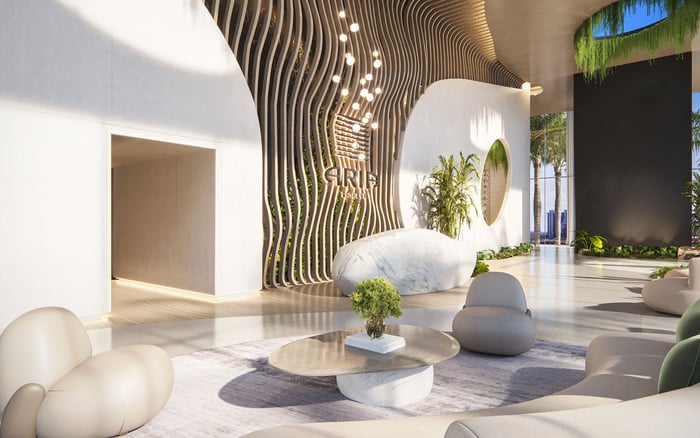
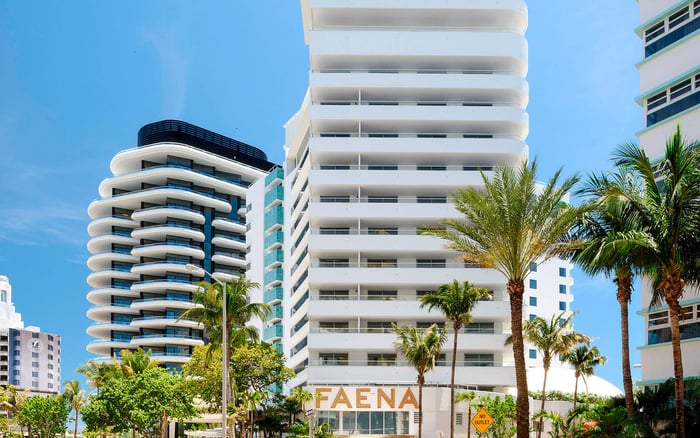
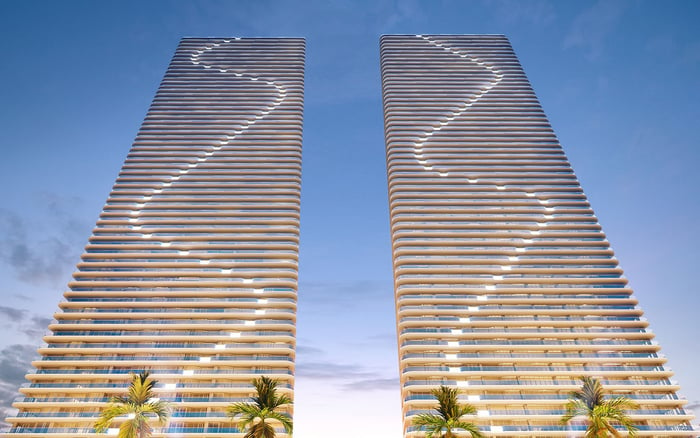
For buyers who prefer neighborhood rhythm over skyline theater, Aria Reserve Miami is the clearer high-rise, view-driven proposition. The more disciplined comparison asks whether 619 Residences can deliver a calmer daily cadence, and whether that calm matters more than Aria Reserve’s waterfront scale, amenity depth, and panoramic identity.
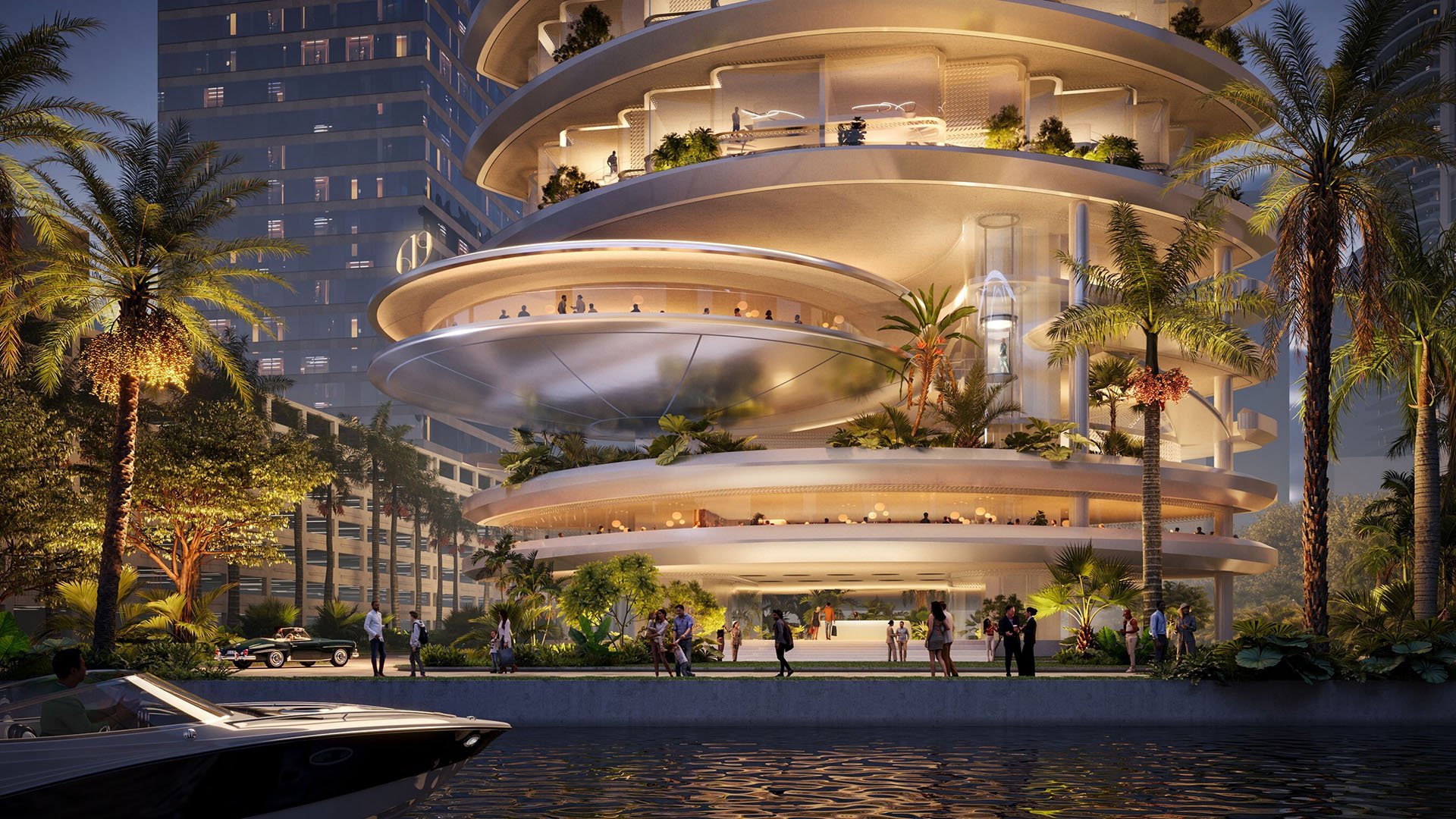
The choice between Aria Reserve Miami and 619 Residences by Foster + Partners + Nobu Hospitality is less about prestige than temperament. Both belong in a serious conversation about contemporary Miami luxury, but this buyer profile is unusually precise: someone who prefers low-rise neighborhood rhythm to skyline drama.
That distinction matters. Some buyers want the exhilaration of elevation, the cinematic sweep of water and city, and the sensation of arriving at a building that announces itself from a distance. Others want a softer daily pattern: easier transitions from residence to street, a less vertical arrival, a quieter relationship with the surrounding neighborhood, and a home that feels integrated rather than lifted above the city.
On the known facts, Aria Reserve Miami is the clearer expression of skyline drama. It is a waterfront development in Edgewater, organized around a pair of tall residential towers. Height is central to its identity, and its appeal is tied to panoramic views, waterfront presence, and an amenity-rich vertical lifestyle. For a buyer seeking low-rise calm, that is not a defect. It is a signal. Aria Reserve is built around a different residential idea.
Aria Reserve Miami belongs to the Miami tradition of luxury as spectacle, scale, and horizon. Its waterfront setting supports a resort-like residential experience, and its tower format naturally emphasizes elevation, visibility, and sweeping views. In practical terms, the project will resonate most strongly with buyers who regard height as a privilege rather than a compromise.
This is especially relevant in Edgewater, a rapidly densifying neighborhood context where the skyline is not background scenery. It is part of the lifestyle proposition. Buyers drawn to Aria Reserve are not simply purchasing a residence; they are choosing a vertical Miami experience defined by water, city, amenities, and the status of outlook.
That is why the vocabulary matters: Aria Reserve Miami in Edgewater sits naturally near Waterview and High-floors, while the buyer seeking Low-floors in a New Project is asking a different question. One profile wants exposure, panorama, and an amenity ecosystem. The other wants proportion, rhythm, and a more intimate sense of place.
For the low-rise-minded buyer, the tension is clear. Aria Reserve’s strengths are the very attributes that may feel too dramatic: tower scale, visual prominence, and a lifestyle organized around height. If the daily dream is to step into a smaller neighborhood cadence, the project’s waterfront grandeur may feel less aligned, even when the architecture, amenities, and views are compelling.
619 Residences by Foster + Partners + Nobu Hospitality enters the comparison as the alternative, but it should be evaluated with discipline. The name carries design and hospitality associations, yet branding is not the deciding issue. For this buyer, the real test is how the finished residential experience handles scale, arrival, privacy, street connection, amenity intensity, and the feeling of home at ground level.
A low-rise rhythm buyer should look for specific signals. Does the building create a calm arrival sequence rather than a theatrical one? Does daily life feel connected to nearby streets, restaurants, walks, and errands? Are the residences arranged to emphasize privacy and proportion, or is the experience primarily vertical? Does the amenity program support ease, or does it turn the home into a social stage?
Those questions matter because low-rise preference is not simply about the number of floors. It is about tempo. A buyer may accept a taller building if the residence feels serene, the entry sequence feels discreet, and the neighborhood connection feels natural. Conversely, a building with celebrated names attached can still feel too performative if the daily experience is dominated by spectacle.
For 619 Residences, the more useful stance is conditional rather than assumptive. If its delivered experience emphasizes intimacy, calibrated hospitality, and a composed relationship with the neighborhood, it may better support the buyer who wants rhythm over skyline. If it leans toward visual theater and destination energy, the distinction from Aria Reserve becomes less about lifestyle and more about taste.
Aria Reserve is the stronger fit for the buyer who wants Miami to feel expansive. This buyer values the waterfront setting, the emotional pull of panoramic views, and the convenience of extensive amenities. They likely enjoy returning to a high-profile residential environment where the building itself is part of the identity.
The project is also better suited to someone comfortable with Edgewater’s densifying urban character. The neighborhood’s growth gives Aria Reserve an energetic context, and the towers respond to that context with scale rather than retreat. For a buyer who wants a commanding residence, that can be precisely the point.
Aria Reserve may be less natural for someone who finds skyline spectacle fatiguing. If the ideal home is quiet, human-scaled, and embedded in a slower neighborhood pattern, then Aria Reserve’s strongest selling points require careful weighing. Its advantages are real, but they are not low-rise advantages. They are vertical luxury advantages.
The buyer inclined toward 619 Residences should prioritize lived cadence over visual command. That buyer may still want design pedigree, hospitality polish, and a refined address, but those elements must serve calm rather than compete with it.
In this comparison, 619 Residences becomes more attractive if the buyer’s highest priority is avoiding the feeling of being absorbed into a skyline object. The key is not whether it appears quieter on paper, but whether its daily experience supports discretion: arrival, elevator rhythm, amenity scale, service posture, and the degree to which the residence feels like part of a neighborhood rather than a perch above one.
The disciplined conclusion is this: Aria Reserve is the clearer benchmark for skyline-oriented Miami new development. 619 Residences may be the better answer for the low-rise rhythm buyer only if its practical residential experience proves calmer, more intimate, and more neighborhood-forward than the tower lifestyle Aria Reserve intentionally delivers.
Begin with the morning, not the brochure. If the ideal day starts with light, water, height, and a resort-like amenity sequence, Aria Reserve deserves serious attention. If the ideal day starts with a quieter exit, a more grounded arrival, and a sense that the city is encountered at walking scale rather than viewed from above, the buyer should interrogate 619 Residences more closely.
Then separate admiration from suitability. It is entirely possible to admire Aria Reserve and still decide it is not the right personal fit. Its waterfront setting, tall towers, panoramic views, and amenity emphasis make it a strong proposition for many luxury buyers. But the buyer in this topic is not asking for maximum drama. They are asking for residential rhythm.
For that buyer, the better choice is the one that makes privacy feel effortless and daily life feel composed. Based on the established character of Aria Reserve, the project is better understood as the skyline choice. The low-rise rhythm buyer should choose it only if the views and amenities outweigh the desire for a calmer, more human-scaled environment.
Is Aria Reserve Miami a low-rise-style choice? No. Its identity is tied to tall residential towers, waterfront presence, panoramic views, and a vertical luxury lifestyle.
Who is Aria Reserve Miami best suited for? It best suits buyers who value height, views, waterfront living, extensive amenities, and a strong skyline presence.
Does Edgewater support a quiet neighborhood rhythm? Edgewater is a rapidly densifying Miami neighborhood context, so buyers seeking calm should evaluate the immediate daily feel carefully.
Can a high-rise still feel calm? Yes, if arrival, privacy, service, and amenity usage are well managed, though the broader identity may still be vertical.
What should low-rise rhythm buyers prioritize first? They should prioritize scale, arrival sequence, street connection, privacy, and whether daily life feels composed rather than theatrical.
Is 619 Residences automatically the better low-rise choice? Not automatically. It should be judged by its actual residential cadence, not by name recognition or assumptions.
What is the main tradeoff with Aria Reserve? The tradeoff is between view-driven, amenity-rich vertical luxury and the quieter intimacy of a lower-scale neighborhood experience.
Should buyers who dislike skyline spectacle avoid Aria Reserve? They should be cautious, because Aria Reserve’s core appeal depends on scale, elevation, visibility, and waterfront drama.
Which option appears clearer from a positioning standpoint? Aria Reserve is the clearer skyline-oriented option in this comparison, while 619 Residences requires closer lifestyle evaluation.
What is the simplest decision test? Choose the home that best matches the desired daily rhythm, not the one that looks most impressive from a distance.
For a tailored shortlist and next-step guidance, connect with MILLION.
If branded residences are on your mind — as a home or as an allocation — we would be glad to share what we are seeing, privately.
Begin a quiet conversation