At Fendi Château Residences, private foyer arrival is only one part of the access equation. Buyers should verify the full service route, technical elevator limits, scheduling rules, finish protection, and contingency options before moving valuable furnishings, art, or event equipment.

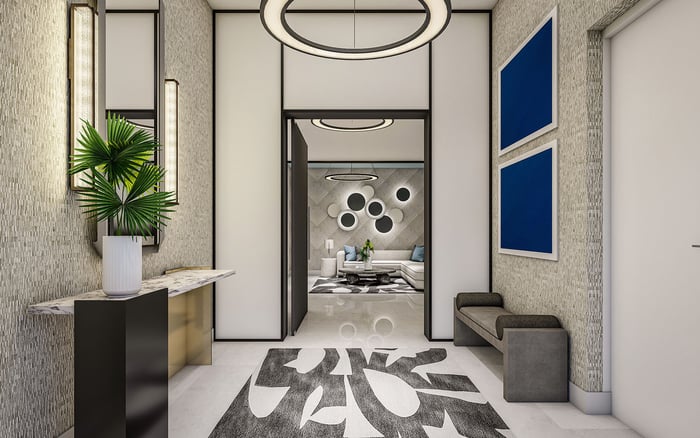
At Fendi Château Residences Surfside, dedicated elevators open into private residential foyers-an elegant arrangement that limits exposure to shared corridors and gives owners a composed arrival sequence. Yet that experience answers a different question from the one facing a mover, art handler, caterer, or rental supplier: Can the designated service route safely accommodate the object, crew, and schedule involved?
The oceanfront condominium stands at 9349 Collins Avenue in Surfside, with 58 flow-through residences, including three penthouses, arranged along roughly 300 linear feet of beachfront. Its gracious proportions include 10-foot ceilings in standard residences, penthouse ceilings of up to 11 feet, and terraces reaching up to 12 feet deep. Those dimensions invite substantial furniture and artwork, but they do not establish whether a crated piece can travel from truck to foyer.
The decisive measurement is the narrowest point along the complete delivery path.
This is a practical consideration within branded residences, where refined arrival design can make operational infrastructure feel almost invisible. For buyers, the relevant distinction is simple: Privacy at the front door should never be mistaken for verified freight capability behind the scenes.
Elevator rated loads, cab width, depth and height, door-opening measurements, and maximum permitted crate sizes are not disclosed. A buyer planning significant installations should therefore request technical sheets for every elevator that management permits vendors to use.
The survey should begin at the loading point, not inside the residence. Confirm vehicle clearance, unloading position, loading-area doors, corridor widths, ceiling heights, thresholds, elevator door openings, cab dimensions, rated load, and every turn between the truck and the final room. The lowest soffit or tightest corner may matter more than the apparent size of the cab.
Measure furniture and artwork in their shipping crates, including protective materials and handling equipment. A sculpture that fits after unpacking may still be impossible to transport in its required museum-grade crate. Weight is equally important: The combined load can include the object, crate, dollies, rigging, and installation team.
Buyers comparing other intimate coastal buildings, such as Arte Surfside, should apply the same route-based test rather than infer capacity from a private-elevator presentation. Elevator privacy, service designation, and freight suitability are separate matters.
Some layouts at Fendi Château include four bedrooms, 4.5 bathrooms, and a staff room. Certain plans also incorporate maid's rooms and service entrances, indicating that household operations were considered separately from the principal arrival. These features can support discreet staffing, but they still do not confirm what may travel in a passenger elevator or when vendors may use it.
Italian marble and Fendi cabinetry further elevate the need for a written protection plan. Movers and installers should know who supplies elevator padding, floor coverings, corner guards, wall protection, and foyer protection. Management should also clarify inspection procedures before and after work, responsibility for damage, and whether a building representative must supervise access.
The same diligence is appropriate at nearby properties such as The Surf Club Four Seasons Surfside and The Delmore Surfside. This is not a comparison of disclosed elevator specifications. It is a reminder that buyers evaluating luxury coastal residences should make operational access part of their physical due diligence.
A technically adequate elevator may still be unavailable at the required hour. Fendi Château offers 24-hour valet, concierge connectivity, and white-glove service on an intimate scale. Amenities include two heated pools, a beach club, an oceanfront restaurant, a residents' lounge with a gourmet kitchen, a screening room, a children's playroom, a wine cellar, a private dining room, and a spa with a European thermal pool, sauna, and steam rooms.
That program generates routine staff, maintenance, provisioning, and vendor traffic. A move, art installation, or private event may compete with normal operations for loading access and elevator time. Buyers should ask whether an elevator can be reserved exclusively, how long the reservation lasts, whether multi-day installations are permitted, and what happens if another building function requires the route.
Shabbat elevator operation is also offered. Management should identify which elevator follows that mode and explain whether it affects weekend moves, deliveries, installation work, catering arrivals, or post-event rental removal. The objective is not merely to secure a preferred time, but to understand the building's complete operating calendar.
Before closing, request the current rules rather than rely on an informal description. The package should address permitted hours, reservation lead times, deposits, elevator padding, security or engineering staff, contractor licensing, certificates of insurance, indemnity requirements, loading-area access, and penalties for overruns.
For art, ask whether management will reserve an elevator for fine-art handlers and whether a passenger elevator may ever be approved when an item cannot fit the designated service route. Any exception should be confirmed in writing. Owners should also determine whether unpacking is allowed in the loading area, service corridor, private foyer, or only inside the residence.
For a private event, map separate windows for catering, florals, rental furniture, audiovisual equipment, and removal. Confirm guest limits and whether vendor circulation can remain distinct from resident arrivals. A private dining room or generous terrace can make entertaining feel effortless, but setup may involve multiple suppliers using the same constrained route.
Treat one representative object as a real-world test case. Select the largest planned sofa, dining table, sculpture, chandelier crate, or terrace furnishing. Record its crated dimensions and total handling weight, then ask management to validate each segment of the proposed route.
Next, obtain the relevant elevator technical sheet and written authorization for the vendor category. Have the mover or installer review the loading geometry, turns, cab, doorway, protection standards, staffing requirements, and schedule. If the object does not fit, establish whether exterior hoisting is allowed and what engineering, insurance, permits, and association approvals would be required. Hoisting should be treated as a conditional contingency, not an assumed solution.
Finally, verify the condominium documents and current operating rules, including the legal unit count, because building descriptions vary between 57 and 58 residences. Flow-through units may offer exceptional spatial continuity, but ownership confidence depends on understanding how the contents of those rooms actually arrive.
At this level of the market, service quality is expressed not only through discretion and hospitality, but also through predictable execution. A documented route, confirmed capacity, protected finishes, reserved time, and an approved fallback plan can prevent a valuable acquisition from becoming a logistical problem.
For private guidance on Surfside residences and operational due diligence, connect with MILLION.
If branded residences are on your mind — as a home or as an allocation — we would be glad to share what we are seeing, privately.
Begin a quiet conversationNo. Private foyer access does not establish whether furniture, crates, or vendors may use a passenger elevator; management must confirm permitted routes in writing.
Public project materials do not disclose rated loads, cab dimensions, door openings, or maximum permitted crate sizes.
Request cab width, depth, height, door-opening dimensions, and rated load for every elevator approved for movers or vendors.
Protective crating can materially increase an object's dimensions and weight, determining whether it can pass through doors, turns, and the elevator.
Check loading-area clearance, every doorway, corridor, ceiling restriction, threshold, turn, elevator opening, cab, and residential foyer.
Confirm permitted hours, reservations, deposits, padding, supervision, insurance, loading access, damage procedures, and rules for multi-day work.
It may affect scheduling, so buyers should ask which elevator follows that mode and how weekend moves, events, or vendor access are handled.
Confirm guest limits, catering routes, reserved elevator windows, delivery timing, vendor circulation, and rental-removal deadlines.
Ask whether another elevator can be approved or whether exterior hoisting is permitted, subject to engineering, insurance, permits, and association approval.
Available descriptions vary between 57 and 58 residences, so buyers should confirm the current legal count in the condominium documents.