A yacht owner's acquisition review near Fendi Château should separate oceanfront prestige from verified marine access. This guide frames the written checks for bridge clearance, dockage rights, storm procedures, arrival privacy, and legal identity before contract deadlines expire.

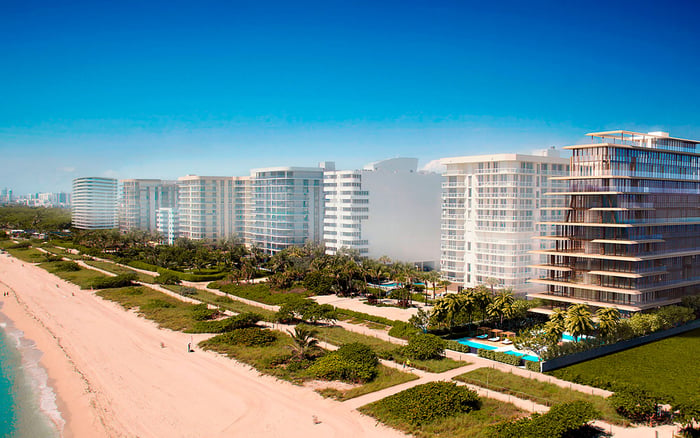
For a yacht owner, an oceanfront address and a workable marine plan are separate assets. Fendi Château Residences Surfside is a 58-residence luxury condominium in Surfside, positioned directly on the ocean. That setting may satisfy the desire for sea views and an immediate coastal atmosphere, but it does not, by itself, establish an on-site marina, a deeded boat slip, or a navigable route from residence to vessel.
Building-controlled slips, vessel-size limits, bridge clearances, slip pricing, and a private yacht-arrival protocol remain unverified. Treat each as an open diligence condition, to be resolved through association records, marina contracts, navigational review, and written management responses-not assumptions drawn from waterfront imagery.
Even the street reference requires scrutiny. The property is identified as 9349 Collins Avenue in some instances and 9365 Collins Avenue in others. A buyer should reconcile the discrepancy through the title commitment, legal description, condominium declaration, association records, and county property records.
This is not clerical housekeeping. The precise legal identity determines which declaration, rules, insurance schedules, assessments, and access rights govern the unit. It also allows counsel to verify that every marine-related agreement, parking privilege, or loading right attaches to the property being acquired.
The building's resale history confirms its ultra-premium context. A residence traded for $7 million in 2020, while Unit 504 sold for $10.6 million-equal to $3,138 per square foot-on February 25, 2025. Within a relatively thin 58-unit comparable pool, valuation and reserve planning warrant equal scrutiny.
Bridge diligence begins with the yacht, not the condominium. Commission a route review based on the vessel's actual air draft, beam, draft, tender arrangement, antenna configuration, and operating tolerances. The captain or marine professional should identify every proposed route, fixed or movable bridge, channel restriction, tide dependency, and opening requirement relevant to the intended berth.
Request clear written answers to practical questions: Is the route usable in both directions at the desired tide? Are bridge openings required? What waiting time should be expected? Is there a credible alternate route? How might seasonal traffic, maintenance, or weather affect the transfer between dock and residence?
A generic clearance figure is inadequate. Test it against the yacht in its operating configuration, with a prudent safety margin and a current navigational review.
No on-site dockage arrangement has been established. A purchaser should determine whether any slip is deeded, leased, licensed, assigned, shared, or entirely off-site. Counsel should review the term, renewal rights, transferability, fees, insurance requirements, utilities, parking, tender storage, liveaboard restrictions, crew access, guest boarding, and cancellation provisions.
If nearby dockage is central to the ownership thesis, inspect the berth and rehearse the complete transfer. Measure the drive, security handoff, luggage movement, provisioning route, and late-night arrival experience. The comparison set may include nearby coastal residences such as Ocean House Surfside and The Surf Club Four Seasons Surfside, but each property's marine claims require the same documentary standard.
For a broader coastal comparison, The Ritz-Carlton Residences® Miami Beach can be assessed through the same lens: residence rights, berth rights, and transportation logistics should be examined independently.
A polished arrival is secondary to a resilient one. Request the condominium's building-specific hurricane procedures, including notice timing, staffing, generator coverage, elevator policy, garage and loading access, shutdown protocols, communications, re-entry rules, and procedures for securing terraces or exterior items.
The yacht requires a parallel plan. Determine who orders relocation, where the vessel may go, who is authorized to move it, how crew access is maintained, and which costs and insurance obligations apply. Confirm whether a marina can terminate occupancy or require evacuation during a named storm-and whether the proposed alternate berth is contractually available rather than merely customary.
Then overlay the residence and yacht plans. The strategy fails if crew cannot reach the vessel, owners cannot retrieve essential property, or building re-entry conflicts with the vessel's return schedule. Written timelines, named contacts, and backup communications carry more weight than broad assurances.
Test privacy as a sequence: disembarkation, vehicle transfer, building arrival, screening, elevator access, and entry into the residence. Ask management to explain visitor logs, camera coverage, staff notification, valet handling, service access, guest identification, crew credentials, package handling, and records retention.
Conduct the route by day and after dark. Observe where an owner pauses, where luggage changes hands, and whether guests or crew must cross public-facing spaces. Determine which stages are governed by the condominium and which depend on third-party marinas, drivers, or security teams. Discretion is only as strong as the least controlled handoff.
Before the diligence period ends, obtain the declaration and amendments, rules, recent budgets, reserve information, insurance documents, board materials, pending assessment information, management responses, and every proposed dockage agreement. Reserve funding deserves particular scrutiny, including the future cost of maintaining finishes consistent with the building's luxury positioning.
The purchase contract should give counsel and marine advisers sufficient time to review title identity, association obligations, navigation, berth terms, storm procedures, and privacy logistics. Any fact essential to ownership should be verified in writing, with responsibility assigned to a named party.
Does Fendi Château have a verified on-site marina? An on-site marina and building-controlled slips remain unverified.
Does oceanfront ownership include a boat slip? No such right should be assumed. Confirm any deed, lease, license, or assignment in writing.
Which address should appear in the contract? Resolve the 9349 and 9365 Collins Avenue references through title, legal, association, and county records.
Who should check bridge clearance? The captain or a qualified marine professional should test the intended route against the yacht's actual dimensions.
What dockage terms matter most? Review duration, transferability, renewal, fees, insurance, utilities, crew access, evacuation, and termination.
Should a buyer rely on a marina's customary storm practice? No. Obtain the operative storm, relocation, and evacuation requirements in writing.
What building storm records should be requested? Ask for hurricane procedures covering staffing, power, elevators, communications, access, and re-entry.
How can arrival privacy be tested? Rehearse the journey from berth to residence and document every public space, checkpoint, and handoff.
Why review reserves in a 58-residence building? A smaller ownership base and luxury-grade finishes can make funding assumptions especially material.
When should marine diligence be completed? Complete legal, navigational, dockage, storm, and privacy reviews before contractual deadlines expire.
For a discreet conversation and a curated building-by-building shortlist, connect with MILLION.
If branded residences are on your mind — as a home or as an allocation — we would be glad to share what we are seeing, privately.
Begin a quiet conversation