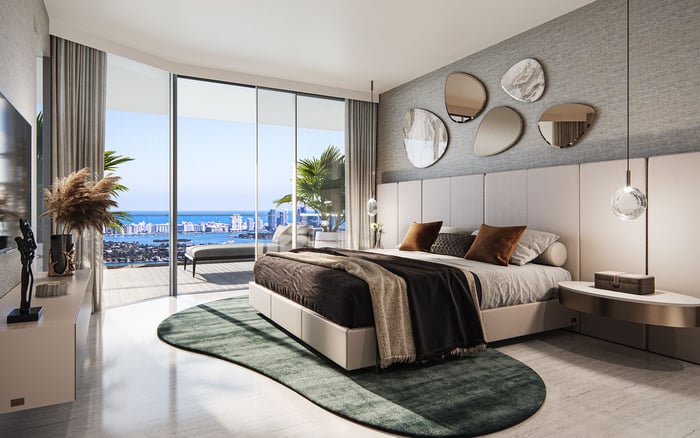
Villa Miami is best evaluated through the lens of household logistics, daily movement, service flow, and the practical needs of complex South Florida ownership.

For a certain South Florida buyer, luxury is no longer measured only by finish packages, skyline views, or the drama of a lobby arrival. It is measured by how well a residence supports the full choreography of an affluent household: morning departures, school and work transitions, private staff movement, visiting family, deliveries, storage, entertaining, and the ability to keep everything coordinated without friction.
That is where Villa Miami deserves a more serious place in the conversation. The strongest way to evaluate it is not simply as a beautiful Miami residence, but as a potential operating base for households that expect daily life to feel coordinated, intuitive, and calm.
This distinction matters. Many ultra-premium buyers already know how to evaluate views, ceiling heights, design language, and overall mood. Fewer pause to ask whether the building will make daily life simpler. For buyers prioritizing strong household logistics, that question should move from the background to the center of the decision.
Miami ownership often involves layered movement. A household may move between schools, offices, airports, restaurants, wellness appointments, cultural events, and waterfront recreation in the same week. For globally mobile owners, the pattern may be even more complex, with frequent arrivals, departures, guests, security preferences, and staff coordination.
Villa Miami’s relevance is tied to how well it can be matched to that routine. Buyers should study commute patterns, arrival sequences, parking needs, guest access, delivery handling, and the practical rhythm of weekday and weekend life. A residence can be visually compelling and still feel inconvenient if the daily operating pattern is not aligned.
Buyers comparing Miami’s urban luxury options may also look at 2200 Brickell to understand how location changes the rhythm of daily life. Brickell can suit certain business-forward routines, while another Miami setting may appeal to households seeking a different residential cadence. The point is not that one choice is universally superior. The point is that logistics should guide the decision as much as architecture or amenities.
Building scale can shape everything from elevator experience to service culture, delivery flow, staff familiarity, and the sense of control residents feel when moving through the property. For high-net-worth households, these details are not minor conveniences. They influence how easy the residence is to live in, manage, and return to after time away.
A larger environment may offer breadth, but not every household wants breadth. Some want predictability, discretion, and a residential experience that feels legible. For families, multi-home owners, and globally mobile buyers, the ability to understand how a building functions can become a meaningful advantage.
This is where Villa Miami’s positioning should be examined carefully. Its value proposition, for this buyer profile, is not only visual luxury. It is the possibility of a residence that supports household routines with intention.
The most refined buildings often distinguish themselves through what residents do not have to think about. Service programming, building operations, and day-to-day coordination can matter as much as finishes or amenity images. When a property is evaluated around lived experience, it can become more than a collection of attractive spaces. It can become part of the household’s operating system.
For owners who divide time across residences, manage staff, host frequent visitors, or travel internationally, consistency is not a minor luxury. It is a requirement. Predictable operations, clear communication, and well-considered service pathways can determine whether a residence feels effortless or demanding.
This is why the operational checklist should be explicit. Arrivals and departures should be considered carefully. Deliveries should be easy to manage. Staff circulation should feel discreet and logical. Entertaining support should align with the way the household actually lives. Storage should be evaluated realistically, not romantically. Digital coordination should support, not complicate, the management of the residence.
In South Florida luxury property decisions, these details are often more consequential than buyers initially expect. A home can be spectacular and still be operationally awkward. Villa Miami’s case is strongest when viewed through this practical lens.
Miami buyers are not short on options, which makes comparison essential. A buyer considering Aria Reserve Miami or EDITION Edgewater may be weighing not only design language and residential positioning, but also how each building will behave in daily use.
For Villa Miami, the key question is whether the building’s full experience matches the household’s real routine. A family with children may prioritize morning and afternoon flow. A multi-home owner may care about arrival readiness and staff communication. A frequent host may focus on guest circulation and practical support. A global buyer may want a residence that feels stable and controlled even after weeks away.
This is where lifestyle and logistics intersect. The more complex the household, the more the residence must perform quietly in the background. Villa Miami should be evaluated on that basis.
Villa Miami is especially relevant for buyers whose lives involve movement, coordination, and multiple stakeholders. That includes families balancing school, work, recreation, and visiting relatives. It includes owners with staff who need a building that supports service flow without making the residence feel institutional. It includes buyers who maintain more than one home and need Miami to function smoothly whether they are in residence for a week, a season, or longer.
It also applies to buyers who have already learned that luxury amenities alone do not solve operational problems. Traffic, inconsistent building operations, awkward service access, inadequate storage, and fragmented amenities can undermine even the most polished residence. Villa Miami should be studied as a potential answer to those common South Florida pain points, not by relying on a single headline feature, but by testing how the overall experience aligns with real household needs.
For the right buyer, that alignment can be more valuable than spectacle. It can determine whether a residence feels like a pleasure to manage or another asset requiring constant attention.
Why should Villa Miami be evaluated through household logistics? Because a luxury residence should support the way a household actually moves, receives guests, manages staff, handles deliveries, and transitions through the week.
Is this article focused only on design and views? No. The focus is on operational fit, including daily movement, service flow, storage, guest circulation, and the ease of managing the residence.
Who should consider Villa Miami most seriously? Families, multi-home owners, globally mobile buyers, staffed households, and owners who frequently host guests may find this logistics-first lens especially useful.
What should buyers test before shortlisting Villa Miami? Buyers should map arrivals, departures, delivery handling, parking needs, guest access, staff movement, and how the residence supports weekday and weekend routines.
Why does building scale matter to household operations? Scale can influence privacy, predictability, elevator flow, service culture, and how easy it feels to move through the property each day.
How should Villa Miami be compared with other Miami projects? It should be compared on practical fit as well as design, including whether the building supports the buyer’s real household rhythm.
Can a visually impressive residence still be operationally difficult? Yes. A residence can look exceptional while creating friction through awkward access, unclear service flow, limited storage, or mismatched daily logistics.
Why is this especially relevant in South Florida? South Florida ownership often involves multiple destinations, seasonal use, visitors, staff coordination, and frequent movement across the region.
What kind of buyer may value this approach most? Buyers who treat a residence as part of a broader lifestyle system may value operational ease as highly as finishes or prestige.
What is the key reason to shortlist Villa Miami? Villa Miami belongs on the shortlist when a buyer wants to test whether a Miami residence can support complex household logistics with less friction.
To compare the best-fit options with clarity, connect with MILLION.
If branded residences are on your mind — as a home or as an allocation — we would be glad to share what we are seeing, privately.
Begin a quiet conversation