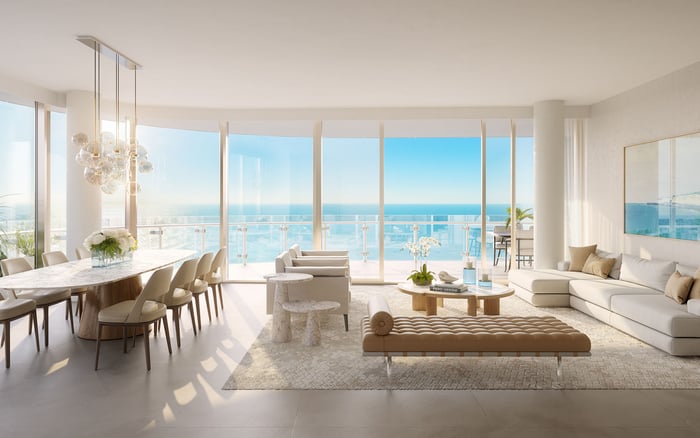
A governance-focused look at The Ritz-Carlton Residences® Pompano Beach, where brand standards, association oversight, maintenance discipline, and service expectations matter as much as visible luxury.

For a certain South Florida buyer, the luxury condominium conversation has changed. Views, finishes, privacy, and amenity programming still matter, but they no longer sit alone at the center of the decision. The more sophisticated question is whether the building can be stewarded with discipline over decades.
That is why The Ritz-Carlton Residences® Pompano Beach belongs on the shortlist for buyers prioritizing strong building governance. Its appeal is not simply that it carries a globally recognized hospitality name. It is that the branded-residence framework gives buyers a more structured lens for evaluating service expectations, maintenance culture, professional oversight, and the condominium association environment.
This is especially relevant in Pompano Beach, where a new generation of coastal development is asking buyers to think beyond immediate lifestyle. Across South Florida, structural safety, reserve planning, long-term maintenance, and owner accountability have become core elements of due diligence. For UHNW purchasers, family offices, and second-home buyers, governance is no longer a back-office detail. It is part of asset preservation.
Visible luxury is easy to tour. It is the waterfront exposure, the lobby arrival, the material palette, the terrace, the spa, the pool deck, and the service choreography. Invisible luxury is harder to assess, but often more consequential. It includes reserves, inspections, management agreements, vendor discipline, budget planning, board transparency, insurance strategy, and how decisions are made when the building requires capital.
The Ritz-Carlton Residences® Pompano Beach is compelling because it invites both conversations. Buyers can evaluate the real estate itself while also examining how the Ritz-Carlton service identity may create more codified expectations around operations. The point is not to assume that a brand name answers every governance question. It does not. The point is that a branded environment can give buyers a clearer framework for asking those questions early, before lifestyle appeal overwhelms fiduciary judgment.
That distinction is central to today’s buyer’s guides for luxury condominiums. A beautiful building with informal operations may feel effortless in year one and expose owners to uncertainty later. A more institutionalized operating environment may be less glamorous to discuss at a cocktail table, but it can matter profoundly when maintenance cycles, budgets, staffing, and board decisions shape the long-term ownership experience.
Branded residences often attract buyers who value predictability. In the case of The Ritz-Carlton Residences® Pompano Beach Pompano Beach, the Ritz-Carlton association gives the property a recognizable service framework, which can reduce reliance on purely ad hoc building culture. That is meaningful for owners who want a building to function with consistency, not improvisation.
Still, disciplined buyers should separate brand promise from documentary proof. The governance review should include how fees are calculated, how reserves are funded, how maintenance is planned, how management responsibilities are allocated, and how owner decision-making is structured. A luxury buyer should ask for clarity around operations with the same seriousness used to review floor plans and views.
In that sense, the project works as a case study for a broader shift in South Florida. Buyers comparing Pompano Beach options such as Armani Casa Residences Pompano Beach, W Pompano Beach Hotel & Residences, and Waldorf Astoria Residences Pompano Beach are not merely choosing a design language or hospitality mood. They are comparing operating models, expectations, and the degree to which ownership may feel professionally managed rather than casually administered.
For new-construction buyers, the first step is not to look for a slogan about safety or service. It is to understand the mechanics. How will routine maintenance be scheduled? What is the reserve philosophy? Which responsibilities sit with the association, which sit with management, and which depend on owner votes? How transparent will budgeting be? What level of professional oversight is embedded in the operating structure?
Pompano Beach is shortlist-worthy because it frames these questions in a setting where service expectations and condominium oversight are both part of the value proposition. That combination can be attractive to buyers who already analyze real estate through a risk-management lens. For a family office, the issue is not only whether the residence is desirable. It is whether the building’s systems appear capable of supporting value over time.
Cost predictability is part of this conversation. So is maintenance discipline. So is asset preservation. A well-governed building cannot eliminate every future expense, but it can make the path of ownership more legible. For buyers deploying significant capital into coastal condominiums, legibility has become a luxury feature in its own right.
Pompano Beach has become a more serious destination for premium condominium buyers who want coastal access without defaulting to the most saturated legacy luxury corridors. That makes governance even more important. In an emerging or rising luxury pocket, the most enduring buildings are likely to be those that pair design and amenities with operating credibility.
The Ritz-Carlton Residences® Pompano Beach sits within that context as a governance-forward option rather than merely another branded address. Its strongest argument is that ownership should feel organized, professional, and accountable. For buyers who have lived through unpredictable condominium cultures elsewhere, that may be as important as the view.
Comparisons across South Florida can sharpen the analysis. A buyer might study how a Ritz-Carlton-branded project in Pompano Beach differs from The Ritz-Carlton Residences® Sunny Isles, not to declare one better, but to understand how branded service expectations, association structures, market positioning, and owner priorities vary by building and location.
The case for The Ritz-Carlton Residences® Pompano Beach is not that governance questions disappear. It is that the project gives governance-minded buyers a strong reason to engage those questions in a more structured environment. Brand standards, professional management expectations, and the condominium association framework together create a clearer ownership context than many buyers may find in smaller, locally managed buildings.
That matters because the definition of luxury condominium value is broadening. The next cycle of prestige will not be measured only by amenities, architecture, or name recognition. It will also be measured by whether a building can maintain itself, budget responsibly, communicate clearly, and protect owner confidence over time.
For buyers who prioritize stewardship, The Ritz-Carlton Residences® Pompano Beach deserves a place near the top of the due diligence file. Not as a substitute for reviewing the documents, but as a property where the governance conversation is central to the luxury proposition.
Why does building governance matter for luxury condo buyers? Governance affects maintenance discipline, cost predictability, reserve planning, and long-term asset preservation.
What makes The Ritz-Carlton Residences® Pompano Beach relevant to this topic? It combines a Ritz-Carlton-branded service identity with a condominium ownership framework, giving buyers a structured environment to evaluate.
Does a branded residence guarantee better governance? No. A brand can create service expectations, but buyers should still review budgets, reserves, management responsibilities, and association documents.
What is invisible luxury in a condominium? Invisible luxury includes reserves, inspections, maintenance planning, professional management, board accountability, and transparent operating systems.
How should buyers evaluate monthly fees? Buyers should ask how fees are calculated, what they support, and whether the budget reflects realistic maintenance and service expectations.
Why is Pompano Beach drawing governance-minded attention? Pompano Beach is seeing more premium residential options, making operating quality an important differentiator for long-term owners.
Is this mainly for primary residents or second-home owners? It is relevant to both, but second-home buyers may place particular value on professional oversight when they are not in residence full-time.
What should family offices focus on first? They should focus on risk, transparency, reserve philosophy, management structure, and the durability of the building’s operating model.
Should buyers compare other Pompano Beach branded projects? Yes. Comparing projects helps clarify differences in service identity, ownership structure, and the practical expectations of daily building operations.
What is the best way to shortlist comparable options for touring? Start with location fit, delivery status, and daily lifestyle priorities, then compare stacks and elevations to validate views and privacy.
For a discreet conversation and a curated building-by-building shortlist, connect with MILLION.
If branded residences are on your mind — as a home or as an allocation — we would be glad to share what we are seeing, privately.
Begin a quiet conversation