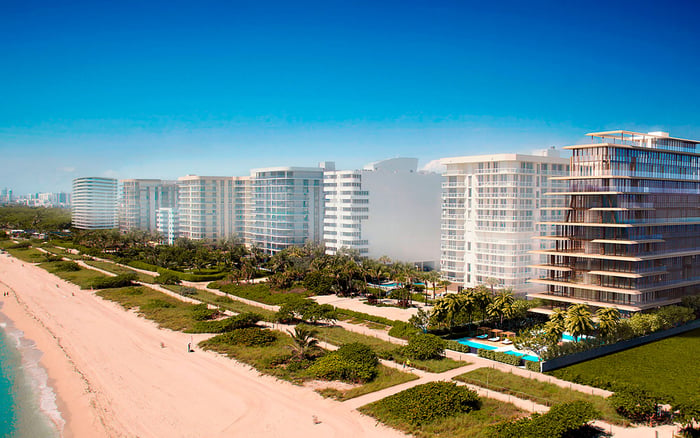
For New York buyers, Surfside presents a compelling ownership proposition built around discretion, attentive residential service, oceanfront living, and homes that can be managed with minimal friction.

For a New York buyer, the most persuasive South Florida address is not always the one making the most noise. Surfside speaks to a more measured sensibility: a home near the ocean, a residential atmosphere, and an ownership experience that feels composed rather than performative. The appeal is less about escaping urban sophistication than translating it into a setting with more light, space, and privacy.
That distinction matters. Buyers accustomed to full-service Manhattan buildings often arrive with exacting expectations. They understand that luxury is not simply a beautiful lobby or a recognizable name. It is the quiet competence behind the residence: how access is managed, requests are handled, the home is prepared before arrival, and the property can be left with confidence after departure.
Surfside therefore resonates as a place where lifestyle and operations can be considered together. The emotional purchase is oceanfront living. The practical purchase is a residence that asks less of its owner.
In New York, experienced condominium and cooperative owners tend to recognize the value of staff, protocols, and accountability. In South Florida, that same instinct should guide the search. Buyers should look beyond the promise of service and examine how the building supports daily life in practice.
The relevant questions are operational. Who receives deliveries? How are guests and vendors admitted? Can the residence be inspected while the owner is away? What support is available before an arrival? Which services are included, and which are arranged separately? A polished experience depends on clear answers, not assumptions.
Projects such as The Surf Club Four Seasons Surfside naturally enter the conversation for purchasers drawn to a hospitality-associated residential identity. Fendi Château Residences Surfside offers another point of comparison for buyers considering branded residences. A brand may set an expectation, but purchasers should still examine the governing documents, service structure, staffing model, fees, and owner responsibilities.
The goal is not service for its own sake. It is continuity. A residence should feel ready when the owner arrives and secure when the owner leaves.
Privacy is often treated as an architectural feature, yet it is equally an operational one. A private-feeling home depends on circulation, access control, guest procedures, staff discretion, and the rhythm of shared spaces. The right floor plan can be undermined by a building whose common areas feel exposed or overly active.
This is where boutique scale can become attractive. Fewer residences may suggest a more intimate atmosphere, although buyers must verify how that translates into staffing, reserves, service coverage, and shared costs. Arte Surfside can be considered within this boutique-minded search, while Ocean House Surfside provides another Surfside reference point for buyers comparing residential character.
A private showing should test the entire arrival sequence. Notice the approach, entry, elevator journey, corridor, and transition into the residence. Ask how employees, contractors, household staff, and guests move through the property. Discretion is experienced in these small moments.
No-frictions ownership does not mean having no responsibilities. It means those responsibilities have been anticipated, assigned, and made manageable. For the second-home purchaser, that usually begins with a realistic plan for periods when the residence is unoccupied.
Buyers should identify who will monitor the interior, coordinate maintenance, manage deliveries, and prepare the home after an extended absence. They should also understand insurance obligations, association requirements, renovation procedures, and any rules affecting household staff or vendors. Legal, tax, insurance, and property-management advisers should review the ownership plan before closing.
A newer offering such as The Delmore Surfside may be evaluated through the same disciplined lens as an established residence: What is promised, what is documented, what is included, and what remains the owner’s responsibility? Newness can be appealing, but clarity is the more durable luxury.
Technology should also be assessed as infrastructure rather than theater. Remote access, environmental monitoring, communications, and building systems are valuable only when reliable, secure, and supported by a defined response process.
The strongest Surfside purchase aligns three priorities. First is personal fit: the residence should support how the owner actually travels, entertains, works, and spends time in South Florida. Second is operational fit: the building’s service model should match the owner’s desired level of involvement. Third is financial fit: recurring costs and future obligations should be understood in relation to the service, privacy, and physical quality received.
This framework helps distinguish surface luxury from lasting ease. A buyer who values quiet mornings, discreet arrivals, and a professionally maintained home may prefer restraint to a long amenity menu. Another may prioritize hospitality-style attention. Neither choice is inherently superior. The best choice is the one whose daily operations remain aligned with the owner’s expectations after the initial excitement has passed.
Before committing, review the condominium documents, budgets, reserves, insurance framework, pending work, service agreements, and use restrictions with qualified advisers. Clarify what the association maintains and what remains the owner’s responsibility. If the residence will sit vacant, establish a written care plan before taking possession.
Buyers should also compare completed and future residences carefully. A completed home can be evaluated in its existing context. A future residence requires close attention to contracts, disclosures, specifications, timelines, and the precise scope of promised services. In both cases, the objective is the same: fewer surprises and a home that performs as elegantly as it presents.
Why does Surfside appeal to New York luxury buyers? It can suit buyers seeking a discreet residential setting and an ownership experience centered on service, privacy, and ease.
What does no-frictions ownership mean? It means establishing clear systems for access, maintenance, home preparation, vendor coordination, and periods of absence.
Is a branded residence automatically full service? No. Buyers should verify the documented service model, inclusions, fees, staffing, and owner obligations.
Does a smaller building always provide more privacy? Not necessarily. Privacy depends on design, circulation, access procedures, staffing, and resident behavior.
What should buyers inspect during a private showing? Evaluate the complete arrival sequence, shared spaces, elevator access, residence layout, and operational details.
How should an absentee owner prepare the residence? Assign responsibility for inspections, maintenance, deliveries, environmental monitoring, and pre-arrival setup.
Are amenities the best measure of value? Amenities matter, but their quality, accessibility, operating cost, and relevance to the owner matter more.
What documents deserve close review? Qualified advisers should examine governing documents, budgets, insurance, reserves, contracts, restrictions, and disclosures.
Should buyers compare completed and future residences differently? Yes. Existing conditions can be inspected directly, while future residences require careful review of contracts and specifications.
What defines the right Surfside residence? It is the home whose privacy, service structure, recurring obligations, and physical character align with the buyer’s priorities.
For a confidential assessment and a building-by-building shortlist, connect with MILLION.
If branded residences are on your mind — as a home or as an allocation — we would be glad to share what we are seeing, privately.
Begin a quiet conversation