For privacy-minded second-home buyers, boat-show week can serve as a practical lens for evaluating arrival patterns, household operations, waterfront access, and the distinction between proximity and exposure.

For an ultra-premium buyer, the Palm Beach International Boat Show matters less as a single engagement than as a practical decision-making lens. It raises a useful question: how should a South Florida residence perform when the owner’s calendar, guests, vehicles, household staff, and time on the water all converge?
That question is especially relevant to seasonal ownership. A selectively occupied home must be ready before arrival, composed throughout the stay, and securely managed after departure. The ideal property is not simply beautiful when empty. It supports a precise lifestyle without making ownership feel operationally burdensome.
Boat-show week can therefore serve as a field test. Buyers can observe whether a preferred location feels comfortably connected or overly exposed, whether daily movements remain intuitive, and whether the journey home preserves the sense of retreat expected in Palm Beach. The objective is not maximum proximity, but controlled access with minimal friction.
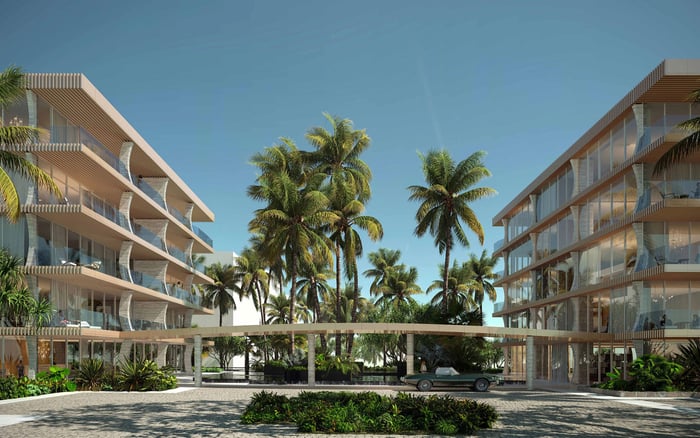
Residential privacy is often discussed as though it begins at the front door. In practice, it starts with the arrival sequence. Buyers should examine how vehicles approach, where guests wait, how deliveries are handled, and whether service movements intersect with resident circulation. Elevators, corridors, parking transitions, and lobby sightlines all warrant attention.
The same scrutiny applies to a waterfront home. A water view may be central to the experience, but privacy must also be considered from the water-facing side. Terraces, glazing, neighboring outlooks, lighting, and the relationship between indoor and outdoor rooms all shape how protected a residence feels.
Here, a comparison between residential formats becomes valuable. Palm Beach Residences can inform a Palm Beach search, while Mandarin Oriental Residences, West Palm Beach can be considered within a West Palm Beach comparison. The purpose is not to assume equivalence, but to examine how each option addresses the buyer’s preferred balance of visibility, service, and separation.
A second home should be evaluated as both a residence and a managed environment. Before purchasing, buyers can establish who will prepare the property, receive vendors, supervise maintenance, manage vehicles, and respond while the owner is away. The fewer unresolved handoffs, the more effortless each arrival can feel.
Seasonal use also heightens the importance of storage. Wardrobes, sporting equipment, water-related gear, owner closets, luggage, and provisions all require dedicated space without compromising the principal rooms. Buyers who expect frequent guests should also consider whether visitors can arrive and depart without disrupting private household routines.
Residences such as Forté on Flagler West Palm Beach and The Ritz-Carlton Residences® West Palm Beach may be included in a broader review of ownership formats. Each should be assessed through documents, physical inspection, and direct questions about access protocols, staffing boundaries, storage, guest procedures, and absence management.
The discipline is straightforward: translate an aspirational calendar into a written operating brief. A residence aligned with that brief is more likely to remain elegant in use, not merely in presentation.
For boating-oriented owners, the relevant measure is not the straight-line distance between home and water. It is the complete sequence from the private rooms to the day’s departure point. Parking access, vehicle staging, guest coordination, equipment movement, and the return home all influence the quality of that journey.
Buyers should also distinguish between occasional boating and a boating-led routine. The former may favor residential seclusion with flexible access. The latter may place greater weight on repeated transitions and the ability to move people and gear discreetly. Neither preference is inherently superior. The right answer depends on how often the route will be used and who will manage it.
To broaden the geographic comparison, The Ritz-Carlton Residences® Palm Beach Gardens can be reviewed alongside choices farther south. This comparison can clarify whether the buyer places greater value on proximity to a particular social pattern or on a quieter sense of separation.
Begin with three scenarios: the owner arriving alone, the household receiving guests, and the residence being managed during an extended absence. Walk through each sequence physically rather than relying solely on plans or renderings. Note every shared threshold and each point where identity, timing, or movement could become visible.
Next, review governing documents and operating policies with qualified advisers. Ask precise questions about guest authorization, vendor access, security procedures, deliveries, service hours, parking, cameras, staffing, renovation rules, leasing, and emergency entry. Privacy depends as much on governance and consistent execution as on architecture.
Finally, separate essential requirements from attractive extras. If discreet arrival, protected outdoor space, managed absence, or efficient boating access is fundamental, treat it as a purchase criterion. The boat show’s greatest value to a buyer may be this clarity: it turns an imagined seasonal routine into a real-world sequence that can be observed, tested, and refined.
Why does the Palm Beach International Boat Show matter to a homebuyer? It provides a useful setting for testing access, privacy, guest movement, and household logistics during an active period.
Should buyers prioritize the closest possible residence? Not automatically. A slightly longer journey may be worthwhile if it delivers a more discreet, composed residential experience.
What is the first privacy feature to inspect? Begin with the full arrival sequence, including the vehicle approach, parking, lobby circulation, elevators, and the private threshold.
How should a seasonal buyer assess household management? Identify who prepares the home, controls vendor entry, supervises maintenance, and responds during the owner’s absence.
Does a water view guarantee privacy? No. Buyers should examine sightlines, neighboring exposures, terrace relationships, glazing, and nighttime visibility.
What should boating-oriented buyers test in person? They should trace the complete route between the residence and departure point, accounting for guests, equipment, vehicles, and the return home.
Are building services always beneficial to privacy? Services can support discretion, but buyers should verify staffing boundaries, access controls, operating policies, and consistency.
How can buyers compare Palm Beach with nearby markets? Apply the same scenarios and criteria in every location, then compare travel friction, exposure, governance, and absence management.
What documents deserve close review? Review governing documents, access policies, parking rules, leasing provisions, service procedures, and renovation restrictions with qualified advisers.
What is the central purchase question? Ask whether the residence protects the owner’s time, identity, and preferred routine throughout arrival, occupancy, entertaining, and departure.
To compare the best-fit options with clarity, connect with MILLION.
If branded residences are on your mind — as a home or as an allocation — we would be glad to share what we are seeing, privately.
Begin a quiet conversation