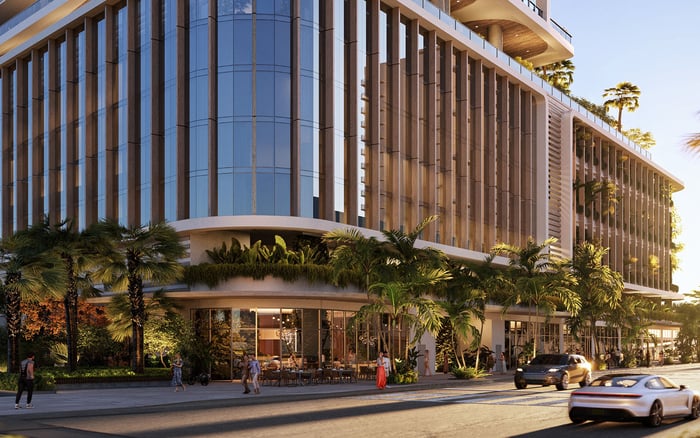
Midtown Miami offers Latin American buyers a polished, practical base for South Florida living, balancing city access, walkability, design culture and condominium optionality without the formality of a traditional resort address.

For many Latin American buyers, South Florida is not simply a vacation choice. It is a base for family movement, business continuity, education planning, cultural life and long weekends that may begin with little notice. Midtown Miami can serve that buyer with a specific kind of refinement: urban, connected and less performative than more resort-driven enclaves.
The appeal is not anchored by a single landmark or one branded address. It comes from the way Midtown positions a resident within the broader Miami circuit. Brickell, Wynwood, the Design District, Downtown, Edgewater, Miami Beach and Miami International Airport all shape the practical geography of the decision. A buyer who wants to arrive, settle in quickly, take meetings, dine well, visit galleries, see family and return to the airport without reorganizing the entire day may find Midtown a disciplined alternative to both beachfront seclusion and financial-district intensity.
That is especially relevant for families who already understand Miami. The more experienced buyer is often not chasing novelty. They are looking for a residence that makes recurring use easy. Midtown’s value, in this sense, is not theatrical luxury. It is the understated luxury of reducing friction.
Latin American buyers often approach Miami with a layered agenda. A residence may be a second home, a seasonal refuge, a family gathering point, a base for medical appointments, a place for adult children or a strategic hold in a familiar U.S. market. Midtown can speak to each of those uses because it is not locked into one identity.
Compared with a pure beach address, Midtown can feel more operational. Compared with Brickell, it can feel less corporate. Compared with a single-family neighborhood, it can feel easier to secure, leave and return to. That balance matters to buyers who divide time between countries and need their Miami residence to work when they are present, and remain manageable when they are away.
The district also benefits from adjacency. Wynwood brings art, restaurants and creative energy into the lifestyle equation. The Design District adds luxury retail and design culture. Brickell remains the business reference point for many international families. Downtown provides another urban layer, while Edgewater offers nearby waterfront condominium comparisons. Rather than forcing a buyer to choose one Miami mood, Midtown keeps several within reach.
For a buyer studying the surrounding condominium landscape, projects such as Miami Design Residences Midtown Miami can be considered within a wider conversation about how design, daily convenience and urban positioning come together. The point is not merely to buy in a named neighborhood. It is to select a residence that supports how the family actually uses Miami.
In South Florida, luxury is often equated with oceanfront living. That instinct is understandable, but it is not universal. For some Latin American buyers, the beach is a weekend preference rather than a daily requirement. The primary need may be a polished, secure, lock-and-leave residence in a location that makes the city feel available.
Midtown answers that desire by offering an urban base rather than a ceremonial retreat. The buyer can evaluate privacy, access, parking, service standards, floor-plan efficiency, terrace usability and building atmosphere with the same rigor they would apply in Miami Beach or Sunny Isles. Refinement is not reduced because the address is inland. It simply shifts from sand and horizon to rhythm and access.
This is where comparisons become useful. A family may study Midtown alongside Baccarat Residences Brickell for a more financial-district lens, or Casa Bella by B&B Italia Downtown Miami for a Downtown perspective. These are not interchangeable choices. They represent different versions of urban luxury, and the right answer depends on how often the owner will be in residence, who will use the home and how much daily movement matters.
For some, the most elegant decision is not the most obvious one. It is the address that makes Miami feel effortless.
The Midtown buyer from Latin America is often highly mobile. They may travel between Miami, Mexico City, Bogotá, São Paulo, Lima, Buenos Aires, Santiago, Panama City or the Caribbean. They may have relatives spread across South Florida and business interests that require periodic visits. In that context, a residence must function as a dependable platform, not only as a showpiece.
This buyer is also increasingly design-aware. They may appreciate architecture, interiors, hospitality cues and the quality of common areas, but still prefer restraint. They do not necessarily want a building that announces wealth at every threshold. They may want service, security and ease, delivered in a tone that feels composed.
Midtown can be evaluated through that lens. Does the building feel calm on arrival? Are the residences planned for real use? Does the immediate environment support coffee, errands, dining and short drives without overcomplication? Does the ownership structure fit a family that may be absent for stretches of the year? These questions are more revealing than a simple price comparison.
Nearby Edgewater can also enter the decision set through residences such as Aria Reserve Miami, while broader Miami options such as Miami Tropic Residences may help frame how a buyer thinks about newer urban inventory. The important exercise is to compare not only buildings, but lives.
A Midtown purchase should begin with use case. Is the residence mainly for the principal owner, extended family, adult children or guests? Will it be occupied for weeks at a time, or used in shorter visits? Does the buyer prioritize immediate city access, privacy, parking, views, building services or future flexibility?
The next layer is building discipline. In any urban condominium purchase, the buyer should understand how the lobby operates, how private the arrival feels, how elevators are managed, how amenities are maintained and how well the residence separates entertaining from sleeping areas. These details are not secondary. They determine whether the home feels luxurious after the first impression fades.
Investment considerations should be treated with equal care. Midtown’s appeal to a Latin American buyer is not just emotional. It can be strategic, particularly for owners who want a Miami base that is easy to understand and simple to use. Still, the best purchase should be grounded in personal utility first. A residence that fits the family’s rhythm is usually more resilient than one chosen only because it appears fashionable.
Buyers should also think about language, service culture and the comfort of visiting family members. South Florida is familiar territory for many Latin American households, but every neighborhood has a different daily cadence. Midtown may be ideal for those who want the city close at hand and do not need the formality of a beachfront address.
Is Midtown Miami a good fit for Latin American buyers? It can be, especially for buyers who want an urban base with access to several Miami districts rather than a single resort-style setting.
How does Midtown compare with Brickell? Brickell often reads as more business-oriented, while Midtown may feel more lifestyle-driven and less corporate for day-to-day use.
Is Midtown better as a primary home or second home? It can support either, but many international buyers may view it as a flexible second home or recurring Miami base.
Why would a buyer choose Midtown instead of Miami Beach? Some buyers prefer city access, easier daily movement and a less beachfront-centered routine while still keeping Miami Beach within their lifestyle map.
Does Wynwood add value to the Midtown lifestyle? Wynwood adds an art, dining and creative dimension that can make Midtown feel culturally connected and less isolated.
Should Downtown be part of the comparison? Yes. Downtown offers another urban reference point and helps buyers understand how different Miami neighborhoods express vertical luxury.
How important is Edgewater when evaluating Midtown? Edgewater is useful for comparison because it gives buyers another nearby condominium context, particularly for those considering views and urban convenience.
What should buyers prioritize inside the building? Privacy, service quality, parking, elevator flow, floor-plan logic and ease of arrival should be considered alongside design.
Is Midtown mainly an investment decision? It should not be viewed only through that lens. The strongest choice is usually the residence that combines personal utility with long-term flexibility.
Can Midtown feel refined without being oceanfront? Yes. Refinement can come from convenience, design restraint, privacy and the ability to move through Miami with ease.
When you're ready to tour or underwrite the options, connect with MILLION.
If branded residences are on your mind — as a home or as an allocation — we would be glad to share what we are seeing, privately.
Begin a quiet conversation