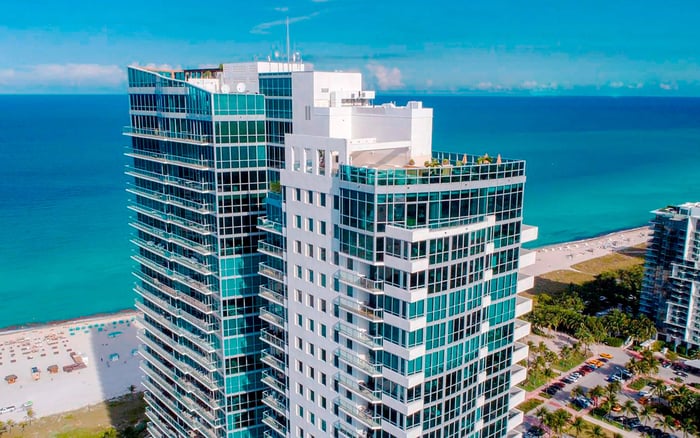
In Miami Beach, resilience belongs in property due diligence. Buyers should look beyond the presence of a generator or an appealing price and examine elevation, flood protection, system placement, backup-power scope, and practical post-storm access.

In Miami Beach, an asking price should be considered alongside the property's physical protections, operating dependencies, and potential adaptation needs. A polished residence may still warrant closer review of entrances, garages, drainage, electrical equipment, air-conditioning systems, and backup power.
The central question is not whether a property has a single resilience feature. Buyers should examine how the residence is intended to limit water entry, protect essential equipment, maintain selected services, and support a practical return after a storm.
This framework can be applied to condominiums and single-family homes, whether newly built or offered for resale. It is a due-diligence exercise rather than a substitute for property-specific advice from qualified professionals.
Request available documentation showing the elevation of occupied areas, garages, entrances, equipment spaces, and the surrounding site. Review those materials with the property's configuration in mind rather than relying on age, building height, or architectural appearance as a proxy.
The useful comparison is property-specific. A buyer should identify which spaces and systems sit lower than others, where water could enter, and whether planned or completed work addresses those points.
A barrier should be evaluated together with the openings it is intended to protect, its component storage, its deployment process, and the people responsible for installation. The review should cover garage entrances, pedestrian doors, service areas, and other openings identified during the property inspection.
Ask for available specifications, instructions, maintenance records, and deployment procedures. A buyer should also determine whether installation depends on the owner being present and whether any unprotected opening could undermine the broader plan.
For a residence near The Perigon Miami Beach, the relevant inquiry is not merely whether barriers are mentioned. It is whether the protection strategy is documented, understandable, and practical for that particular property.
Finished-floor elevation is only one part of the review. Buyers should identify the location of air-conditioning equipment, electrical panels, controls, pumps, communications equipment, and other systems that affect day-to-day use.
For a managed property such as The Ritz-Carlton Residences® Miami Beach, distinguish between equipment serving the private residence and systems serving common areas. Request clear information about which functions depend on shared infrastructure and which can operate independently.
Equipment location should be considered together with access for inspection, maintenance, and repair. A difficult-to-reach component may create a different operational concern even when its placement appears favorable.
The existence of a generator does not, by itself, explain what will remain operational during an outage. Request documentation identifying the connected loads, transfer equipment, fuel arrangement, maintenance history, and any limits on duration or capacity.
Review the complete installation rather than focusing only on the generator unit. Associated components and their placement may be relevant to the system's reliability, serviceability, and exposure.
For a condominium, ask whether emergency power serves private residences, elevators, water systems, gates, lighting, communications, life-safety functions, air conditioning, or only selected shared loads. The answer should come from property documentation and qualified review, not sales shorthand.
Property readiness and the ability to reach or occupy a residence are not the same issue. Buyers should ask how management or ownership plans to inspect the property, communicate conditions, activate emergency systems, address damage, and determine when the residence is ready for use.
When comparing Shore Club Private Collections Miami Beach with a private home, consider who is responsible for each task. A managed building and an individually operated residence may assign those responsibilities differently.
No property feature should be treated as a promise of a particular return timeline. The diligence goal is to understand the property's procedures, dependencies, and decision-making structure.
Before allowing price to drive the decision, request available elevation records, flood-related documentation, permits, equipment schedules, barrier information, drainage materials, generator details, maintenance records, and plans for relevant improvements.
Then review the residence as an interconnected system. Identify potential water pathways, determine who can deploy protective measures, verify which services receive backup power, and establish what may remain unavailable during an outage.
Any planned purchase or renovation should be reviewed against current, property-specific requirements by the appropriate qualified professionals. The objective is to understand present protections, operational limitations, and possible future work before completing the acquisition.
Why should resilience be reviewed separately from asking price? The review can reveal operating dependencies or future work that may not be apparent from presentation or price alone.
Which elevations should a buyer examine? Review available documentation for occupied areas, entrances, garages, equipment spaces, and the surrounding site.
Is the presence of a flood barrier enough? No. Buyers should examine its intended coverage, storage, deployment process, maintenance, and responsible parties.
Which openings deserve attention during barrier diligence? Review garage entrances, pedestrian doors, service areas, and other openings identified through a property-specific inspection.
Why does mechanical and electrical placement matter? Placement can affect a system's exposure, accessibility, serviceability, and role in restoring normal use.
Does a generator confirm whole-property backup power? No. Documentation should identify the connected loads and any limits affecting coverage.
Which generator records should a buyer request? Ask for available equipment schedules, load information, transfer-equipment details, fuel documentation, permits, and maintenance records.
What should condominium buyers ask about shared systems? They should determine which essential functions rely on common infrastructure and which are included in emergency-power plans.
Can a residence promise a specific storm re-entry time? A property feature or operating plan should not be treated as a guarantee of a particular return timeline.
Who should review resilience documentation? Buyers should use qualified professionals to assess property-specific records, physical conditions, and current requirements.
To compare the best-fit options with clarity, connect with MILLION.
If branded residences are on your mind — as a home or as an allocation — we would be glad to share what we are seeing, privately.
Begin a quiet conversation