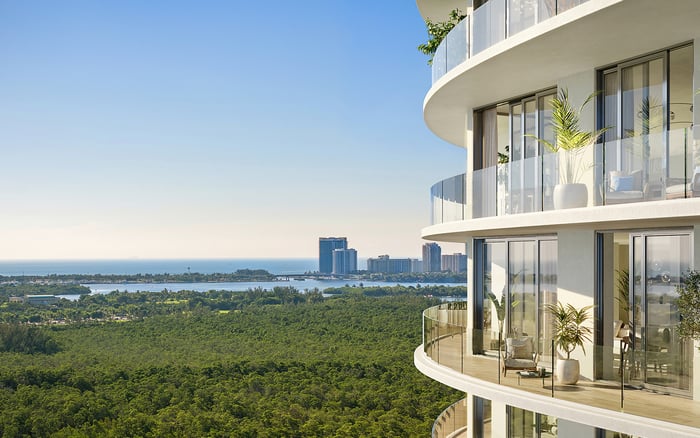
At Shoma Bay, impact glass should be verified as a complete installed system, not accepted as a broad marketing description. Buyers should secure product approvals, permit records, written warranties, responsibility provisions, and claim procedures before closing.

At Shoma Bay North Bay Village, buyers should treat the exterior envelope as a consequential part of ownership rather than a background specification.
This is where design appeal meets documentary precision. New-construction and pre-construction buyers should not accept the phrase “impact glass” as a complete answer. Balcony doors, fixed panes, operable windows, frames, glazing, hardware, anchors, and installation details collectively determine what was approved, what was installed, and what may be covered.
Final offering documents and installed-product records should take precedence over preliminary descriptions. The relevant diligence concerns the actual assembly rather than an early specification.
Impact glass is one component of a tested window or exterior-door system. A Florida Product Approval, usually identified by an FL number, or a Miami-Dade Notice of Acceptance applies to a defined assembly with specified glass, frame, dimensions, hardware, and installation conditions.
Buyers should request the exact approval identifier for every window and exterior-door style in the residence. That number should then be matched to the manufacturer, model, frame, glazing configuration, hardware, and permitted installation. A general representation that the building uses impact glass does not establish which approved system was installed.
Certification and warranty serve distinct purposes. Approval documentation identifies the tested system and its permitted configuration. Warranty language defines contractual coverage, exclusions, deadlines, remedies, and the party responsible for administering a claim. Neither can substitute for the other.
The cleanest approach is to request one coordinated window and exterior-glazing packet. It should include product schedules, shop or specification records, FL approvals or Miami-Dade NOAs, manufacturer warranties, installer workmanship coverage, permits, sign-offs, final inspection records, and the relevant declaration provisions.
Every installed assembly should be traceable across those documents. Confirm the manufacturer and model, then compare the frame, glass build-up, hardware, opening type, and approval number with the permitted configuration. If a substitution occurred during construction, request the revised approval and permit trail rather than assume equivalency.
The same standard applies when evaluating neighboring developments. Buyers considering Continuum Club & Residences North Bay Village or Tula Residences North Bay Village can use the same discipline: identify the specific installed system, connect it to approvals and permits, and establish the claim path in writing.
A manufacturer warranty generally addresses covered product issues, while an installer’s workmanship guarantee generally concerns installation-related problems. Water intrusion, failed seals, damaged hardware, frame issues, and glass breakage may be treated differently depending on the cause and contract language.
Obtain both warranties in writing. Review the effective date, coverage duration, transferability, component-specific terms, exclusions, maintenance obligations, notice deadlines, required evidence, and available remedy. Coverage may begin at installation, substantial completion, certificate issuance, or unit closing. Confirm the controlling date in writing because it directly affects the remaining claim period.
Identify the administrator for each claim as well. The developer, installer, manufacturer, or association may have distinct roles. Buyers should know where notice must be sent, whether an inspection is required, who authorizes access, and whether repair or replacement is the stated remedy. Verbal assurances do not resolve conflicting warranty terms.
Condominium responsibility cannot be inferred from the location of the glass alone. The declaration and association rules should establish whether windows and balcony doors are unit components, common elements, or association-controlled exterior features. Responsibility may also vary according to the cause and circumstances of the work.
If the association controls the exterior envelope, it may coordinate access, replacement standards, approvals, appearance, or warranty enforcement, even when an owner bears some expense. Condominium counsel should review unclear provisions before closing, particularly when responsibility for diagnosis, temporary protection, deductibles, repair, or replacement is divided among parties.
The practical question is not simply who pays. It is who has authority to act, who must receive notice, and who holds the records required to preserve a claim.
A complete closing file should preserve approvals, warranties, permits, sign-offs, final inspection records, offering and closing documents, inspection reports, dated photographs, maintenance records, and all repair correspondence. Retain the original files alongside an organized digital copy.
If staining, drafts, corrosion, seal failure, hardware difficulty, or water intrusion later appears, document the condition before any alteration. Record dates, weather context when relevant, communications, access attempts, inspections, and remedial work. Before authorizing changes that could complicate warranty eligibility, review the applicable notice and maintenance terms.
The absence of an exact approval number or written warranty for the installed Shoma Bay system should remain an unresolved diligence item. The buyer’s objective is a clear chain of evidence connecting each physical opening to its approval, permit, warranty, and responsible claim administrator.
Is “impact glass” enough to verify the windows? No. Obtain the FL approval number or Miami-Dade NOA for each installed window and exterior-door style.
What should match the approval record? The manufacturer, model, frame, glazing configuration, hardware, opening type, and permitted installation should align.
Does product approval guarantee warranty coverage? No. Approval addresses the tested system, while the written warranty defines contractual coverage and remedies.
Why are permit records important? They can connect installed products to approval documents, authorized configurations, inspections, and project sign-offs.
Are manufacturer and installer warranties the same? No. Product defects and installation workmanship may be covered by different parties under separate terms.
When does window coverage begin? It may begin at installation, substantial completion, certificate issuance, or closing. Confirm the controlling date in writing.
Who pays for a condominium window repair? Responsibility depends on the declaration, association rules, warranty terms, and the circumstances that caused the work.
What happens if the installed system was substituted? Request revised approvals, specifications, permits, sign-offs, and warranty confirmation for the actual replacement assembly.
What records should an owner preserve? Keep approvals, warranties, permits, inspections, photographs, closing documents, maintenance records, and repair correspondence.
Who should review an unresolved mismatch? Condominium counsel or a qualified building-envelope professional should review unclear responsibility, substitutions, or water-intrusion concerns.
When you're ready to tour or underwrite the options, connect with MILLION.
If branded residences are on your mind — as a home or as an allocation — we would be glad to share what we are seeing, privately.
Begin a quiet conversation