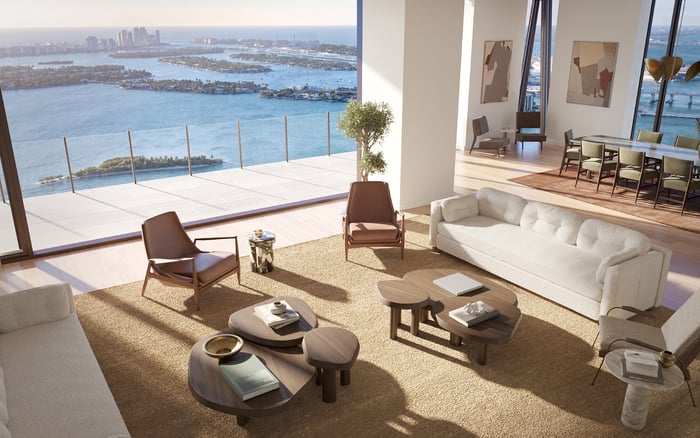
A discreet buyer’s view of Edgewater as a polished Miami base for New York and Florida living, focused on ease, privacy, design, and lock-and-leave practicality.

For buyers who divide their calendar between New York and Florida, the ideal South Florida residence is rarely about spectacle alone. It is about rhythm. The home must feel complete enough for extended stays, efficient enough for brief arrivals, and refined enough to meet the standards of a primary residence in Manhattan, Brooklyn, or the Hamptons.
Edgewater can serve that purpose because it offers a distinctly residential version of Miami urban living. It is not simply a weekend escape, and it does not need to function as a full relocation statement. For the right buyer, Edgewater becomes a composed Florida base: private, design-forward, water-oriented, and connected to the broader Miami lifestyle without requiring a resort mindset every day.
That distinction matters. Many New York buyers want the warmth, light, and outdoor ease of South Florida, but they do not necessarily want to give up an urban sensibility. They are accustomed to architecture, service, restaurants, culture, and a walkable sense of personal routine. Edgewater allows that buyer to consider Miami through a more nuanced lens, especially when the residence itself is chosen with care.
Miami offers several high-profile addresses for luxury buyers, but not every buyer wants the same expression of prestige. Some prefer the beachfront. Others want the formality of a financial district or the privacy of an island setting. Edgewater sits in a different category, one that can appeal to buyers seeking a polished home base rather than a trophy address defined by a single lifestyle cue.
The area’s appeal lies in its balance. It can feel urban without being overly corporate, residential without feeling detached, and water-oriented without requiring the daily cadence of a beach residence. For a buyer flying in from New York, that balance can be especially persuasive. The home can support a morning of remote work, an afternoon of appointments, and an evening of dining or entertaining, without forcing the household into vacation mode.
This is why projects such as Aria Reserve Miami resonate in the conversation. The appeal is not only the idea of a Miami residence, but the possibility of one that feels substantial, contemporary, and appropriate for repeated use throughout the year.
The most successful Florida base for a New York buyer is not necessarily the largest residence or the most dramatic view, though Waterview orientation can be a meaningful part of the emotional equation. The stronger question is how the home performs when the owner is away, when the owner arrives late, and when the owner stays longer than planned.
Service is central. A two-city household needs a building environment that supports arrivals, departures, deliveries, guests, maintenance, and privacy with minimal friction. The residence should feel easy to reopen after time away. Storage should be practical. Furnishings should be durable without appearing casual. Outdoor space should be usable, not simply decorative.
The same discipline applies to privacy. Many buyers splitting time between New York and Florida do not want a transient atmosphere. They want a building that feels composed, with amenities that are elegant rather than over-programmed. A refined Second-home should reduce decisions, not add them.
This is where EDITION Edgewater can enter the discussion for buyers who associate hospitality-informed living with ease, polish, and a more managed residential experience.
A South Florida base must pass the lock-and-leave test. That means the owner can depart for New York without feeling that the residence requires constant supervision. It also means the return experience should be graceful: climate, lighting, access, staff interaction, and the general feeling of the home should reinforce a sense of continuity.
For high-net-worth buyers, this is not a minor detail. The inconvenience of a poorly managed second residence can quietly erode its value, regardless of price. A refined Edgewater purchase should be evaluated as a lifestyle system. The buyer is not only acquiring rooms and views. The buyer is acquiring a more fluid way to move between markets.
Residences such as Villa Miami speak to this broader desire for a Miami address that can feel personal, design-conscious, and suitable for a sophisticated owner who may arrive for a week, a month, or a season.
New York buyers often respond to neighborhoods that feel layered rather than static. Edgewater’s value proposition is tied to that sense of evolution. It is a place for buyers who want to participate in Miami’s contemporary residential moment without necessarily choosing the most predictable luxury enclave.
That makes it particularly relevant for collectors, founders, finance professionals, designers, and families who want a South Florida presence with an urban edge. The residence can function as a quiet retreat, a social platform, or a work-from-Florida environment. The key is to choose a building and floor plan that support the owner’s actual pattern, not an imagined vacation lifestyle.
In this context, The Cove Residences Edgewater may appeal to buyers considering how architecture, water, and neighborhood energy can combine into a more personal Miami base.
A disciplined buyer should begin with use case. Will the residence be occupied for long weekends, school holidays, winter months, or flexible work periods? Will guests arrive often? Will the owner entertain, or is the apartment primarily a private retreat? Does the household require staff coordination, pet comfort, office separation, or generous outdoor living?
From there, the evaluation becomes more precise. Study the arrival sequence, elevator experience, amenity scale, parking convenience, residence orientation, ceiling heights, terrace usability, and the way public and private spaces separate. A beautiful residence that does not support daily routines will feel less luxurious over time.
For New York buyers, the best Edgewater choice should feel effortless but not generic. It should offer enough Miami character to justify the purchase, while still delivering the discretion, finish, and operational ease expected by an owner accustomed to top-tier urban living.
Is Edgewater a good fit for New York buyers seeking a Florida base? Yes. Edgewater can suit buyers who want Miami access, residential calm, and a polished lock-and-leave setting.
Is Edgewater better as a primary home or Second-home? It can work for either, but many buyers consider it especially compelling as a Second-home because it supports flexible use.
What should buyers compare before choosing Edgewater? Compare building service, privacy, residence layout, outdoor space, arrival experience, and how the home performs when unattended.
Why might a buyer choose Edgewater over Miami Beach? Edgewater may appeal to buyers who want a more urban, residential Miami rhythm rather than a beach-forward daily lifestyle.
Does Waterview matter in Edgewater? Waterview can be important, but it should be weighed alongside floor plan, privacy, light, and overall livability.
Are branded residences relevant for two-city owners? They can be, particularly when the service model supports frequent arrivals, departures, and a more managed home experience.
How should buyers think about amenities? Amenities should be elegant, useful, and easy to access, not merely extensive for presentation purposes.
Is Edgewater appropriate for remote work from Florida? It can be, especially when the residence offers separation between entertaining, sleeping, and focused work areas.
What is the main risk in choosing the wrong residence? The main risk is buying for appearance rather than routine, which can make a second residence feel demanding over time.
How can buyers approach the market discreetly? Work with an advisor who understands building culture, privacy expectations, and the practical needs of a two-city household.
For a confidential assessment and a building-by-building shortlist, connect with MILLION.
If branded residences are on your mind — as a home or as an allocation — we would be glad to share what we are seeing, privately.
Begin a quiet conversation