In Miami’s luxury condo market, the view remains powerful, but the lobby increasingly shapes first impressions, privacy, daily rhythm, and long-term confidence.
For decades, the Miami condo search has been framed around the window. Ocean, bay, skyline, sunset, sunrise, wide water, protected sightline: the vocabulary of value has often begun with what a buyer sees after crossing the threshold. Yet among sophisticated purchasers, another question is moving closer to the center of the conversation: what does the building feel like before the elevator doors open?
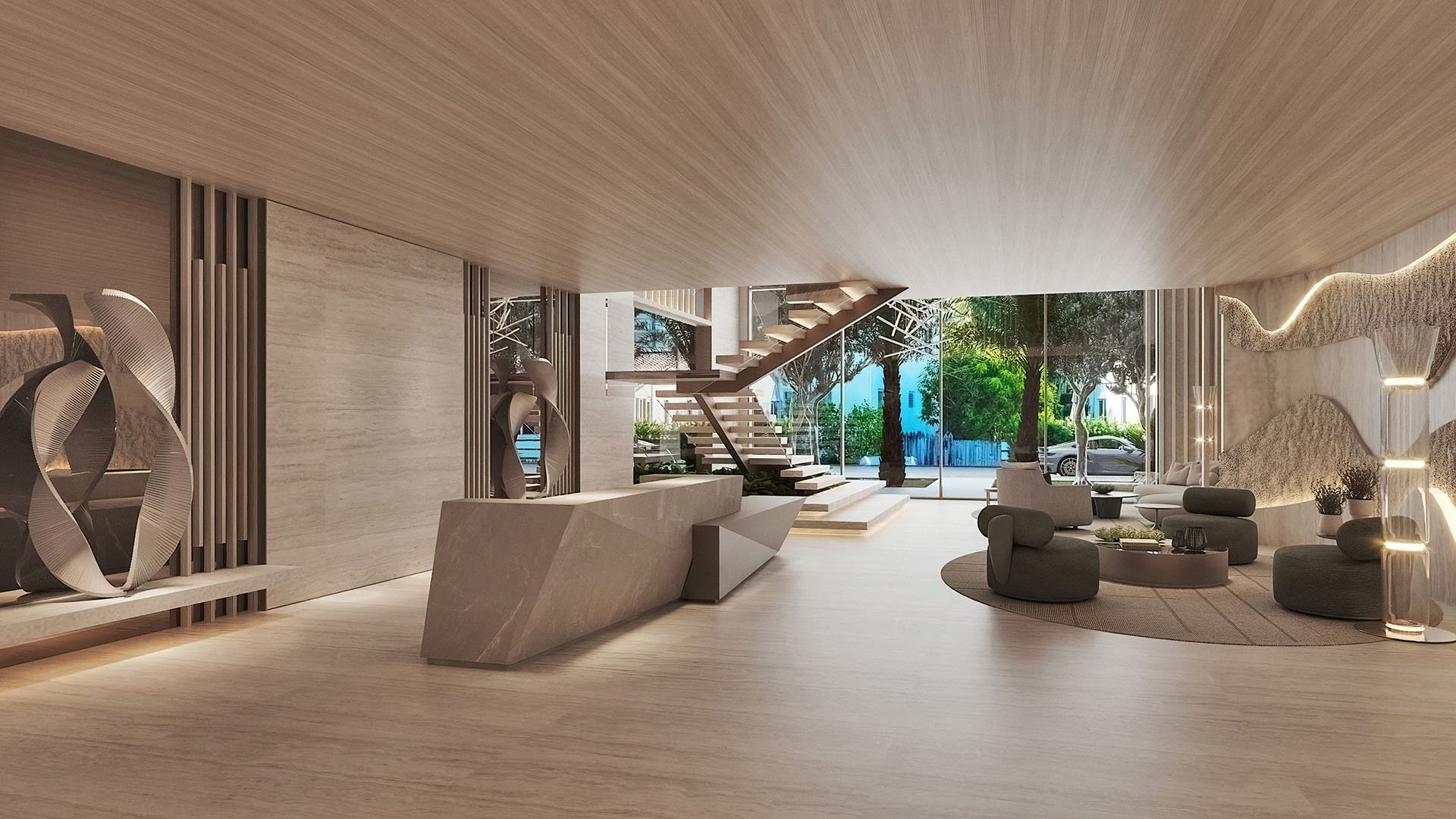
Lobby volume is not simply ceiling height. It is the architecture of arrival: the pause between porte-cochere and private residence, the sense of proportion as guests enter, the way light moves through a reception space, and the degree to which a building remains calm even when fully occupied. In a Miami condo search, that first impression may carry more emotional and practical weight than many buyers initially expect.
A view can seduce in seconds. A lobby reveals itself over time. The most discerning buyers understand that they do not live only inside the residence. They live through the building every day, with family, guests, service providers, drivers, deliveries, pets, and seasonal visitors all moving through the same threshold.
A voluminous lobby can communicate order, privacy, and confidence without announcing itself too loudly. In the ultra-premium segment, that matters. A compressed arrival may still be beautifully finished, but it can feel transactional if circulation is tight, seating is limited, or staff positions are too exposed. A larger, more gracious lobby gives residents room to arrive without friction.
The best lobbies are not merely big. They are composed. They create visual distance between entry, reception, elevators, lounge zones, and private corridors. They allow a resident to greet a guest without standing in the path of another resident’s luggage cart. They give staff a dignified command of the room while preserving discretion. They also soften the transitions of daily life, from early departures to late returns.
For buyers moving from large single-family homes, this can be especially important. The lobby becomes the estate’s front hall, scaled for a vertical residence. It helps replace the ceremony of a private driveway, gate, foyer, and gallery. In that sense, volume is not ornamental. It is spatial reassurance.
No serious buyer should dismiss the value of a compelling outlook. A residence with a strong water or skyline view can feel expansive, restorative, and distinctly Miami. For many purchasers, the view remains the emotional reason to buy. The question is not whether views matter. The question is whether a view alone can compensate for a building experience that feels under-scaled.
A spectacular living room panorama may impress at a showing, while a crowded entry sequence may become a daily irritation. Conversely, a residence with a more nuanced outlook can feel elevated if the building experience is quiet, generous, and impeccably choreographed. The strongest purchases usually reconcile both, but when compromise is required, lobby volume can be decisive for buyers focused on long-term livability.
This is particularly relevant in a refined Brickell search, where balcony, terrace, waterview, pool, and pet preferences often compete with questions about circulation, staff presence, and privacy. A buyer may begin with the view filter, then ultimately choose the building that feels more composed at ground level.
Luxury real estate is rarely evaluated by square footage alone. It is evaluated through feeling, sequence, and memory. The lobby is the first scene in that sequence. It sets the emotional temperature before a buyer steps into the elevator, and it shapes what guests believe about the residence before they see the home itself.
A high-volume lobby can slow the experience down. It gives the eye a place to travel. It allows materials, art, lighting, and landscaping to breathe. It can make a building feel less dense, even when the tower above is substantial. That perception matters because affluent buyers often prize ease as much as spectacle.
There is also a hospitality dimension. Many Miami buyers are accustomed to hotels, private clubs, airport lounges, yachts, and members-only environments where arrival is carefully managed. In that context, a condo lobby is not just a passageway. It is a service arena. A generous lobby can make greeting, waiting, transferring, and assisting feel natural rather than improvised.
The most persuasive lobbies often solve problems buyers may not name immediately. Where do guests wait without feeling watched? Can deliveries be handled without dominating the room? Is there a clear relationship between reception and elevators? Does the entry feel secure without feeling defensive? Can multiple parties arrive at once without diminishing the atmosphere?
Volume helps, but planning is equally essential. A tall lobby with awkward circulation may feel theatrical rather than useful. A more restrained lobby with excellent separation of uses may perform beautifully. The buyer’s task is to read the room beyond its finishes.
Consider the sightlines. A discreet reception desk can project attentiveness without turning the lobby into a checkpoint. Seating should feel intentional, not leftover. Elevator access should be intuitive, but not overly exposed. Lighting should flatter both architecture and people. These subtle cues reveal whether the building was conceived for daily residents or merely staged for first impressions.
High-floor residences have obvious appeal, especially when they open to dramatic vistas. Yet height is not the only measure of prestige. Some buyers would rather own a residence in a building with a stronger arrival experience than move higher in a tower where the common spaces feel generic or undersized.
This is not a rejection of the view. It is a broader definition of value. The buyer is asking: will I feel proud bringing guests here? Will the building age gracefully? Does the lobby support the price point? Does the arrival sequence match the architecture of the residence above?
For second-home owners, the issue can be even more pronounced. If the property is used seasonally, each arrival carries a heightened emotional charge. The first few minutes in the building shape the return. A gracious lobby can make the transition from travel to residence feel immediate and serene.
A buyer evaluating lobby volume should visit at different moments if possible. A quiet morning arrival tells one story. A late-afternoon lobby, with residents returning and guests appearing, tells another. The goal is not to catch a building at its busiest, but to understand whether the room maintains composure under normal use.
Look for proportion rather than spectacle. Does the ceiling height relate elegantly to the width of the room? Are furnishings scaled to the space? Do materials feel durable enough for coastal life and frequent use? Does the lobby feel naturally connected to gardens, water, art, or amenity spaces, or does it feel sealed off from the larger residential experience?
Then return to the residence and reassess the view. The best decision is rarely binary. A buyer should weigh the private outlook against the public arrival, the plan of the residence against the plan of the building, and the immediate emotional pull against the daily pattern of ownership.
For South Florida’s most discerning buyers, the question is not whether a condo has a beautiful view. Many do. The more revealing question is whether the building offers a complete luxury sequence from curb to residence. Lobby volume is one of the clearest expressions of that sequence because it cannot be hidden once a building is occupied.
A great view belongs to the residence. A great lobby belongs to the life around it. When both are strong, the result is rare. When only one can lead, buyers with long memories and exacting standards may increasingly choose the building that makes every arrival feel composed, private, and worthy of the home above.
Is lobby volume more important than a water view? Not universally. For some buyers, however, a gracious arrival experience can matter more in daily life than a marginally better outlook.
What does lobby volume mean in a condo search? It refers to the scale, height, proportion, and spatial generosity of the lobby. It also includes how well the arrival sequence functions.
Should I still prioritize a high-floor residence? High floors can be highly desirable, but they should be considered alongside building quality, privacy, layout, and common-area experience.
Can a smaller lobby still feel luxurious? Yes. A smaller lobby can feel exceptional if it is beautifully proportioned, well staffed, and thoughtfully planned.
Why do buyers notice the lobby after repeated tours? The first tour often centers on the residence. Later visits reveal how the building actually feels as a daily environment.
Does lobby design affect resale appeal? It can influence perception. Buyers often form expectations about the entire building within moments of entering the lobby.
What should I look for beyond ceiling height? Study circulation, reception placement, seating, lighting, elevator access, privacy, and how calmly the room handles movement.
Is a dramatic lobby always better? Not necessarily. Drama without function can feel staged, while quiet proportion can feel more enduring and residential.
How does this apply to pied-a-terre buyers? A strong arrival can make seasonal returns feel easier and more refined, especially after travel.
What is the best balance between view and lobby? The ideal purchase aligns a compelling private outlook with a building experience that feels discreet, calm, and well scaled.
To compare the best-fit options with clarity, connect with MILLION.
If branded residences are on your mind — as a home or as an allocation — we would be glad to share what we are seeing, privately.
Begin a quiet conversation