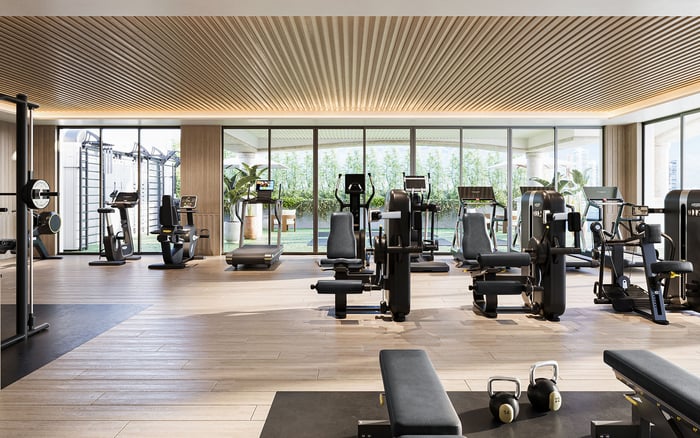
On Fisher Island, an amenity’s existence does not by itself establish access, availability, or technical performance. Buyers should separate condominium rights from club privileges, then verify wellness capacity, indoor-air systems, water treatment, and guest procedures in writing.

For buyers considering Palazzo del Sol and The Links Estates at Fisher Island, the most consequential questions may extend beyond architecture, views, and finish selections. Wellness amenities have practical value only when owners can use them at preferred times. Air and water systems matter only when their design, maintenance, and measured performance are understood. On Fisher Island, access rules warrant a distinct line of diligence.
Most island amenities and restaurants are managed by Fisher Island Club, so ownership should not be equated with automatic, unrestricted access to every facility. Club membership privileges encompass golf, racquet facilities, dining, spa and wellness services, marinas, a private beach club, the Vanderbilt Mansion pool, a children’s club, and member events. Membership is required, and 15 all-suite accommodations are reserved for members.
A luxury amenity has value only when its access, capacity, and performance are clear.
The central task is to distinguish what belongs to the condominium or residence from what depends on separate club privileges. That distinction should be documented for the owner, household members, guests, staff, and any permitted occupants.
A buyer should create two parallel inventories. The first should cover condominium-controlled or residence-specific facilities, services, systems, and booking procedures. The second should address club-controlled privileges, eligibility, reservations, charges, and guest rules. This prevents a polished presentation of the island’s broader lifestyle from being mistaken for a contractual statement about a particular home.
The distinction is especially important because island properties do not necessarily share identical club arrangements. At least one accommodation operator is unaffiliated with the club, while its guests must register as temporary club members to use many on-island amenities. That example does not define the terms for either residential project, but it demonstrates why assumptions are inappropriate.
Palazzo del Sol Fisher Island buyers should ask the seller and association to identify every included facility and corresponding governing document. The Links Estates at Fisher Island buyers can likewise use the project’s public phone and email channels to request documentation concerning amenities, club rights, indoor air, water treatment, and guest booking.
A spa, salon, wellness center, gym, pool, or private beach may be compelling, but the useful measure is whether the experience works with an owner’s schedule. Spa reservations are handled by phone through Spa Internazionale, making advance confirmation of availability and procedures prudent.
Ask how far in advance treatments can normally be reserved, how peak-season demand affects access, and whether cancellation windows or charges apply. Confirm guest eligibility, the number of people an owner may book simultaneously, and whether household members hold the same rights as the titled owner. Buyers who entertain regularly should also establish whether they can coordinate several appointments at once.
The private beach, marina access, golf, dining, and wellness facilities may each operate under different rules. Obtain the current terms rather than extrapolating from one amenity to another. When comparing the broader Fisher Island market, residences such as Palazzo della Luna or The Residences at Six Fisher Island can be assessed through the same rights-versus-capacity framework without assuming equivalent arrangements.
Club benefits do not establish building-specific HVAC filtration ratings, outdoor-air rates, humidity targets, fine-particle performance, or commissioning results for Palazzo del Sol or The Links Estates. These are residence- and building-specific questions, not conclusions that can be drawn from a general amenity description.
Request the HVAC equipment schedule, filter rating and replacement protocol, ventilation design, humidity-control strategy, maintenance history, and any recent indoor-air testing. Clarify which components are maintained by the association and which are the owner’s responsibility. If equipment has been altered within a residence, ask for permits, service documentation, and applicable operating instructions.
Testing should be current enough to inform the home’s intended use. A buyer planning year-round occupancy may approach operating schedules differently from a second-home owner whose residence may remain unoccupied for extended periods. In either case, responsibility for monitoring, filter changes, servicing, and corrective work should be explicit before closing.
Club membership materials do not establish potable-water treatment or in-residence filtration specifications for either project. Water diligence should therefore trace the complete path: municipal supply, any building-level treatment, storage, distribution, and point-of-use filtration.
Ask whether the property uses storage tanks and, if so, request the maintenance and cleaning protocol. Identify filtration equipment serving the building and individual residence, along with filter type, service intervals, replacement costs, and responsible party. Buyers may also request any available independent laboratory results and determine precisely where samples were taken.
A countertop device, refrigerator filter, or under-sink system is not necessarily evidence of whole-residence treatment. The scope must be stated clearly. Buyers planning renovations should also confirm how a proposed filtration upgrade would interact with building systems and association requirements.
Fisher Island’s gated-community character makes arrival procedures a material part of ownership. Guest access requires prearranged clearance verified through community guest-clearance personnel. Buyers who frequently host family, friends, household staff, vendors, or permitted renters should map the process before relying on it.
In at least one island accommodation context, temporary guest access requires temporary club registration and carries a daily transfer and access fee. Late arrivals may encounter limited access to restaurants, the spa, gym, golf, and tennis facilities. These terms should not be presumed to govern a private residence, but they reveal the operational questions a purchaser should ask.
Confirm clearance lead times, required guest information, transfer arrangements, fees, arrival windows, after-hours procedures, and temporary-member rules. Ask who may submit a clearance request and how quickly changes can be made. For hosted stays, determine whether an owner must be present and whether guest amenity reservations can be made before arrival.
The cleanest approach is a written matrix with separate columns for the owner, spouse or partner, other household members, guests, staff, vendors, and any permitted occupants. Rows should cover club eligibility, initiation or recurring charges, beach access, golf, marina privileges, wellness reservations, dining, transportation, guest clearance, and cancellation terms.
A second technical schedule should record HVAC specifications, filtration, ventilation, humidity control, maintenance responsibility, water treatment, storage-tank protocols, filter replacement, and available test results. Attach supporting governing documents, current rules, service records, and written confirmations rather than relying on verbal descriptions.
This is the essence of sophisticated buyer’s-guide diligence: not questioning the appeal of Fisher Island, but defining precisely how that appeal functions in daily life. For discreet guidance on evaluating Fisher Island residences, connect with MILLION.
If branded residences are on your mind — as a home or as an allocation — we would be glad to share what we are seeing, privately.
Begin a quiet conversationNo. Buyers should distinguish condominium-controlled facilities from amenities requiring separate club privileges and confirm the applicable rights in writing.
Privileges include golf, racquet facilities, dining, spa and wellness services, marinas, a private beach club, the Vanderbilt Mansion pool, a children’s club, and member events.
Review appointment lead times, peak-season demand, cancellation terms, guest eligibility, and limits on simultaneous bookings.
Request HVAC schedules, filter ratings, ventilation design, humidity-control details, maintenance history, and recent indoor-air testing.
No. General membership benefits do not establish project-specific filtration, ventilation, humidity, fine-particle, or commissioning performance.
It should trace municipal supply, building treatment, storage-tank maintenance, in-unit filtration, replacement responsibility, and available laboratory results.
Frequent hosts need to understand lead times, required information, arrival windows, transfer arrangements, fees, and after-hours procedures.
In one temporary-access context, late arrivals may have limited access to dining, spa, gym, golf, and tennis facilities, so residence-specific rules should be confirmed.
Yes. The purchase file should distinguish rights for owners, household members, guests, staff, vendors, and any permitted occupants.
Use a written matrix pairing each user category with access rights, booking rules, fees, technical specifications, and supporting documents.