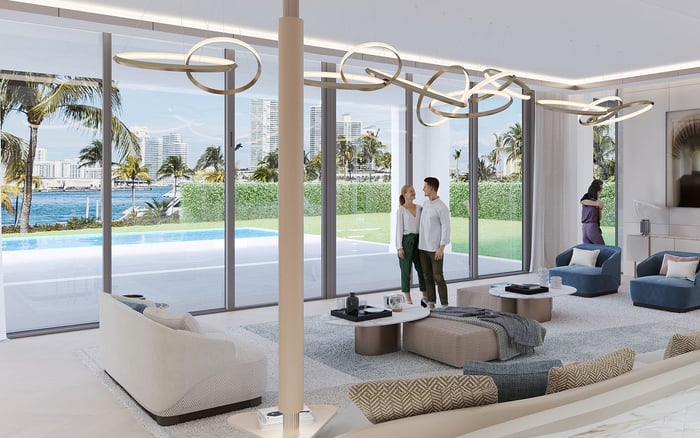
A buyer-oriented portrait of daily life near Palazzo del Sol, focused on the subtle interplay of privacy, dining, club culture, waterfront access, and residential fit.

For buyers considering Palazzo del Sol, the central question is not simply what life looks like inside a residence, but how the surrounding environment feels from morning through evening: the quiet of departure, the ease of moving between home and leisure, the cadence of dining, and the degree to which privacy remains intact throughout the day.
That texture is especially important on Fisher Island, where a luxury purchase is inseparable from lifestyle expectations. The phrase Palazzo del Sol Fisher Island may identify a residential choice, but ownership is ultimately experienced as a sequence of transitions. The most persuasive setting is one in which those transitions feel composed rather than complicated.
Prospective owners should therefore evaluate the neighborhood at different hours. Morning calm, afternoon activity, and evening arrivals can reveal more than a single scheduled viewing. Listen to the environment, observe circulation, and consider whether the pace aligns with the household’s preferred level of sociability.
Luxury dining is most valuable when it fits naturally into daily life. Buyers should look beyond celebratory evenings to repeatable rituals: a quiet breakfast, an unhurried lunch, an impromptu table with friends, or a dinner that requires no elaborate planning.
The relevant measure is not the number of options, but how comfortably they support a household’s habits. A residence may be beautifully appointed, yet daily life can still feel fragmented if every meal demands too many decisions. Conversely, a well-matched dining rhythm gives the week structure and makes entertaining feel more spontaneous.
Club culture can also shape this equation. For some owners, it offers a familiar social setting and a sense of continuity. For others, discretion and the ability to opt out matter just as much. Buyers should ask not only where they might dine, but how often, with whom, and whether the surrounding atmosphere suits family life, business entertaining, or a quieter second-home routine.
The appeal of gated-community living is often framed in terms of security and seclusion, but its social dimension deserves equal attention. A club-oriented environment can create effortless encounters, recurring routines, and a recognizable community. The right fit depends on whether that familiarity feels reassuring or overly programmed.
Privacy should be assessed in layers. Consider the journey from arrival to residence, the visibility of shared spaces, and the ease of hosting without disrupting the household. True discretion is not isolation; it is the ability to choose when to participate and when to retreat.
Buyers comparing Palazzo della Luna with Palazzo del Sol can apply this lens without reducing the decision to finishes alone. More revealing are questions of atmosphere, circulation, service expectations, and how each property supports the desired balance between connection and reserve.
Beach access is not a single amenity checkbox. Its value is determined by friction: how easily a resident can decide to go outside, how comfortable the route feels, and whether returning home is equally simple. The best test is experiential. Walk the anticipated path, consider what would be carried, and imagine the routine with children, guests, or visiting family.
Waterfront living also changes the emotional tempo of a home. Light, weather, and open views can influence when residents entertain, exercise, or pause between obligations. Yet buyers should distinguish between a compelling outlook and a practical outdoor routine. The two may overlap, but they are not identical.
A viewing should therefore address privacy, shade, wind, storage, guest movement, and the transition between outdoor activity and interior living. These details determine whether access becomes part of daily life or remains an occasional pleasure.
The presence of distinct residential options allows buyers to refine what they truly value. The Residences at Six Fisher Island can be viewed through the lens of a buyer seeking another expression of Fisher Island living, while The Links Estates at Fisher Island invites consideration of a different residential format.
The purpose of comparison is not to identify a universal winner, but to clarify trade-offs. Some households prioritize effortless lock-and-leave use. Others place greater weight on separation, entertaining, outdoor space, or the feeling of a private domain. A second-home buyer may value simplicity above all, while a full-time resident may scrutinize storage, work areas, family circulation, and the practicalities of everyday service.
Lifestyle should be tested against a realistic calendar. Imagine a quiet weekday, a full house during the holidays, an evening with guests, and a departure under time pressure. A property that performs elegantly across these scenarios is more likely to retain its appeal after the initial impression fades.
Before deciding, buyers should revisit the setting without treating every moment as a formal tour. Begin with arrival, continue through the shared spaces, and end with the routines that matter personally. If beach time, dining, wellness, or social activity is important, test each one as a sequence rather than an abstract promise.
Household differences also matter. One partner may seek community, while another values quiet. Children, staff, and guests may experience circulation differently. The strongest choice accommodates these preferences without making the residence feel operationally complex.
Near Palazzo del Sol, the enduring luxury is coherence. Architecture establishes the frame, but neighborhood texture determines how gracefully life unfolds within it.
What should buyers evaluate first near Palazzo del Sol? Start with daily transitions, including arrival, privacy, shared-space circulation, and access to preferred routines.
Why does neighborhood texture matter in a luxury purchase? It shapes the pace, discretion, and ease experienced beyond the residence each day.
How should dining influence a buying decision? Consider whether dining supports ordinary habits as comfortably as special occasions and entertaining.
What is the practical value of club culture? It can provide social continuity and convenience, provided participation aligns with the household’s preferences.
How can a buyer assess privacy? Observe arrival routes, shared spaces, guest circulation, and the ability to withdraw without feeling isolated.
What makes beach access genuinely useful? A comfortable route, minimal friction, and an easy return can turn occasional access into a regular ritual.
Should buyers visit at different times? Yes. Morning, afternoon, and evening visits can reveal meaningful shifts in pace and atmosphere.
How should second-home buyers approach the decision? They should emphasize simplicity, dependable routines, guest comfort, and ease of arrival and departure.
What should full-time residents examine more closely? Storage, work areas, family circulation, privacy, and service logistics deserve particular attention.
Is there one ideal residential format on Fisher Island? No. The strongest fit depends on household rhythms, desired privacy, entertaining style, and frequency of use.
If you'd like a private walkthrough and a curated shortlist, connect with MILLION.
If branded residences are on your mind — as a home or as an allocation — we would be glad to share what we are seeing, privately.
Begin a quiet conversation