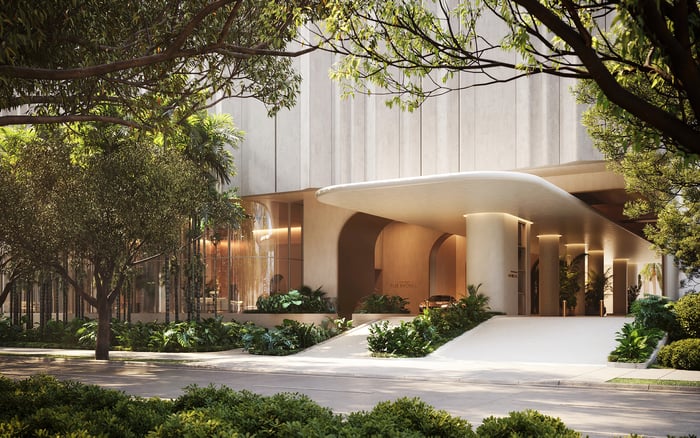
An upper-floor purchase at Viceroy Brickell calls for more than a review of finishes and floor plans. Buyers should clarify emergency communications, conditional refuge procedures, mobility assistance and the building documents that establish how those arrangements work.

An upper-floor residence should suit the way its owner lives-including circumstances that rarely appear in a sales presentation. At Viceroy Brickell, marketed at 77 SE 5th Street, Miami, FL 33131, the brochure, fact sheet, neighborhood map and floor plans offer a starting point. Emergency communications and assistance arrangements warrant a separate conversation.
Marketing descriptions include fire-sprinkler protection and advanced, prewired smart-building infrastructure. Neither description alone establishes emergency-system specifications or explains what a resident should do when ordinary elevator access is unavailable. An absence of explanation in sales materials is not evidence of missing systems, a safety deficiency or a code violation.
The buyer's task is to distinguish an amenity description from an operational procedure. That distinction matters especially for anyone who cannot descend stairs independently, may need accessible alerts or expects older relatives and children to stay in the residence.
A familiar residential brand does not answer a practical question: how does an emergency message reach someone inside a closed bedroom? Ask management to identify the in-unit audible alarms, any visual notification devices and any emergency voice-announcement system. Request an explanation of what activates each system and which instructions residents should expect to receive.
For a deaf or hard-of-hearing household member, ask specifically about visual alerts. Confirm the proposed residence's actual equipment and the process, if any, for addressing individual needs; do not assume that particular devices are installed at Viceroy Brickell.
The same documentation-first approach applies when comparing Cipriani Residences Brickell. It is a standard for evaluating a purchase, not a claim that the two properties have identical systems.
Ask how assistance requests are received, recorded, updated and communicated to emergency responders. A request for help should follow a defined process beyond a conversation with the sales team. Notifying building staff is not a substitute for calling 911 when an emergency is discovered.
Everyday elevator convenience and fire evacuation are separate subjects. Do not use ordinary elevators for fire evacuation; follow the building's procedures and emergency responders' instructions. Elevators may be recalled to the lobby by the alarm system or firefighters, and they can become trapped or affected by smoke.
For an upper-floor buyer, the question is not simply how many elevators serve the residence. Ask where the protected stairs are, where they discharge and how the building's emergency procedures address residents who cannot use them. Review the route from the apartment, not just the position of a stair symbol on a floor plan.
Do not independently decide which floors must evacuate during an incident. Obtain the building's procedures and follow emergency responders' instructions.
Stairway fire doors should remain closed when not in use, and exit routes should remain unobstructed. These operational basics belong alongside any discussion of private entries or convenient circulation.
For a resident unable to use stairs, ask whether the building's procedures contemplate remaining inside an apartment while awaiting assistance, and under what circumstances. A fire outside the apartment is not, by itself, enough to determine the appropriate response; smoke conditions and emergency responders' instructions matter.
Do not assume that an apartment is a formally designated refuge space or that Viceroy Brickell has designated, marked refuge spaces in stairwells or common areas. Ask whether such spaces exist, where they are and how they fit into the building's approved procedures.
If instructed to remain in an apartment while awaiting assistance, keep doors and windows closed, call 911, report the exact location and request assistance when needed. Follow emergency responders' instructions, including if conditions change. The planning conversation should also establish how management will communicate that location to responders.
Buyers considering The Residences at 1428 Brickell can ask the same questions without assuming the answers transfer between towers. Refuge arrangements must be understood building by building.
Emergency planning should accommodate children, older adults and people with disabilities living above ground level. It should also account for temporary limitations. A resident recovering from surgery may need a different arrangement from the one contemplated at purchase.
Notify management or security about special needs, including temporary disabilities, so planning can account for them. Before committing to an upper-floor residence, ask who maintains that information, how residents update it and what assistance protocol follows. Clarify how the arrangements apply to visiting family members as well as owners.
Request a walkthrough of the relevant routes and procedures with management. Discuss what happens if a household member cannot descend stairs, how their location is communicated and which instructions govern waiting for assistance. Do not assume that a concierge service description includes a defined emergency-assistance role.
These questions are equally relevant when evaluating St. Regis® Residences Brickell. The comparison should focus on documented arrangements, not assumptions drawn from branding.
Ask for approved life-safety plans, the alarm sequence of operations, evacuation procedures, occupancy documentation and relevant inspection records. Request details of emergency-power coverage and duration, including which systems are supported. A general reference to backup power does not answer those questions.
Review the materials with an appropriately qualified adviser when technical interpretation is needed. Seek written clarification when an answer affects the household's ability to receive alerts, reach an exit or request assistance. The goal is an understandable plan, not merely a collection of documents.
Ask where evacuation routes and emergency telephone numbers are posted. Review the residence's escape plan with management in light of the actual layout; do not treat windows or balconies as usable escape routes without appropriate confirmation.
Fire procedures should not automatically be extended to hurricanes, flooding or medical emergencies. Request separate policies, including elevator use and assistance arrangements for each circumstance. Knowing one protocol does not establish the others.
Before occupancy, ensure the household understands the applicable procedures and how to communicate its exact location. For an upper-floor buyer, reassurance comes from a documented arrangement that fits the people who will live there-not a broad promise of sophisticated technology.
For a considered approach to Brickell ownership and residential due diligence, explore MILLION.
If branded residences are on your mind — as a home or as an allocation — we would be glad to share what we are seeing, privately.
Begin a quiet conversationViceroy Brickell Residences is marketed at 77 SE 5th Street, Miami, FL 33131.
No. Smart-building and sprinkler descriptions do not, by themselves, establish the building's emergency communications, evacuation procedures or assistance arrangements.
No. An omitted explanation does not establish that a system is absent or that the building has a safety deficiency or code violation.
Ask about in-unit audible and visual alarms, emergency voice announcements and how assistance requests reach responders. Confirm the equipment serving the actual residence.
Do not use ordinary elevators for fire evacuation; follow the building's procedures and emergency responders' instructions. Elevators may be recalled to the lobby or affected by smoke.
No; a fire outside the apartment alone does not establish that remaining inside is appropriate. Clarify the building's procedures for residents unable to use stairs and follow emergency responders' instructions.
No. Ask whether the building has formally designated refuge spaces, where they are and how they fit into its approved procedures.
Keep doors and windows closed, call 911, provide the exact location and request assistance when needed. Follow emergency responders' instructions, including if conditions change.
Yes. Notify management or security about temporary as well as permanent needs so emergency planning can account for them.
Request approved life-safety plans, the alarm sequence of operations, evacuation procedures, occupancy documentation and inspection records. Also clarify emergency-power coverage and duration, and obtain separate policies for non-fire emergencies.