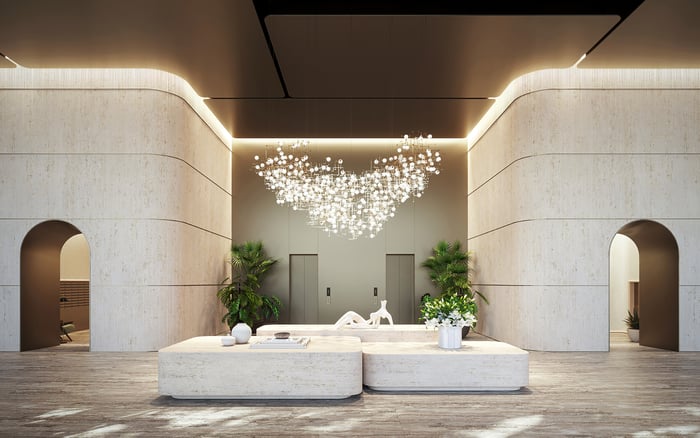
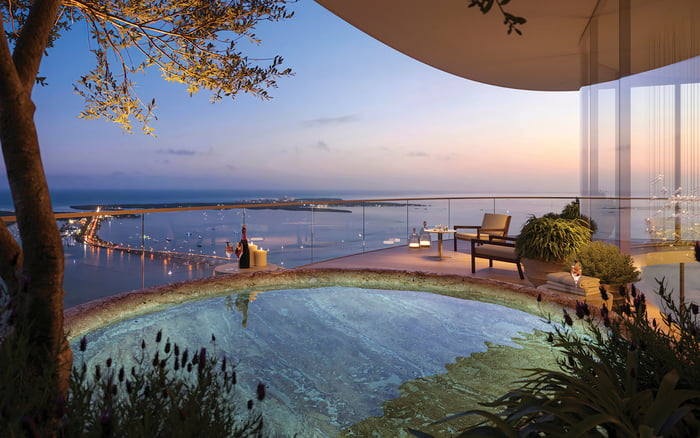
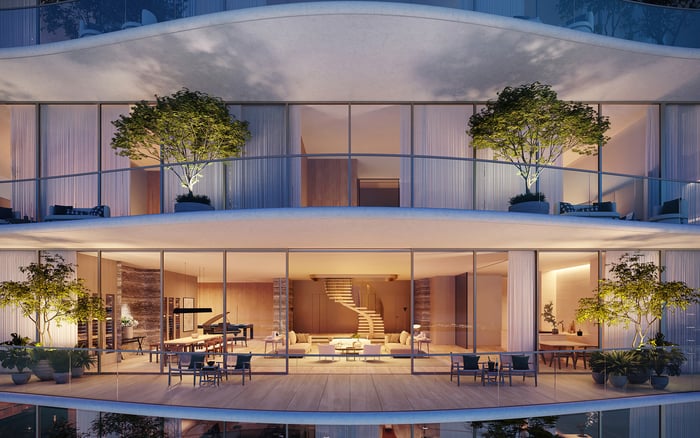
At 1428 Brickell, the journey from street to residence is part of the ownership experience. Controlled circulation can shape privacy, security, discretion, and the daily pleasure of living above a dense urban district.
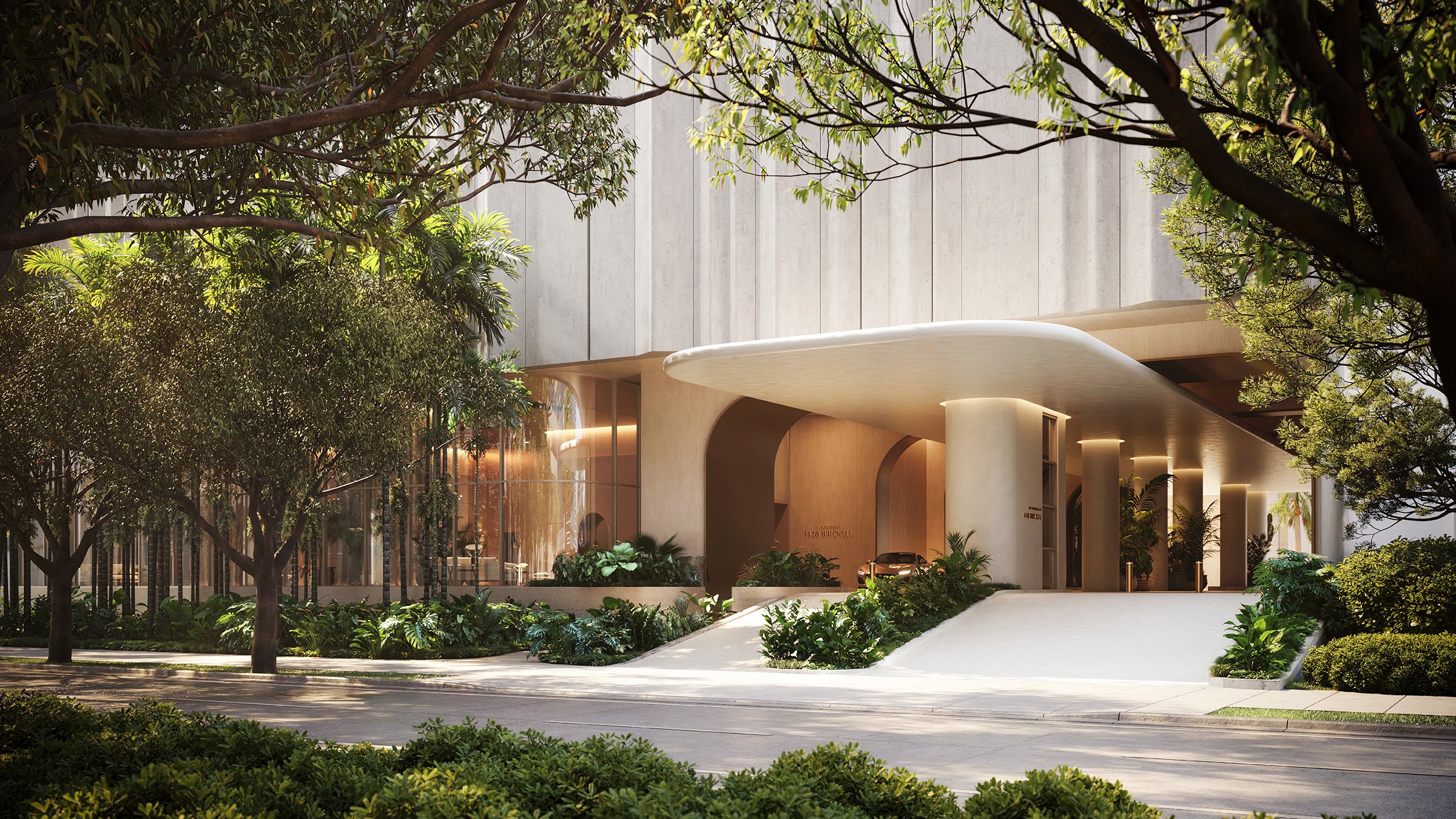
In a high-rise residence, the experience of home begins well before the front door. The sequence from curb to lobby, then elevator to residential floor, determines how quickly the city recedes and privacy takes hold. At The Residences at 1428 Brickell, vertical access is best understood as part of the ownership experience, not simply as a building utility.
That distinction is especially relevant in Brickell, where street traffic, ride-share arrivals, deliveries, visitors, and commercial activity create a constant public rhythm. Controlled circulation offers a quieter counterpoint. It makes each arrival feel deliberate and can extend the perceived boundary of home into the journey through the tower.
For privacy-sensitive owners, this subtle shift is consequential. The elevator becomes an antechamber in motion, creating psychological distance between the urban neighborhood below and the private sanctuary above.
Luxury is often defined by space, materials, and views. Yet discretion also depends on frequency: how often an owner encounters neighbors, guests, staff, vendors, or other building users while coming and going. Vertical-access design shapes those interactions, as well as the visibility of arrivals and departures.
Restricted access to residential floors can reinforce the sense of both security and exclusivity. The objective is not isolation for its own sake, but control over the social texture of daily life-allowing an owner to move through the property without every transition becoming a public moment.
This is particularly meaningful when returning late at night, circulating with children, or coordinating household arrivals. A well-composed route home reduces friction without calling attention to itself. That quiet competence is central to the lifestyle proposition of an ultra-luxury tower.
Buyers evaluating new construction in the district are not comparing finishes alone. They are comparing complete arrival sequences. Alongside 1428 Brickell, properties such as Cipriani Residences Brickell, St. Regis® Residences Brickell, and Una Residences Brickell offer useful points of reference for considering how each tower approaches circulation, hospitality, and privacy.
The comparison should remain practical. Buyers can examine how residents, guests, deliveries, and service personnel move from entry to destination. The goal is to determine whether those paths feel intuitive and appropriately separated, rather than relying on a general promise of exclusivity.
Within this context, The Residences at 1428 Brickell draws attention to the emotional quality of ascent. When generous interiors and skyline views are already expected, the route to them becomes a meaningful point of distinction.
The most valuable questions are operational. Buyers should request clear explanations of floor-access permissions, guest authorization, staff circulation, delivery handling, elevator dispatch, and procedures during maintenance. They should also determine whether the access experience varies by residence or floor.
Buyers should not assume that every residence has direct private-elevator entry or that a particular access-control technology is installed. Elevator count, elevator-to-residence ratio, backup-power specifications, and storm procedures should all be confirmed through current project documentation.
Performance matters as much as privacy. High floors can magnify the importance of wait times, reliability, and contingency planning. For a primary home or frequently used second residence, these are daily quality-of-life considerations, not technical footnotes.
The strongest vertical-circulation concepts are almost invisible in use. Doors open where expected, permissions are clear, guest movement is simple, and the transition from public to private space feels composed. Good design and architecture transform a logistical requirement into an atmosphere of calm.
This is why elevator privacy deserves the same scrutiny as a kitchen, terrace, or view corridor. A residence can be visually exceptional, yet its ownership experience remains incomplete if every arrival feels exposed or cumbersome. Conversely, controlled access can make a tower feel more residential, even at the center of Brickell.
For buyers' guides, the lesson is straightforward: evaluate the path home as carefully as the home itself. In ultra-premium vertical living, privacy is not confined to square footage. It is expressed through sequence, separation, and control.
Does this analysis treat elevators as part of the luxury experience at 1428 Brickell? Yes. It considers vertical access an element of ownership rather than merely a functional building service.
Does every residence have direct private-elevator entry? That detail should be confirmed for the specific residence under consideration and never assumed.
Why does controlled floor access matter? It can limit unnecessary movement onto residential floors, supporting a stronger sense of security and exclusivity.
How can elevator design improve privacy? It can reduce unplanned encounters and make resident arrivals and departures less visible to other building users.
Is elevator privacy useful for families? Yes. A calmer circulation sequence can be especially meaningful when residents are traveling with children.
What should late-night users consider? They should assess access permissions, arrival visibility, staffing procedures, and the clarity of the route from entry to residence.
Why is reliability important for high-floor ownership? Elevator performance directly affects convenience and the lived experience of returning to or leaving a residence.
Should buyers ask about storm-related operations? Yes. Buyers should verify backup-power provisions, operating protocols, and contingency procedures in current project materials.
What access details deserve due diligence? Confirm elevator count, floor permissions, guest handling, service circulation, maintenance procedures, and any residence-specific access arrangement.
Can vertical access distinguish an ultra-luxury tower? Yes. When space, finishes, and views are expected, a private-feeling journey home can become a defining experiential difference.
For a tailored shortlist and next-step guidance, connect with MILLION.
If branded residences are on your mind — as a home or as an allocation — we would be glad to share what we are seeing, privately.
Begin a quiet conversation