A buyer-focused look at Park Grove’s architectural claims, the distinction between structural glazing and weatherseals, and the records needed to evaluate balcony waterproofing, rain resistance, and future maintenance.
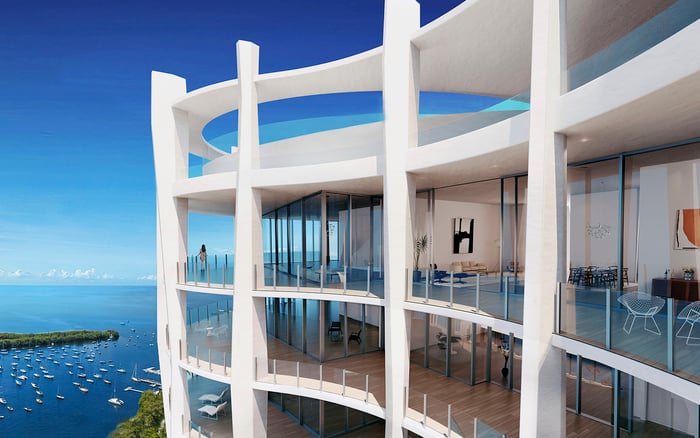
At Park Grove Coconut Grove, the architectural proposition includes curved façade plates described as optimizing views, decreasing wind loads, and improving façade-to-area ratios. These design attributes merit a buyer’s attention. They are not, however, substitutes for evidence of weatherseal condition, balcony waterproofing, or performance under wind-driven rain.
The architectural description does not disclose a façade-sealant replacement schedule, a balcony-membrane renewal interval, or a wind-driven-rain test report. The distinction matters: an architectural description is not a maintenance plan, and its silence does not establish that those records do not exist.
Nothing in the information considered here establishes Park Grove-specific envelope defects, failed rain testing, or an overdue replacement program. The useful question is not whether the architecture conceals a problem, but which documents allow a purchaser to understand the building envelope and its future obligations.
A claim of reduced wind loads addresses a different question from a tested water-penetration rating. It does not establish pressure-cycling performance either. Buyers should not treat these claims as interchangeable, even when they appear within the same architectural narrative.
To evaluate wind-driven-rain resistance, request any available water-penetration testing. Ask the reviewing professional to identify the assembly tested, the conditions represented, and the relevance to the residence under consideration. If corrective work occurred, request the associated remediation and retesting records rather than assuming the original test reflects the current condition.
The same discipline applies when considering Four Seasons Residences Coconut Grove: evaluate each performance claim against its own supporting documents. This is a comparison framework, not a suggestion that different properties share systems, maintenance histories, or concerns.
“Sealant” is too broad a term for a meaningful maintenance discussion. Structural glazing adhesive and perimeter weatherseal require separate consideration. Guidance for the adhesive that fastens glass or other panels to curtain-wall framing should not be generalized to every exterior joint.
Structural-glazing guidance identifies approved silicone elastomer adhesives and sealants with a 100% silicone polymer for that fastening function. Recurring inspection guidance for threshold buildings with exterior structural-sealant glazing focuses on the condition of the glazing adhesive. Neither point establishes which systems are installed at Park Grove or supplies a replacement timetable for them.
Request the permitted envelope drawings, installed-product names, warranties, and maintenance schedules. Ask the reviewing engineer or architect to distinguish structural glazing from weathersealing and identify the scope of any sealant adhesion testing. A record concerning one application should not be assumed to answer questions about the other.
Rather than adopting a generic replacement interval, seek a documented recommendation tied to the installed materials, inspections, and repair history. The distinction is between a calendar assumption and an assessed maintenance need.
A balcony review should extend beyond the visible walking surface. Representative deck-waterproofing approvals address cracks, joints, penetrations, flashings, and horizontal-to-vertical transitions. Some balcony and plaza-deck approvals also include non-skid pedestrian surfacing requirements. The finish is only one part of the documentation a buyer should examine.
Approval scope matters as well. Separate representative approvals cover waterproofing over wood decks and over lightweight concrete decks. They illustrate why a product name alone is insufficient: the substrate and assembly must match the approval being relied upon.
These examples are not evidence of products installed at Park Grove, nor does their inclusion establish that the approvals remain current. Request the actual installed-system identification, approval numbers, waterproofing details, warranties, and inspection closeouts. Have a qualified professional reconcile those records with the permitted assembly rather than transferring requirements from an unrelated example.
For purchasers also considering Mr. C Tigertail Coconut Grove, the same document-led questions provide a consistent basis for diligence without implying identical construction or waterproofing arrangements.
Representative waterproofing approvals state compliance with the Florida Building Code, including its High-Velocity Hurricane Zone provisions. That is meaningful within the approval’s scope. It is not proof of the system installed at a particular property or a substitute for installation records.
One representative approval requires a contractor licensed for roofing or waterproofing work in Miami-Dade County. It also requires submission of system specifications and details to the building official and assigns responsibility for proper materials and installation to the contractor.
For a buyer, the practical sequence is to identify the installed assembly, establish the applicable approval and permitted details, then review evidence of installation and subsequent maintenance. An approval document and a completed installation answer different questions. Both deserve attention; neither substitutes for the other.
A useful envelope review brings together three groups of records. The first establishes what was designed and installed: permitted drawings, product names, approval numbers, details, warranties, and closeouts. The second addresses performance and condition: water-penetration tests, adhesion tests, leak logs, engineering surveys, repairs, and retesting. The third addresses planning: maintenance schedules, reserve studies, and related assessments.
Read these records together. Ask whether recommendations identify specific work, whether completed repairs have supporting closeouts, and whether financial planning reflects the documented maintenance approach. These are buyer questions, not findings about Park Grove’s condition or finances.
In Miami-Dade, recertification begins at 30 years and continues at 10-year intervals. That is a safety-review timetable, not a published Park Grove sealant or balcony-membrane replacement cycle. Recertification requires a Florida-registered professional engineer or architect to certify structural and electrical safety for continued occupancy. Its façade review extends to cladding and appurtenances that could detach.
Waterfront purchases deserve this separation of architectural appeal, safety review, and maintenance planning. Whether the search includes Park Grove or Vita at Grove Isle, the objective is not to presume a defect or demand an unsupported lifespan. It is to understand what is installed, what has been evaluated, and what ownership may require next.
For a discreet perspective on South Florida residences and the questions worth asking before purchase, explore MILLION.
If branded residences are on your mind — as a home or as an allocation — we would be glad to share what we are seeing, privately.
Begin a quiet conversationNo. A claim about reduced wind loads does not establish a tested water-penetration rating or pressure-cycling performance.
The cited architectural description does not disclose a façade-sealant replacement schedule. That does not establish that a schedule is unavailable elsewhere.
The information presented does not establish Park Grove-specific envelope defects, failed rain testing, or an overdue replacement program.
No. They serve distinct functions, and structural-glazing guidance should not be generalized to every façade joint.
Request installed-product names, approval numbers, permitted details, warranties, inspection closeouts, and maintenance schedules. Review these with a qualified professional.
No. They illustrate approval requirements and assembly-specific scope, not the products installed at Park Grove or the approvals’ current status.
Approval scope is substrate-specific. Separate representative approvals for wood decks and lightweight concrete decks demonstrate why the actual assembly must be identified.
Request any water-penetration testing, leak logs, engineering surveys, remediation records, and retesting. Ask a reviewing professional to assess their relevance to the residence.
No. Miami-Dade’s described 30-year initial and 10-year recurring recertification timetable is a safety-review schedule, not a Park Grove replacement cycle.
Review condition records and repair history alongside maintenance schedules, reserve studies, and related assessments. Ask whether planned work and financial provisions align with documented recommendations.