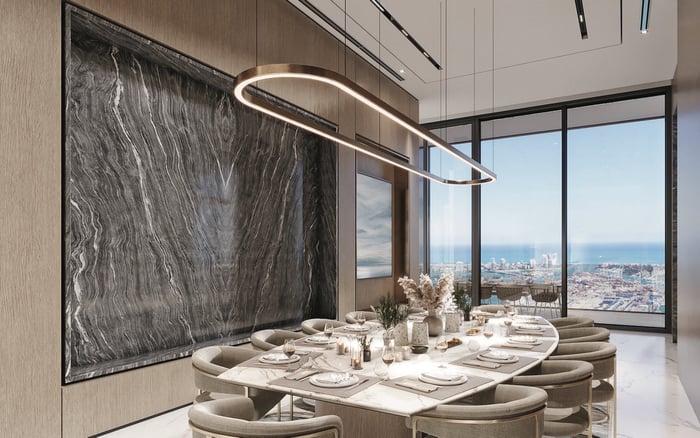
A discreet operational comparison of Waldorf Astoria Residences Downtown Miami and Villa Miami for buyers focused on elevator quiet, corridor privacy, and daily household flow.

For a certain Miami buyer, the defining luxury is not the tallest tower, the most photographed lobby, or the broadest amenity menu. It is the ability to come home quietly, move from car to elevator to residence without unnecessary contact, and sleep without the mechanical signature of an elevator core behind the wall.
That is why Waldorf Astoria Residences Downtown Miami and Villa Miami make such a useful comparison. They are not simply two new luxury addresses in neighboring urban districts. They represent two different philosophies of household operation.
Waldorf Astoria Residences Downtown Miami is the Downtown option: a skyline-defining supertall branded tower with a mixed hotel-and-residential program. Villa Miami is the Edgewater option, positioned as a smaller, largely residential bayfront tower with a more club-like identity. One leans into spectacle and a broader building ecosystem. The other leans into intimacy and residential rhythm.
For buyers who need quiet elevators and minimal hallway exposure, the decisive question is not which address feels more glamorous in a rendering. It is which floor plan, elevator sequence, and arrival path will remain calm on an ordinary Tuesday morning.
The appeal of Waldorf Astoria Residences Downtown Miami is immediate. It sits in Downtown, carries a globally recognized hospitality name, and belongs to the category of high-profile vertical residences that reshape a skyline. Buyers who want a branded environment with hotel energy, broad programming, and major-tower presence will understand its pull.
The operational tradeoff is just as clear. A mixed hotel-and-residential building introduces more circulation questions than a simpler residential tower. Hotel guests, residents, amenity users, visitors, service teams, and deliveries may all need to move through the building during the same daily windows. That does not make the concept flawed. It makes separation critical.
A privacy-sensitive buyer should focus on how residential elevators, hotel elevators, service elevators, and amenity access are separated in practice. The key phrase is “in practice.” A sales presentation can describe a private residential experience, but the buyer should still study the actual route from arrival to residence. Where does the resident enter? Where are guests directed? How does a dog walk happen? How does a private chef, housekeeper, tutor, or security detail move through the building?
Elevator-noise-sensitive households should ask even more precise questions. Where are the elevator banks in relation to primary bedrooms, nurseries, offices, and media rooms? Which walls share adjacency with shafts or service areas? How close is the residence to high-traffic amenity or hotel levels? High floors are not automatically quieter if the plan places a bedroom near a mechanical or vertical-circulation condition.
For minimal hallway exposure, Waldorf buyers should prioritize plans with direct or near-direct elevator access and avoid layouts requiring long shared-corridor walks. In a major branded tower, the best household plan may be the one that makes the building feel smaller once the resident leaves the elevator.
Villa Miami’s advantage is not that every operational answer is automatic. It is that the starting premise is more residential and more intimate. As an Edgewater bayfront tower with a smaller, club-like positioning, it should appeal to buyers who want luxury without the constant sensation of crossing paths with a broader hospitality audience.
For this buyer profile, Villa Miami deserves particular attention because the central operational questions are easier to isolate. How many residences share a floor? How close is each elevator landing to the residence entry? Do the corridors feel semi-private, or do they feel like shared hotel passageways? Does the arrival sequence compress movement, or does it expose the household to unnecessary public space?
If its floor plates deliver fewer shared doors per landing and shorter residential corridors, Villa Miami becomes the stronger candidate for buyers who measure privacy in seconds and footsteps. A shorter walk from elevator to front door can matter more than a long amenity inventory. It reduces visual exposure, casual encounters, and the subtle friction of daily domestic logistics.
That said, a quieter tower concept still requires plan-level review. Buyers should verify whether bedrooms and quiet rooms are kept away from elevator cores and service areas. They should also study whether the residence entry feels protected, whether service circulation is discreet, and whether the floor’s shared space has the quality of a private landing rather than a corridor.
This is where Edgewater’s residential personality matters. Buyers comparing Villa Miami with nearby bayfront choices such as EDITION Edgewater are often responding to the same instinct: water, light, and a more residential daily cadence than the most active mixed-use pockets of the urban core.
Elevator quiet is not a single specification. It is the result of shaft location, equipment design, acoustic isolation, ride frequency, lobby placement, door operation, and how many different building populations rely on each bank.
At Waldorf Astoria, buyers should treat elevator diligence as central rather than incidental. The broader mixed-use program makes it important to understand how residents are protected from hotel and visitor circulation. Even if the residential elevator experience is intended to feel private, the buyer should map every ordinary use case: late arrivals, early departures, package delivery, staff access, guest arrival, and movement to amenities.
At Villa Miami, the questions are more residential in character. Does the elevator open to a small number of homes? Is the landing acoustically and visually calm? Are the most sensitive rooms buffered from the core? Does the service path intersect with the resident path, or does it remain discreet?
Buyers should also resist the assumption that a prestigious building automatically solves quiet. The best comparison is not tower versus tower in the abstract. It is stack versus stack, line versus line, and floor versus floor. The difference between a serene residence and a compromised one can be a single wall, a service door, or a corridor turn.
Downtown buyers who enjoy large-scale architecture may also cross-shop other prominent urban towers such as Aston Martin Residences Downtown Miami, but the same operational discipline applies. In new construction, brand and height should never replace a careful reading of daily movement.
Minimal hallway exposure is a quiet form of status. It means children do not pass multiple doors on the way home. It means evening guests do not share a long residential corridor. It means household staff can arrive with discretion. It means a resident can step from the elevator into a zone that feels personal, not communal.
Waldorf Astoria’s challenge is to deliver that privacy inside a larger, more complex building. Buyers who are comfortable with a major mixed-use branded environment may find the tradeoff worthwhile, especially if the selected residence has direct or near-direct elevator access and strong separation from hotel and amenity traffic.
Villa Miami’s promise is different. Its lower-density residential emphasis makes it a more natural fit for buyers prioritizing quiet daily household operations, assuming the floor plates support that promise. Fewer shared doors per landing, shorter residential corridors, and protected entries would reinforce the sense of a semi-private arrival.
The correct choice depends on temperament. Some buyers want the energy and symbolic value of a landmark Downtown tower. Others want the household to feel insulated from the building’s public life. Both are luxury positions, but they are not the same position.
Choose Waldorf Astoria Residences Downtown Miami if you want the aura of a major branded tower and are comfortable performing detailed operational diligence. It is best suited to households that appreciate a larger building ecosystem and will select a residence carefully for elevator separation, corridor length, and adjacency to active zones.
Choose Villa Miami if your priority is the calm of day-to-day living. It is the stronger conceptual fit for buyers who want a bayfront residential environment, quieter vertical circulation, and less hallway exposure, provided the exact plan confirms those advantages.
In either case, do not buy the brochure. Buy the path home. Walk the arrival sequence verbally with the sales team. Ask to see the elevator relationship to the residence. Study where the bedrooms sit. Understand how guests, service providers, and residents move at peak hours. The most elegant residence is the one that protects the household before the front door even opens.
Which building is better for quiet elevators? Villa Miami is the stronger conceptual fit for quiet daily circulation, but the final answer depends on the specific floor plan and elevator-core adjacency.
Is Waldorf Astoria Residences Downtown Miami too busy for privacy-sensitive buyers? Not necessarily, but its mixed hotel-and-residential program requires more careful review of residential, hotel, service, visitor, and amenity circulation.
Why does hallway exposure matter in luxury condos? It affects how often residents encounter neighbors, visitors, staff, and deliveries between the elevator and the residence entry.
What should buyers ask about Waldorf Astoria elevators? Ask whether residential, hotel, service, and amenity elevator flows are separated in daily use and where each bank sits relative to the residence.
What should buyers ask about Villa Miami corridors? Ask how many residences share the landing, how long the corridor is, and whether the entry sequence feels semi-private.
Are high floors always quieter? No. Quiet depends on elevator adjacency, shaft isolation, amenity proximity, service areas, and the room layout inside the residence.
Is Downtown or Edgewater better for discreet living? Edgewater may feel more residential in this comparison, while Downtown offers a larger, more visible urban tower experience.
Can a mixed-use branded tower still feel private? Yes, if residential access, service movement, and amenity circulation are carefully separated and the chosen plan minimizes shared exposure.
What is the most important due-diligence step? Study the exact path from arrival to front door, including elevator bank, landing, corridor, service routes, and bedroom adjacency.
Who is Villa Miami best suited for? It is best suited for buyers who value an intimate Edgewater setting and want quieter household operations over landmark-tower spectacle.
For a confidential assessment and a building-by-building shortlist, connect with MILLION.
If branded residences are on your mind — as a home or as an allocation — we would be glad to share what we are seeing, privately.
Begin a quiet conversation