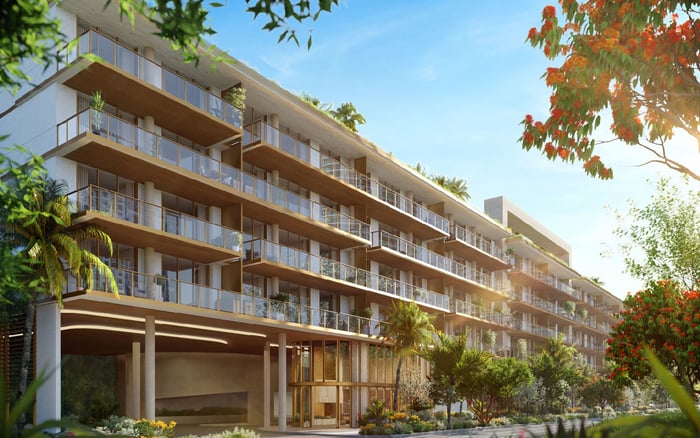
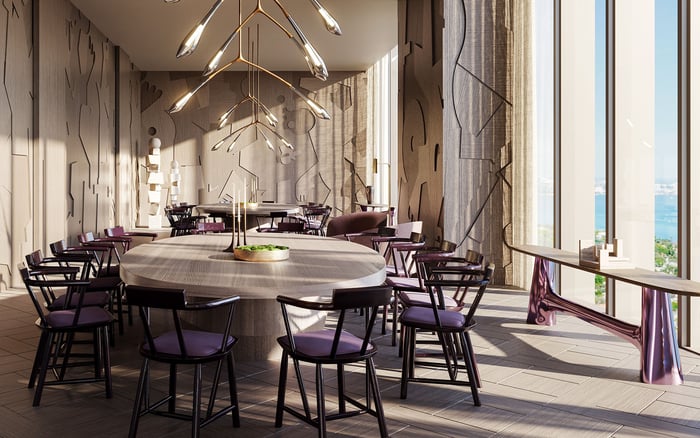
Villa Miami is emerging as one of Edgewater’s most tightly curated new-construction offerings: a 56-story, 650-foot bayfront tower with just 70 residences and a lifestyle concept built around The Copper Club. With half-floor and full-floor layouts, direct Biscayne Bay positioning, and hospitality programming led by Major Food Group, the project is designed to read less like a typical high-rise and more like a vertical collection of private estates.
Edgewater has become a proving ground for a specific Miami buyer: someone who wants the immediacy of the urban core, but still demands water, park frontage, and a residence that feels protected from the pace outside. In that context, Villa Miami draws attention as much for what it avoids as for what it promises. It does not read as a high-volume condominium with hundreds of front doors, and it does not market itself as a public-facing resort.
Publicly disclosed plans describe a 56-story residential tower rising roughly 650 feet, positioned directly on Biscayne Bay at 700 NE 29th Street. The residence count is intentionally limited to 70 homes, with planning constrained to half-floor and full-floor configurations. That is boutique living as it is increasingly defined in Miami: not smaller for the sake of scarcity alone, but smaller so arrival, service, and daily use can feel measured rather than busy.
For buyers who have watched the market tilt toward vertical density, Villa Miami’s thesis is clear. It aims to pair estate-scale interiors with a skyline-level vantage, then layer in a social offering that can be present when you want it and discreet when you do not.
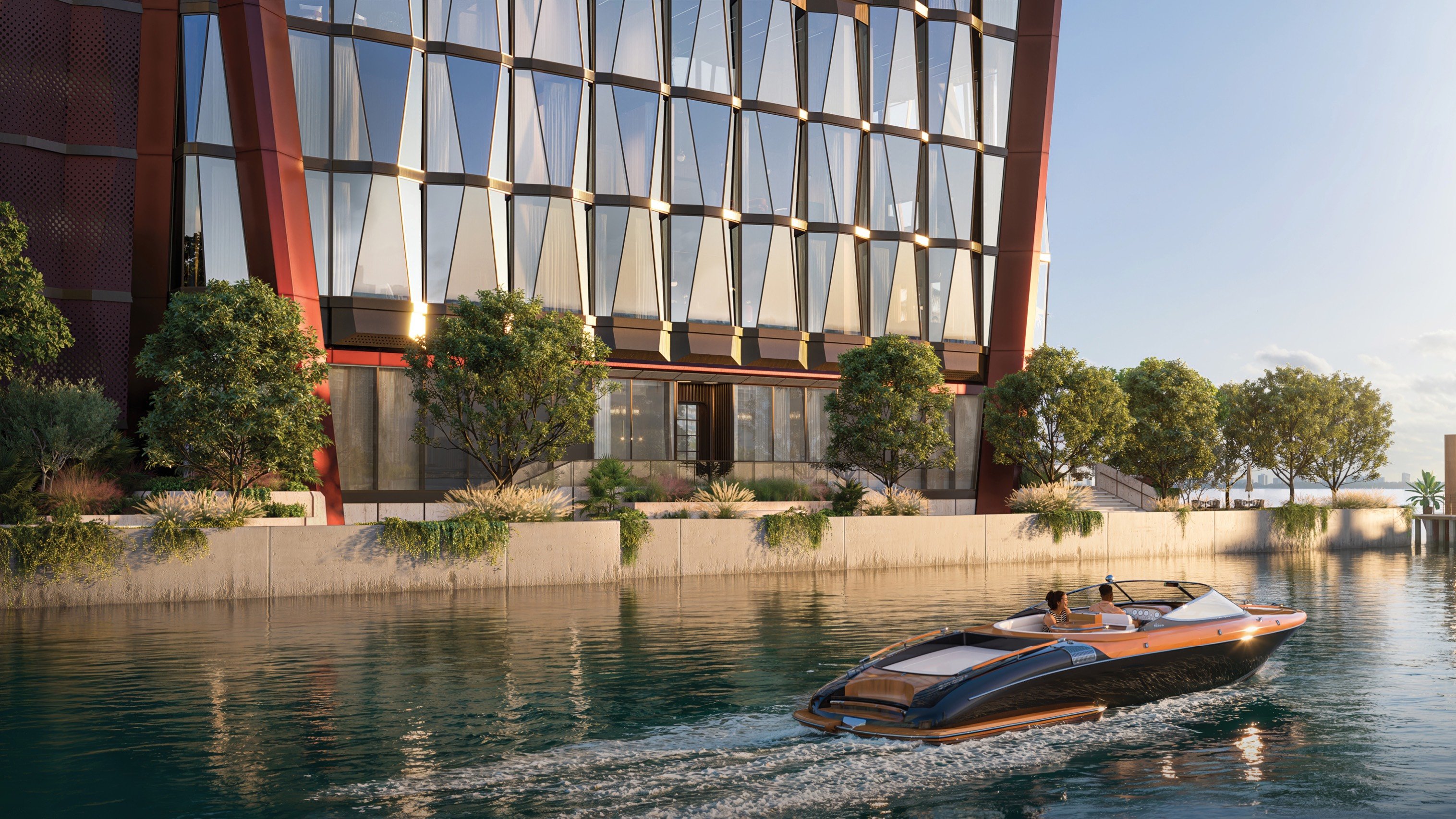
Villa Miami’s design has been widely covered for its copper-toned exoskeleton, wrapped around a faceted glass form. The architectural intent has been described as a response to the light and water conditions of Biscayne Bay. That detail matters because it suggests a building conceived as part of the waterfront setting, not simply as a commodity of height.
In published renderings and design descriptions, the tower reads warmer than Miami’s typical palette of white surfaces and blue glass. Here, copper is not treated as a simple color decision. It is positioned as a way to shape how the building presents itself across the day, from morning glare off the bay to evening reflections from the skyline.
For a luxury buyer, this kind of material narrative often signals a broader commitment to finish and proportion. It points to common areas that feel designed rather than decorated, and residences that aim to feel composed, not merely delivered.
Villa Miami frames its homes around two formats: half-floor residences and full-floor residences. The objective, as stated in project materials, is privacy and scale, with an “estate in the sky” sensibility instead of a conventional condominium stack.
Half-floor “Villa Mezzo” homes are generally described as three- to four-bedroom layouts. Full-floor “Villa Piano” homes are generally described as four- to five-bedroom layouts. Across both, the recurring themes are flow-through planning, large terraces, and expansive glazing intended to capture bay views on one side and city perspectives on the other.
Pricing has been publicly marketed from roughly $4.8 million for half-floor homes and from roughly $8.5 million for full-floor homes, with the standard caveat that marketing figures can shift with sales velocity and construction progress. For many buyers, the more useful lens is not simply entry price. It is door count, elevator-adjacent privacy, and whether the plan lives like a true residence rather than a pied-a-terre.
In Edgewater, where new supply has often favored higher unit counts, this “fewer, larger” approach reads as a real differentiator.
Ultra-luxury buyers increasingly separate buildings into two categories: those that offer amenities, and those that operate with a clear philosophy of service and programming. Villa Miami positions itself in the second group through “The Copper Club,” presented as a private club environment for residents.
Major Food Group is featured as the operator and creator behind resident-facing dining and hospitality experiences within this concept. Practically, that implies entertaining options beyond your own dining room, and a service posture designed to align with buyers who prioritize consistency and discretion.
This reframes the value of amenities. Instead of focusing on the square footage of a lounge or gym, the questions become who runs the experience, how it feels on a weeknight, and whether the building’s social energy can be as quiet as it is active.
For buyers comparing club-oriented living across South Florida, it is worth noting that Miami Beach is leaning into a similar model in newer offerings, including Shore Club Private Collections Miami Beach and Setai Residences Miami Beach. Even if your search is centered on Edgewater, the market direction is consistent: residences are being positioned as curated lifestyles with a recognizable hospitality hand.
In a market where execution risk is scrutinized, financing and early milestones carry real weight. Villa Miami has reported securing $285 million in construction financing following its groundbreaking. Construction updates have also described a major foundation pour involving more than 3,400 cubic yards of concrete and 2,095 tons of steel, completed in roughly 14 hours.
As reported during foundation progress, Moss Construction is serving as general contractor, with DeSimone Consulting Engineers as structural engineer. Timelines can evolve, but this level of publicly shared milestone reporting often reassures buyers that the project is moving through the most technically demanding early phase with institutional support.
In new-construction decision-making, especially at the ultra-premium tier, confidence rarely comes from a single headline. It builds through a pattern: credible teams, credible capital, and visible on-site progress.
Edgewater’s appeal is easy to describe and difficult to duplicate. It is a Biscayne Bay-front Miami neighborhood east of Biscayne Boulevard that has become a major corridor for new high-rise condo development. Commonly cited boundaries run from Biscayne Bay on the east to the Florida East Coast Railway corridor on the west, roughly between NE 17th Street and NE 37th Street.
That geography creates a distinct daily rhythm. You can be in the Design District, Wynwood, Downtown, or the beaches without feeling removed from the city, yet your home life can still revolve around open sky and water.
Margaret Pace Park is frequently highlighted as a neighborhood anchor. For many residents it functions as an extension of the living room: a waterfront place to reset, walk, or exercise without leaving the immediate area. It is the kind of lifestyle asset that rarely appears in a brochure, yet consistently influences buyer decisions.
For those who want to stay in Edgewater while comparing design language and service models, EDITION Edgewater offers another branded approach within the same neighborhood conversation.
In luxury real estate, the top residence often serves as a statement of intent. Villa Miami has been publicly described as offering a headline penthouse priced at $55 million, measuring approximately 15,000 square feet across three stories. It has been characterized as an “estate in the sky,” with multiple terraces and a suite of luxury features.
Even for buyers not shopping at that level, a true penthouse offering tends to shape perception of the entire building. It can pull finish expectations upward, sharpen service assumptions, and reinforce that the top tier is not simply a larger condo, but a different category of home.
It also underscores Edgewater’s position in the ultra-premium conversation. Increasingly, Edgewater and Miami Beach compete on different strengths: Miami Beach for sand-adjacent heritage and global resort culture, and Edgewater for bayfront scale with fast access to the city’s commercial and cultural nodes.
Buyers evaluating Villa Miami are often optimizing for a short list of non-negotiables, and the project’s published details map directly to them.
First is privacy. Half-floor and full-floor planning reduces hallway traffic and increases the sense of ownership per level. Second is indoor-outdoor livability, expressed through terraces and expansive glazing intended to frame Biscayne Bay and the city skyline.
Third is lifestyle infrastructure. Project materials describe direct water access via a private dock component on Biscayne Bay, along with a rooftop helipad as part of the tower’s ultra-luxury positioning. Not every owner will use those features regularly, but their presence signals a specific profile: boating-oriented residents, executives who value time compression, and second-home owners who want frictionless arrival and departure.
Finally, look beyond the rendering. Edgewater continues to evolve quickly, and the strongest buying decisions are typically those where the home performs both as a personal sanctuary and as a strategic location within the larger Miami map.
Is Villa Miami a large-scale condo tower? No. It is described as a boutique tower with 70 total residences, organized as half-floor and full-floor homes.
Where is Villa Miami located? The site is publicly listed at 700 NE 29th Street in Edgewater, directly on Biscayne Bay.
What is The Copper Club? It is presented as a private club concept for residents, with dining and hospitality experiences created and operated by Major Food Group.
What types of residences are planned? Project materials describe half-floor “Villa Mezzo” homes (generally 3 to 4 bedrooms) and full-floor “Villa Piano” homes (generally 4 to 5 bedrooms), with an emphasis on terraces and expansive glazing.
For private guidance on Edgewater and Miami’s most design-forward buildings, connect with MILLION Luxury.
If branded residences are on your mind — as a home or as an allocation — we would be glad to share what we are seeing, privately.
Begin a quiet conversation