Villa Miami’s planned Edgewater offering pairs bayfront residences with managed hospitality. For buyers, the decisive questions concern service commitments, dining access, privacy, and the distinction between boat pickup and permanent berthing.

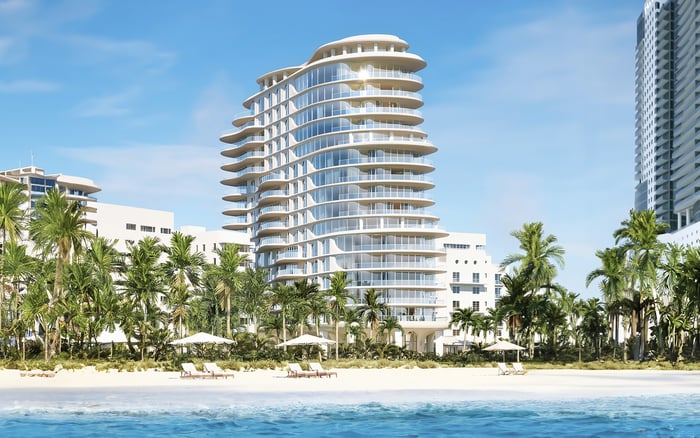
The clearest way to understand Villa Miami is as a proposal for bayfront living supported by managed hospitality. Planned for 710 NE 29th Street in Edgewater, directly on Biscayne Bay, it emphasizes full-floor and half-floor homes rather than a conventional high-density condominium arrangement. Its appeal rests on the relationship between a substantial private residence and services intended to make daily ownership less demanding.
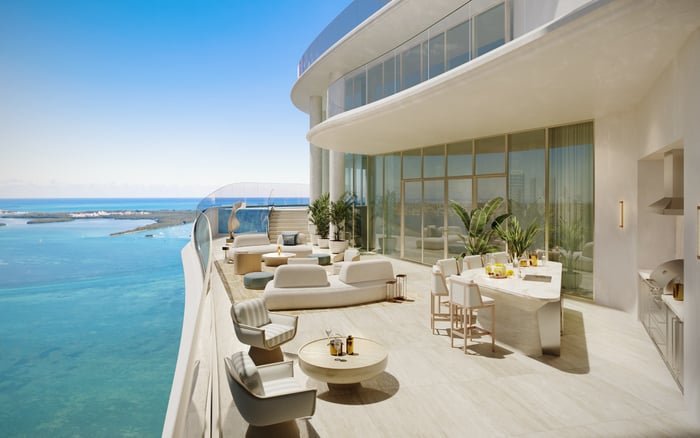
Residences are marketed with panoramic views spanning Biscayne Bay, downtown Miami, Miami Beach, and the ocean horizon. The essential geographic distinction, however, is straightforward: this is bayfront living, not direct ocean-beach living. Buyers should evaluate the waterfront experience on those terms, rather than treating a distant ocean view as a substitute for beach access.
The amenities and services described here are planned or advertised. Their inclusion should guide due diligence, not be read as confirmation that they are operational.
Villa Miami’s planned service structure includes an in-house curator, concierge support, estate-management-style assistance, and back-of-house delivery operations. Advertised services also include 24-hour valet, concierge, and security. Together, these suggest an ownership experience designed around delegation, from coordinating arrivals to managing deliveries.
For a buyer, however, a service title matters less than its scope. Ask which requests fall within the condominium’s standard services, which require advance notice, and which carry separate charges. Estate-management-style assistance should not be assumed to cover every responsibility normally assigned to a private household employee.
The final condominium budget and service agreements deserve close attention. Request staffing commitments, coverage arrangements, and a clear explanation of how requests are handled when several households need assistance at once. The relevant luxury is not simply access to a concierge desk, but confidence that routine tasks can be handled predictably and discreetly.
Major Food Group’s planned on-premises restaurant is conceived as a two-level, Italian-inspired venue with bayfront dining. Plans describe private dining rooms as exclusive to residents. That distinction matters: resident-exclusive rooms do not establish that the entire restaurant will be residents-only.
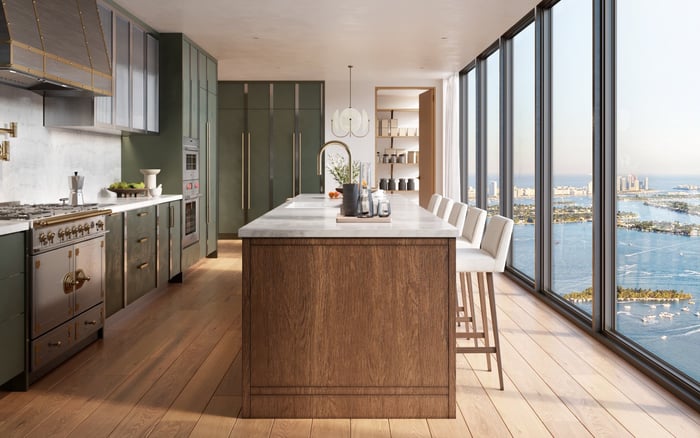
The advertised hospitality program also includes kitchens and dining rooms on demand, along with private and on-site catering by Major Food Group chefs. Residences are promoted with chef’s kitchens designed by Major Food Group co-founder Mario Carbone. For an owner who entertains, the attraction is the possibility of moving between private cooking, catered evenings, and restaurant dining without making each a separate logistical exercise.
Before assigning value to that convenience, establish restaurant hours, reservation procedures, private-room booking terms, and catering charges. Clarify what “kitchens and dining rooms on demand” means in practice. Buyers also considering Cipriani Residences Brickell can apply the same discipline: compare documented dining privileges, not assumptions prompted by a name.
Full-floor and half-floor residences may appeal to buyers seeking a more private residential setting, but floor size alone does not establish privacy. The decisive questions concern elevator access, shared corridors, visitor screening, and the separation of household life from deliveries and service activity.
Request the final layouts and trace several ordinary journeys: an owner arriving home, dinner guests visiting, a caterer bringing equipment, and a delivery reaching the residence. Ask where those routes overlap. A back-of-house delivery program is advertised, but buyers should establish how it connects to each home and who controls access along the way.
The planned restaurant raises another question: how will dining arrivals relate to residential circulation? Seek clear access arrangements rather than assuming separation. A rooftop helipad is also advertised, but its value depends on permitted uses and operating restrictions. It should not be treated as unrestricted private aviation access.
Villa Miami’s advertised private bayfront dock is intended for owner boat pickup and drop-off coordinated through the concierge. This may suit a household seeking waterborne arrivals and departures, but it is not the same proposition as keeping a vessel at home. The planned dock is a pickup-and-drop-off facility, not a marina offering resident-owned slips.
Ask for written dock policies covering reservations, vessel suitability, guest access, operating hours, and any charges. Owners should also clarify how scheduling conflicts and weather-related interruptions would be handled. These are practical questions, not reasons to discount the amenity.
Waterfront value is personal. If permanent berthing is essential, a convenient pickup point does not meet that requirement. If the priority is occasional boat access coordinated by a concierge, the advertised arrangement may better align with the intended lifestyle.
The advertised pool program combines a bayfront pool deck with a separate Lake Como-inspired floating pool vessel. Poolside food-and-beverage service is also planned. These features warrant separate questions about access, operating arrangements, and service hours, rather than being treated as one interchangeable amenity.
Planned wellness facilities include an Italian-thermal-style spa, hot and cold plunges, sauna, steam room, and salon facilities. Advertised fitness amenities include Technogym equipment and dedicated yoga, Pilates, and boxing studios. Shared spaces also include lounges, a library, boardroom, games room, screening room, and family-oriented entertainment areas.
Lifestyle fit depends on how these spaces support a normal week. Ask whether treatments, instruction, room reservations, and food service carry separate charges. A broad amenity program is most valuable when the facilities an owner expects to use are accessible on workable terms.
For a second-home buyer, the service proposition may be especially relevant, but seasonal absence warrants specific questions about the limits of household support. Establish whether requested residence checks or arrival preparations fall within the agreed service scope; do not assume they are included.
Buyers comparing EDITION Edgewater should use the same review framework: final floor plans, documented services, recurring costs, and access rules. The comparison is most useful when it tests the buyer’s actual routine rather than the length of an amenity description.
Villa Miami’s clearest proposition is bayfront residential living with planned dining and managed hospitality. Its suitability turns on whether the final operating arrangements deliver the right balance of assistance, social access, and privacy for the purchasing household.
For a discreet conversation about Villa Miami and your South Florida residential priorities, connect with MILLION.
If branded residences are on your mind — as a home or as an allocation — we would be glad to share what we are seeing, privately.
Begin a quiet conversationVilla Miami is planned for 710 NE 29th Street in Miami’s Edgewater neighborhood, directly on Biscayne Bay.
Its setting is on Biscayne Bay, not directly on an ocean beach. Marketed ocean-horizon views should not be confused with beach access.
The residential offering emphasizes full-floor and half-floor homes. Buyers should review final layouts and access arrangements before drawing conclusions about privacy.
The planned program includes an in-house curator, concierge support, estate-management-style assistance, and back-of-house delivery operations. Marketing also lists 24-hour valet, concierge, and security.
Major Food Group’s planned restaurant is a two-level, Italian-inspired venue with bayfront dining. Private dining rooms are described as exclusive to residents.
Resident exclusivity is specified for private dining rooms, not the entire restaurant. Buyers should confirm the broader restaurant’s access rules.
The advertised program includes private and on-site catering by Major Food Group chefs, plus kitchens and dining rooms on demand. Booking terms, scope, and charges should be confirmed.
No resident-owned slips are described in the advertised program. The private dock is intended for owner boat pickup and drop-off coordinated through the concierge.
No. A rooftop helipad is advertised, but buyers should confirm its permitted uses and operating restrictions.
Request the final condominium budget, service agreements, staffing commitments, and final access layouts. Also confirm restaurant hours, dock policies, helipad restrictions, and separately charged services.