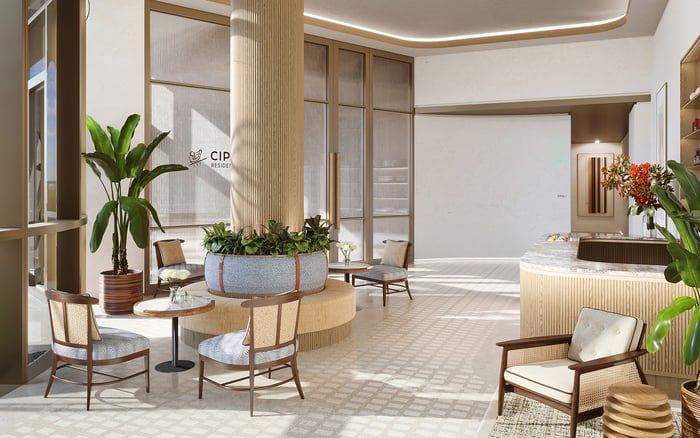
A buyer-focused framework for examining private arrival, household-staff circulation, deliveries, parking, and visitor control at Colette Residences Brickell and Una Residences Brickell without assuming unverified operating details.

In a condominium, arrival privacy is best examined as a sequence rather than a single feature. The review should follow every threshold from the property entrance to the residence while accounting for owners, guests, household employees, vendors, deliveries, and emergency personnel.
This framework can be applied when evaluating Colette Residences Brickell and Una Residences Brickell. Because no project-specific operating details are established in the supplied fact table, buyers should confirm every feature and procedure directly instead of treating general terminology as proof of a particular access arrangement.
Begin at the street and document each decision point through the parking or vehicle-handoff area, lobby, elevator, corridor, and residential entrance. Ask where identity is checked, which credentials are required, which doors remain controlled, and whether the route changes outside normal staffing hours.
Parking and valet procedures should be reviewed separately. A buyer should determine how vehicles enter, where passengers transfer, how keys are managed, whether temporary vehicles follow a different process, and what happens when a credential fails.
A private or controlled arrival experience depends on elevator programming as much as physical design. Buyers should ask who may call each elevator, which floors a credential can reach, whether visitors receive temporary permissions, and how those permissions expire.
The review should also cover overrides. Management should be asked how access is handled during maintenance, a power interruption, a medical event, or another emergency. Any explanation should be checked against the current governing and operating documents.
Household employees may need recurring access without receiving owner-level permissions. Test separate scenarios for a housekeeper, chef, nanny, driver, personal assistant, or other authorized employee, focusing on entry times, permitted destinations, parking access, elevator use, and credential records.
Buyers should request a physical route demonstration rather than assume that household staff use either the owner path or a service path. The demonstration should cover arrival, departure, access while the owner is away, and the process for immediately suspending or replacing a credential.
Visitor control extends beyond the first point of contact. Ask how guests are registered, announced, admitted, directed, and limited to an approved destination. Recurring visitors and event guests may require different procedures, so each use case should be discussed independently.
Vendors, contractors, brokers, and move-in teams can create different circulation demands. Buyers should identify the approved entrance, staging area, elevator, hours, insurance requirements, supervision process, and route for oversized items without presuming that any particular protocol is available.
Package handling should be evaluated from the first handoff through retrieval or delivery to the home. Ask where items are accepted, how residents are notified, who may retrieve them, how refrigerated or high-value deliveries are treated, and how access records are maintained.
Food delivery, floral installation, furniture delivery, and after-hours service may follow distinct routes. Each scenario should be tested for its effect on resident privacy and on shared arrival areas.
Use the same checklist for both featured residences so that differences are based on verified procedures rather than presentation language. The method can also support comparisons with The Residences at 1428 Brickell and St. Regis® Residences Brickell, provided each project is assessed using current, project-specific documentation.
A useful review includes a live walkthrough, written answers, applicable plans, and the documents governing access and operations. Buyers should note which details are confirmed, which remain subject to change, and which depend on management practices rather than physical design.
What is the first step in evaluating private arrival? Trace the complete route from the property entrance to the residence and record every controlled threshold.
Should a buyer rely on the phrase “private elevator”? No. The buyer should verify call permissions, floor restrictions, temporary access, overrides, and the route leading to the elevator.
How should household-staff access be reviewed? Test recurring access, permitted times and destinations, credential records, parking, and the process for suspending access.
What should buyers ask about guest entry? Ask how guests are registered, announced, admitted, directed, and restricted to an approved destination.
Why should vendor circulation be examined separately? Contractors, brokers, movers, and other vendors may require different entrances, elevators, staging areas, hours, and supervision.
What delivery scenarios should be tested? Review packages, food, flowers, furniture, high-value items, refrigerated goods, and after-hours deliveries as separate cases.
How should parking and valet be assessed? Examine vehicle entry, passenger transfer, key handling, temporary vehicles, credential failures, and after-hours procedures.
Why are emergency overrides important? They show how controlled access changes during maintenance, power interruptions, medical events, or other emergencies.
What makes a fair comparison between Colette and Una? Apply the same circulation checklist to both and rely only on current, project-specific documents and demonstrations.
What should a buyer request before making a decision? Request a live walkthrough, written answers, relevant plans, and the current documents governing access and operations.
For a tailored shortlist and next-step guidance, connect with MILLION.
If branded residences are on your mind — as a home or as an allocation — we would be glad to share what we are seeing, privately.
Begin a quiet conversation