A buyer-focused comparison of how 57 Ocean and Setai frame private arrival, valet handling, elevator access, household-staff circulation, and visitor oversight.
In a luxury condominium, privacy begins well before the residence door. The route from street to porte-cochère, lobby, elevator, and private foyer determines how often an owner encounters other residents, guests, vendors, or deliveries. It also shapes whether household staff can work discreetly without interrupting the principal arrival sequence.
That distinction is especially relevant when comparing 57 Ocean Miami Beach with Setai Residences Miami Beach. Both support staff-managed vehicle arrivals, but they define vertical circulation with different levels of architectural detail. 57 Ocean provides more explicit documentation of private arrival and, at the penthouse tier, separate service access. Setai places greater emphasis on valet transportation and a four-elevator core, with less detail about residence-specific service routing.
True residential privacy depends on the entire route, not simply the front door.
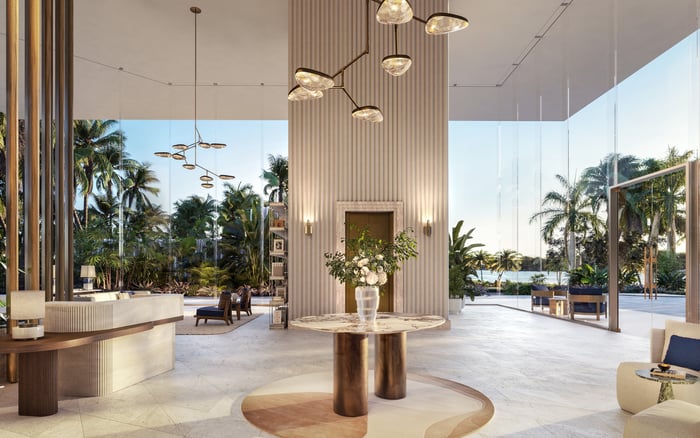
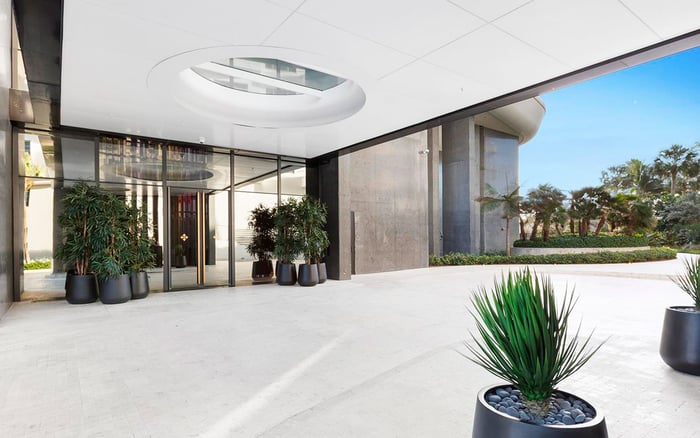
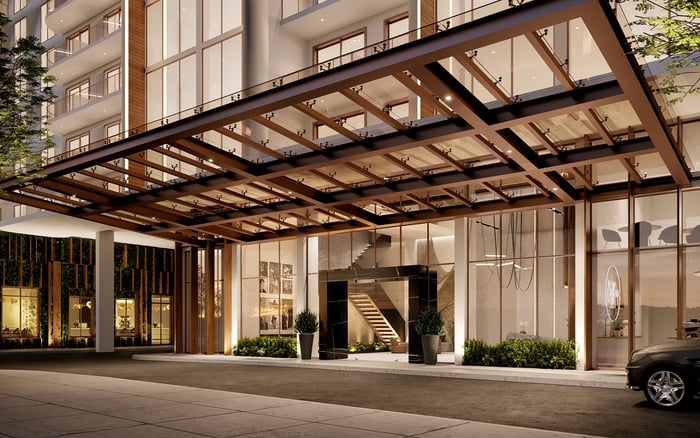
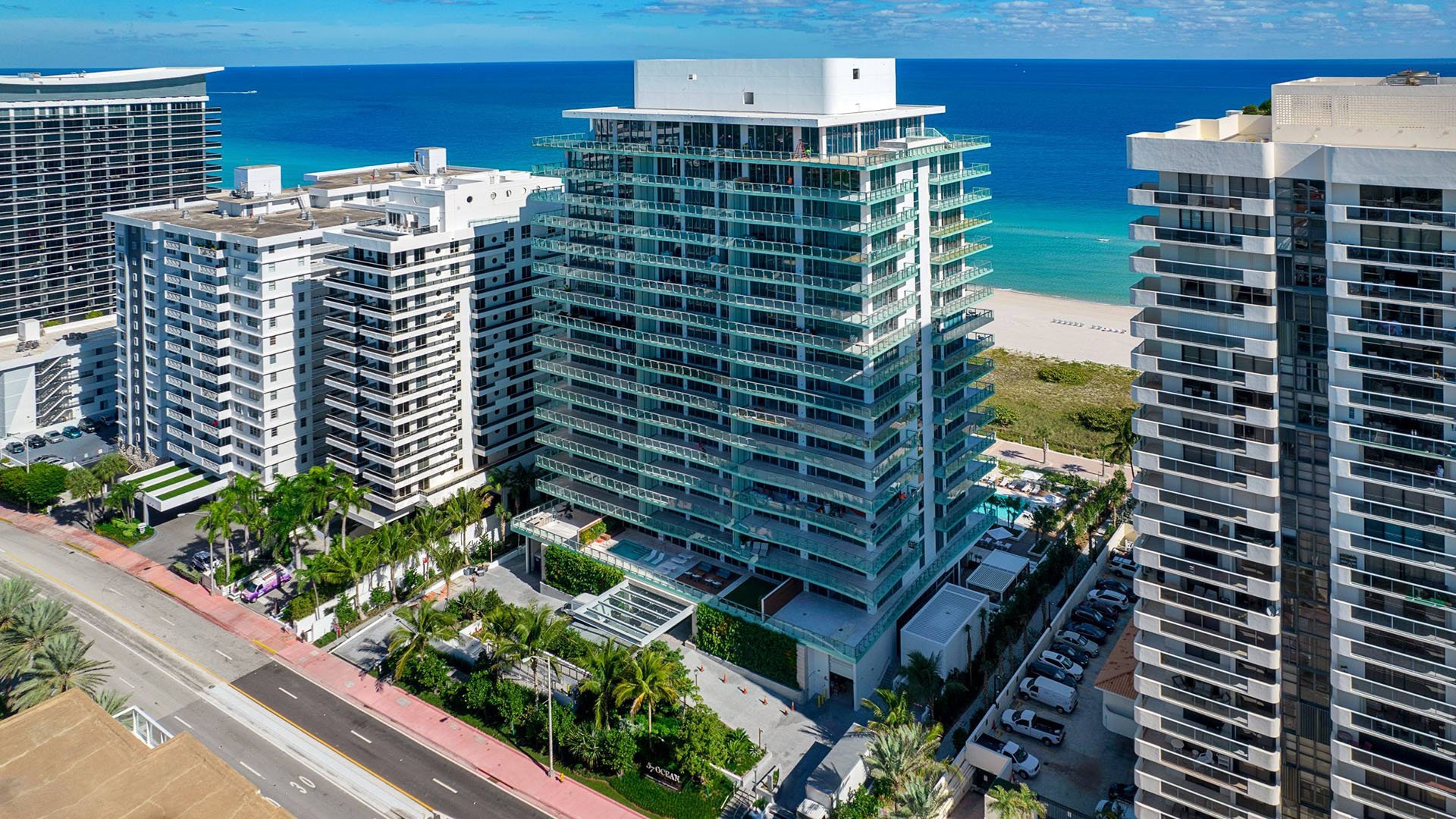
57 Ocean is an oceanfront condominium at 5775 Collins Avenue in Miami Beach’s Mid-Beach area. The approach begins at a private Collins Avenue entrance. A cantilevered glass canopy and vertical gardens screen the porte-cochère, creating visual separation during vehicle drop-off before the sequence continues into a double-height lobby with ocean views.
The ground-floor plan expressly identifies a zone beside the lobby and wellness pavilion as “PRIVATE ARRIVAL.” That language is meaningful because it ties privacy to a planned spatial sequence rather than treating it solely as a service promise. Full-time valet staff transfer vehicles from the porte-cochère to underground parking, reducing the need for residents to pass through the garage.
From the lobby, internal circulation connects to the wellness pavilion, pools, meditation gardens, and beachfront. Direct beachfront access also allows residents to reach the shore and adjacent pedestrian setting without crossing public retail or hotel facilities. For buyers focused on design and architecture, the relationship among arrival, amenities, and the water is as consequential as the lobby’s aesthetic treatment.
57 Ocean residences are marketed with private elevator entry, allowing an owner to arrive at a residence-specific foyer rather than rely on a conventional shared corridor. Residence 704 has been described as having direct private-elevator access to its own foyer. This can improve discretion, although buyers should still confirm where an arriving guest waits, how authorization occurs, and whether the elevator opens directly into the residence or into a secured vestibule.
The clearest separation appears in the penthouse specifications. The residence is described with three elevators, including a private elevator serving the main foyer and a separate service elevator. At that tier, the architecture distinguishes principal arrival from service circulation. The available information does not establish that every residence offers comparable service-elevator separation, making the precise stack and floor plan decisive.
This distinction matters to owners who employ a housekeeper, private chef, or personal assistant, as well as those arranging personal trainers or in-residence spa treatments. A concierge can coordinate access, but coordination is not equivalent to a physically separate staff route. Buyers should determine whether providers enter through the principal lobby, a service entrance, or another controlled point-and which elevator they may use.
Setai offers private ground transportation and valet parking, indicating a staff-managed vehicle-arrival model. Parking allocation is described as one valet space for one- and two-bedroom residences and two valet spaces for homes with three or more bedrooms. This arrangement supports a managed handoff at arrival, but parking allocation alone does not explain how residents, guests, and household employees separate after leaving the vehicle.
The building has four high-speed elevators. However, private elevator foyers for every residence and residence-specific service-elevator routes are not identified. Floor plans span one- through four-bedroom residences but offer limited detail about staff corridors and back-of-house movement.
The practical conclusion is not that visitor control is absent. Rather, staffed transportation and a shared elevator core are more clearly defined than architectural separation. A buyer considering Setai should request the current operating protocols behind those services, including guest authorization, delivery acceptance, and elevator permissions.
Private arrival is both physical and procedural. A screened porte-cochère, private foyer, or service elevator can create inherent separation. Security, concierge, and valet teams then determine how that framework functions day to day. 57 Ocean offers full-service concierge, 24-hour security, and 24-hour valet service, creating staffed control points throughout the arrival sequence.
At either property, visitor control should be tested through specific scenarios. Can an owner pre-authorize a dinner guest? Where does a private chef check in? May a housekeeper retain credentials? How are packages, floral installations, and furniture deliveries routed? What happens when several vendors arrive while the owner is away? The answers may reside in condominium rules and security procedures rather than in a floor plan.
These questions also help buyers compare other Miami Beach options without assuming equivalence. A focused tour could add The Perigon Miami Beach and The Ritz-Carlton Residences® Miami Beach to the consideration set, then apply the same arrival and circulation test to each. Within MILLION's Buyer's Guides, the useful comparison is not a broad amenity count but the lived sequence from curb to residence.
Begin with the specific residence, not the building’s broader marketing language. Request its elevator plan and confirm whether entry is direct, foyer-based, or corridor-based. Ask which elevators are available to household staff, outside providers, and deliveries. If a separate service elevator is essential, obtain confirmation that it serves the residence under consideration rather than another tier or stack.
Next, review the current rules for guest registration, recurring staff credentials, delivery hours, move-ins, and large-item handling. Establish whether valet parking is mandatory, where vehicles are staged, and how private drivers are accommodated. For a second home, ask how access is managed when the owner is absent and whether staff may enter only during approved windows.
Finally, walk the route in person. Start at the vehicular entrance, continue through the lobby and elevator, and trace the path to the amenities and beach access. Observe sightlines, waiting areas, and potential intersections. In an ultra-premium residence, quiet choreography is not a decorative extra. It is a daily component of privacy.
Based on the plans and specifications, 57 Ocean presents the more explicit architectural case for private arrival, with documented private elevator entry and separate service access at the penthouse level. Setai presents a staff-managed valet model and four high-speed elevators but requires more property-specific diligence regarding internal separation. For Miami Beach buyers, the right answer depends on the exact residence, household routine, and desired boundary among family life, staff movement, and guests.
For discreet guidance on evaluating private circulation and visitor protocols in South Florida residences, connect with MILLION.
If branded residences are on your mind — as a home or as an allocation — we would be glad to share what we are seeing, privately.
Begin a quiet conversation57 Ocean more explicitly documents a screened porte-cochère, a designated private-arrival zone, and private elevator entry.
That is not established by the available details. Separate service-elevator access is specifically documented for the penthouse, so buyers should verify the exact residence.
Full-time valet staff move vehicles from the porte-cochère to underground parking, reducing residents’ need to circulate through the garage.
Setai’s building specifications identify four high-speed elevators but do not detail private foyers for every residence or residence-specific service routing.
No. Elevator design supports discretion, but guest authorization, credentials, and security procedures determine how access works operationally.
Concierge-accessible services include personal trainers and spa treatments, supporting coordinated access for outside providers.
Buyers should confirm entry points, credential rules, permitted elevators, access hours, and procedures when the owner is absent.
Request current delivery rules, approved hours, loading procedures, elevator permissions, and routes for large items.
Yes. The disclosed allocation is one valet space for one- and two-bedroom residences and two for residences with three or more bedrooms.
Elevator access and service separation can vary by tier, stack, and floor plan, so building-level descriptions may not apply uniformly.