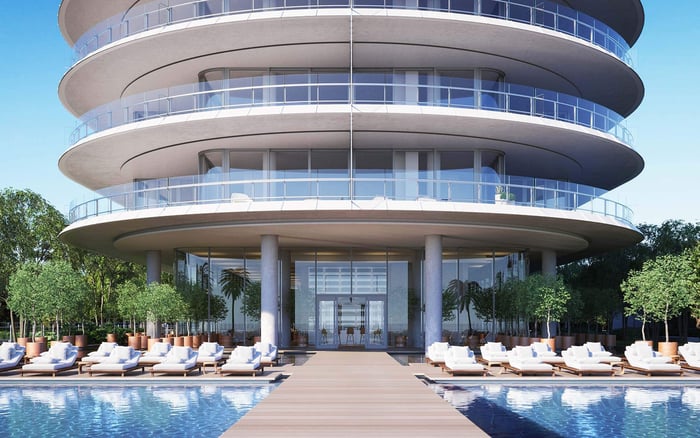
A buyer-focused examination of how brand licenses, operating budgets, shared services, and governing documents shape ownership at two prominent Brickell branded residences.

In Brickell, a celebrated name can shape a residence’s design language, hospitality ambitions, and market identity. Yet sophisticated buyers should distinguish the emotional power of a brand from the legal framework that permits a development to use it. At both 888 Brickell by Dolce & Gabbana and Baccarat Residences Brickell, the branded identity rests on a license agreement rather than direct ownership or development by the namesake luxury house.
That distinction is central to evaluating brand-management continuity. The legal disclosure for 888 Brickell states that the condominium is not owned, developed, or sold by Dolce & Gabbana or its affiliates. The developer’s right to use the marks arises from a license that may be terminated under its terms. Dolce & Gabbana also assumes no responsibility or liability for the project and makes no representation or warranty concerning it.
Baccarat’s documentation establishes a comparable separation. The developer uses Baccarat trade names, marks, and logos under a license agreement, while Baccarat is identified as neither the developer nor the party responsible for the developer’s representations. If the license ends, the Baccarat name and logos will no longer be used.
The brand creates identity, but the contracts determine continuity and recourse.
A terminable license does not predict a brand’s departure. It does mean that continued branding is contractual, not assured in perpetuity. Buyers should therefore seek a clear explanation of the provisions governing duration, renewal, termination, defaults, cure rights, and the consequences of a name change. The practical issue extends beyond whether signage could change. Buyers must determine whether operating standards, approved finishes, staff presentation, marketing, or required capital improvements are tied to the license or to separate management arrangements.
The most useful review maps each visible promise to the party responsible for fulfilling it. Who must deliver the residence? Who controls the condominium association? Who provides hotel or residential services? Who employs or supervises the staff? Who is responsible for defects, interrupted services, or unfulfilled representations? The answers may be distributed across the purchase agreement, declaration, prospectus, budget, brand-license disclosure, management contract, and warranty materials.
Buyers comparing other branded residences in the district, including Cipriani Residences Brickell and St. Regis® Residences Brickell, can apply the same discipline. A prestigious name should prompt more document review, not less, because design identity, services, management, and legal responsibility may be allocated among different entities.
888 Brickell is planned as a hybrid hotel and luxury condominium at 888 Brickell Avenue, with 259 private residences. Marketed homes range from one to four bedrooms and approximately 2,173 to 9,780 square feet. Some residences are designed to transition among a private residence, a corner hotel suite, and a hotel-room configuration.
That flexibility makes expense allocation especially important. A condo-hotel structure may encompass residential components, hotel operations, shared amenities, and services whose costs must be allocated. Buyers should determine which facilities are common elements, which are shared with the hotel, how shared expenses are apportioned, and whether specific services are included in regular assessments or charged by use. They should also identify costs associated with brand licensing or management and determine whether those obligations could affect association budgets.
Estimated 888 Brickell HOA dues are approximately $1.99 per square foot per month. At that rate, a 3,000-square-foot residence would equate to about $5,970 each month. This is a useful sizing exercise, not a substitute for the governing budget. The operative budget should confirm the current estimate, the area used in the calculation, included services, reserves, insurance treatment, and any expenses outside the recurring assessment.
No supported comparable HOA amount is available here for Baccarat Residences Brickell, so the two properties should not be modeled at the same rate. Each project’s budget, service scope, allocation method, and governing contracts require independent review.
A refined amenity program can justify meaningful operating expenditure, but buyers should understand which costs are fixed, variable, optional, or vulnerable to change. Begin with the proposed association budget and reconcile every material line with the declaration and management agreements. Determine whether hotel guests and residential owners use the same facilities, whether either component subsidizes the other, and how staffing, security, maintenance, utilities, and replacement reserves are divided.
The brand relationship warrants a separate cost inquiry. Buyers should establish who pays licensing and management fees, whether those fees can increase, and whether renewal, termination, rebranding, or brand-mandated upgrades could create new expenses. They should also determine which decisions belong to the developer, association, hotel operator, manager, or brand licensor. Control matters because an owner may bear an economic consequence without holding the corresponding decision right.
For larger residences, even modest changes in a per-square-foot charge can materially alter annual ownership costs. A prudent model should test the disclosed base case alongside higher-assessment scenarios, while separating recurring assessments from usage charges and potential special assessments. This level of detail belongs in serious buyer’s guides, particularly when a hospitality component adds operational complexity.
Owner recourse begins with the actual contracting parties, not the logo. At 888 Brickell, buyers should not assume that Dolce & Gabbana provides construction, operational, or service-level warranties. At Baccarat Residences Brickell, buyers likewise should not treat Baccarat as responsible for the developer’s representations. The appropriate remedy for a particular issue will depend on who made the promise, which document contains it, and what limitations, notice requirements, or dispute provisions apply.
Before signing, counsel should identify the entities responsible for development, construction obligations, deposits, warranties, management, and service delivery. Marketing language should be reconciled with the purchase agreement and condominium documents. If a service is material to the purchase decision, the buyer should locate its contractual basis, determine whether it can be modified, and understand what happens if the provider or brand changes.
Prospective owners should also review association governance: when control transfers, which approvals are required for major contracts, how budgets and assessments are adopted, and what access owners have to records. These provisions help clarify whether owners can influence management changes, challenge an allocation, or respond collectively to rebranding and capital requirements. Individual and association rights are not necessarily interchangeable, reinforcing the need for project-specific legal advice.
The central lesson is not that branded ownership is unusually uncertain. Rather, luxury identity and legal accountability occupy different layers. The brand license governs the right to use a name. The purchase agreement governs the acquisition. The declaration and budget shape condominium economics. Management and service contracts determine who operates the experience. Warranties and dispute provisions define where an owner may seek a remedy.
For buyers evaluating 888 Brickell by Dolce & Gabbana and Baccarat Residences Brickell, the most elegant approach is also the most exacting: value the design and service proposition, then underwrite its contractual durability. Confirm the current budget, identify every responsible party, test the effect of license termination, and insist that essential promises appear in enforceable documents rather than rest on assumptions.
For confidential guidance on Brickell ownership opportunities, connect with MILLION.
If branded residences are on your mind — as a home or as an allocation — we would be glad to share what we are seeing, privately.
Begin a quiet conversationNo. The legal disclosure states that the condominium is not owned, developed, or sold by Dolce & Gabbana or its affiliates.
No perpetual branding is established. The developer's right to use the marks comes from a license agreement that is terminable according to its terms.
No. Baccarat is identified as neither the developer nor the party responsible for the developer's representations.
The disclosed consequence is that the Baccarat names and logos will no longer be used.
A market-facing estimate is approximately $1.99 per square foot per month, but buyers should confirm the current amount and inclusions in the governing budget.
At $1.99 per square foot monthly, the calculation is approximately $5,970 per month, subject to confirmation in the project budget.
No supported Baccarat HOA amount is provided, so its charges should be reviewed independently rather than assumed to match 888 Brickell.
Its hybrid hotel and condominium format makes the allocation of shared services, amenities, and operating expenses an important document-review issue.
Buyers should focus on the purchase agreement, declaration, budget, license disclosures, management contracts, and applicable warranty materials.
Buyers should not assume so. The disclosures separate each namesake brand from the developer and direct attention to the actual contracting parties.