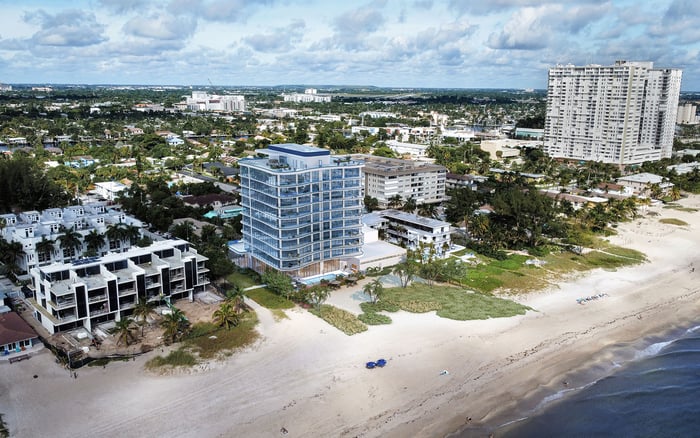
A document-focused comparison of what beach access and cabana language currently establishes at two Pompano Beach developments, plus the records buyers should review before treating exclusivity as a property right.
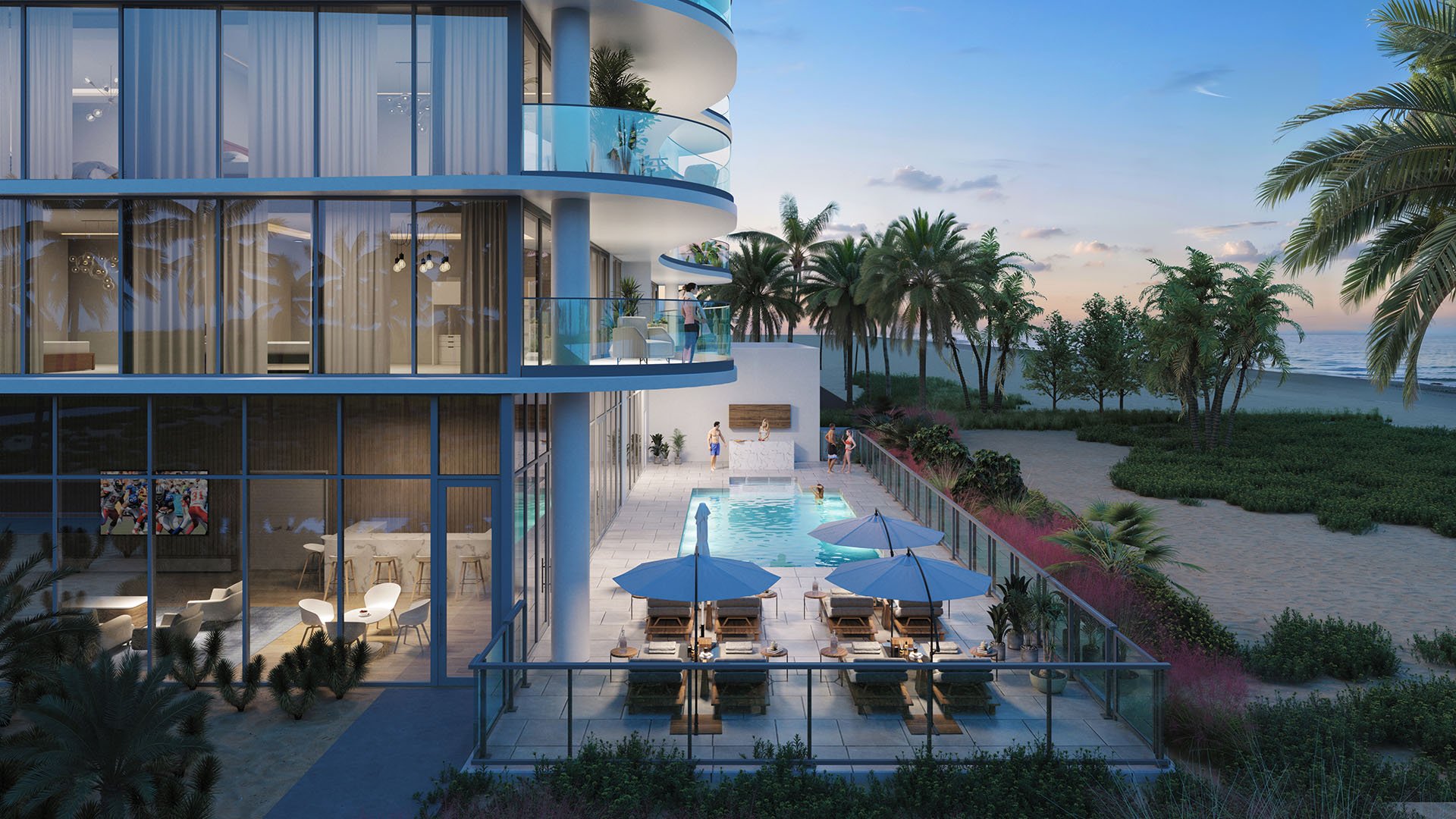
For an oceanfront buyer, the phrase “private beach access” carries an intuitive promise: a graceful path from residence to sand, a controlled arrival, and service calibrated to residents rather than the general public. Legally and operationally, however, access is not ownership. Nor does exclusivity in marketing language, absent the governing instruments, define who may use the shoreline or cross a particular parcel.
That distinction is central to comparing Ocean 580 Pompano Beach with Waldorf Astoria Residences Pompano Beach. Both are presented around direct coastal living, yet the available descriptions do not include recorded plats, public-easement maps, or legal opinions establishing shoreline ownership and public-use rights.
Beach access is an amenity promise; its enduring value depends on the documents beneath it.
Ocean 580 is a boutique beachfront condominium at 580 Briny Avenue in Pompano Beach. Its central proposition includes direct ocean views and “exclusive private beach access.” The outdoor program includes a beachside pool deck, spa, sun deck, loungers, and private beach access.
Those points establish the intended resident experience, but they do not define ownership of the beach or the legal perimeter of “exclusive.” The available project materials also do not publish detailed terms governing cabana ownership, assignment, reservations, fees, or guest use. A buyer should therefore avoid assuming that a cabana is included with a residence, separately purchasable, permanently assigned, or transferable.
The practical question is not whether the project is designed to feel private. It is. The question is which rights attach to the unit, which privileges arise from association rules, and which services remain subject to future operating policies. Until those distinctions appear in binding documents, loungers and access can be evaluated as disclosed amenities; specific cabana rights remain unconfirmed.
Waldorf Astoria Residences Pompano Beach is marketed as directly on the sand, with private beach access. Residents are described as receiving direct, private access to 200 linear feet of beachfront. The beachfront program includes a café with room service, pool, Jacuzzi, cabanas, and poolside dining.
Its amenity plan is more explicit about cabanas. A 20,000-square-foot oceanfront pool deck is set to include private resident cabanas, along with a spa, dining lounge, outdoor bar, summer kitchen, and sun deck. Private oceanfront cabanas are expressly offered for purchase. Importantly, the cabanas are situated on the oceanfront pool deck, not described as permanent structures at the waterline.
What remains unspecified is the legal character of the purchased interest. The available materials do not state whether a cabana is a deeded unit, a limited common element, a license, or another controlled-use right. Nor do they settle transfer restrictions, recurring charges, leasing, succession with the residence, or the association’s authority to regulate use.
Project-related locations are identified at 1350 S Ocean Boulevard and 1213 S Ocean Boulevard. Buyers should reconcile the role of each location across the purchase agreement, declaration, survey, and title materials, particularly where access routes and amenity parcels are concerned.
A separately priced cabana can feel like a natural extension of an oceanfront residence, yet its value depends on enforceability and control. At Waldorf, the purchase opportunity is clear; the precise property interest is not. At Ocean 580, the available disclosures do not substantiate detailed cabana terms at all.
Before assigning value, buyers should determine whether the right is exclusive, transferable, revocable, inheritable, or tied to continued ownership of a particular residence. They should also clarify reservation priority, operating hours, guest privileges, food-and-beverage obligations, insurance, maintenance, assessments, and the treatment of the right upon resale.
If a cabana is governed by rules rather than conveyed as real property, its utility may still be meaningful. It should simply be underwritten as an amenity privilege, not automatically as a separately owned asset. The purchase documents must control that conclusion.
No available material establishes that a public walkway or dune crossover passes through either development. Equally, promotional references to private or exclusive access do not establish the absence of recorded public rights. The prudent position is neutral until the relevant records are reviewed.
The essential package should include the recorded condominium declaration, plats, surveys, title exceptions, easement instruments, coastal-boundary records, and current operating rules. Together, these materials can reveal whether access paths cross association property, whether another parcel supports the route to the beach, and whether recorded rights affect privacy, circulation, security, or maintenance.
This review is especially important in Broward coastal purchases, where a buyer may care as much about the lived arrival at the sand as the view itself. The objective is not to infer a problem, but to determine whether the physical experience depicted in presentation materials is supported by durable rights and clearly allocated obligations.
The meaningful contrast is not simply boutique versus branded. Ocean 580 establishes an exclusive-access concept with a beachside outdoor program, but leaves cabana mechanics undefined in the available materials. Waldorf offers a broader, hospitality-led beachfront program and expressly makes private cabanas available for purchase, yet the form of that interest remains unresolved.
Buyers surveying the wider Pompano Beach market may also consider Armani Casa Residences Pompano Beach or The Ritz-Carlton Residences® Pompano Beach. Such comparisons are most useful when the same diligence framework is applied to every project: access route, ownership structure, cabana instrument, guest policy, recurring cost, and recorded easements.
Brand service may shape daily life, but it does not replace document review. Likewise, a boutique environment may offer intimacy without automatically answering how amenities are assigned or altered. The stronger purchase decision aligns design preference with legal and operational clarity.
Request a marked survey showing the route from the residential property to the beach, then match it to the declaration and easement schedule. Ask the developer to identify every parcel involved in that route and state who owns, maintains, insures, and controls it.
For any cabana, request the actual purchase or use instrument before attributing value. Confirm whether the right travels with the residence, may be sold separately, can be reassigned, and remains subject to rule changes. Obtain the current guest, reservation, service, and fee provisions in writing.
Finally, distinguish the shoreline experience from the legal interest being conveyed. A refined beach program can be a genuine lifestyle advantage. The buyer’s task is to ensure that expectations around access, privacy, service, and cabanas are expressed in enforceable documents rather than left solely to presentation language.
For discreet guidance on evaluating South Florida’s most considered coastal residences, connect with MILLION.
If branded residences are on your mind — as a home or as an allocation — we would be glad to share what we are seeing, privately.
Begin a quiet conversationNo. Access language alone does not establish beach ownership or define public-use rights along the shoreline.
Ocean 580 promotes exclusive private beach access as part of its beachfront residential experience.
The available materials do not specify cabana ownership, assignment, reservations, fees, or guest-use terms.
Residents are described as receiving direct, private access to 200 linear feet of beachfront.
Private oceanfront cabanas are expressly offered for purchase, but the legal form of the interest is not specified.
They are described on the oceanfront pool deck, not as permanent cabanas at the waterline.
Buyers should review recorded declarations, plats, surveys, title exceptions, easement instruments, coastal-boundary records, and operating rules.
No available material establishes that a public walkway or dune crossover passes through either development.
It determines whether the right is owned, licensed, transferable, revocable, or controlled through association rules.
Confirm the beach-access route, every parcel involved, maintenance obligations, recorded easements, cabana terms, guest rules, and recurring fees.