For seasonal owners with significant artwork, Pompano Beach’s branded residences call for careful planning beyond the arrival experience. A buyer-focused guide to ownership rules, freight routes, handling responsibility and climate continuity at W and The Ritz-Carlton Residences®.
A seasonal residence should feel effortless on arrival. For an owner bringing paintings, sculpture or a carefully assembled collection, that ease depends on arrangements made well before the first crate reaches the building. The essential questions extend beyond where a work will hang: how it arrives, who assumes responsibility and what happens while the residence is empty.
At W Pompano Beach Hotel & Residences and The Ritz-Carlton Residences® Pompano Beach, the distinction between hospitality and collection care deserves particular attention. Private elevator entry, attended lobbies and waterfront settings do not, by themselves, establish an art-logistics program. The useful comparison is not which brand sounds more accommodating, but which owner-specific arrangements can be confirmed in writing.
Neither project can be ranked above the other for art logistics on the available specifications. An undisclosed facility is not necessarily an absent one; it is a question to resolve before closing or shipment.
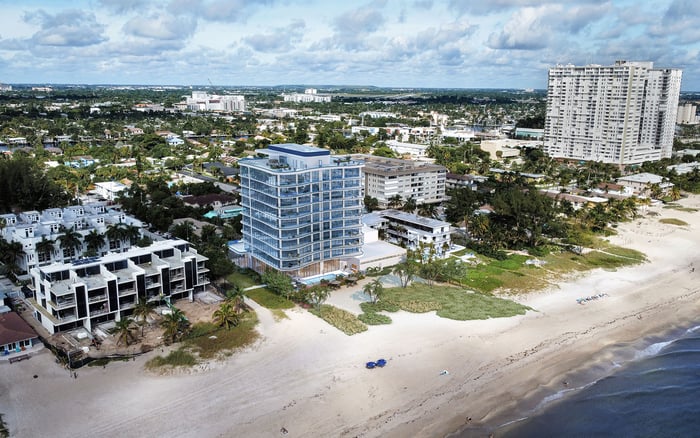
W occupies an Atlantic beachfront address at 20 North Ocean Boulevard. Its offering distinguishes 74 private residences from 296 fully furnished condo-hotel suites. That separation should frame the first conversation about personal artwork.
The private residences offer approximately 2,388-3,462 interior square feet and private elevator entry. The suites are fully furnished and fully finished, with layouts spanning 580-1,860 square feet. Neither floor area nor the furnishing description establishes permission to alter walls, replace furnishings or install a collection.
A private-residence buyer should request the applicable installation and delivery rules. A suite buyer should obtain suite-specific artwork and furnishing restrictions, rather than assume the same permissions apply. Ask who approves installers, whether proposed mounting work requires consent and what documentation must accompany a delivery.
W’s bellman services, dedicated lobby and reception, and 24-hour attended lobby and valet service are hospitality conveniences-not confirmation of specialist handling or liability coverage. Likewise, climate-controlled warehousing and white-glove installation associated with project furniture, fixtures and equipment should not be treated as continuing services for owners’ collections.
The Ritz-Carlton development extends between the Atlantic Ocean and the Intracoastal Waterway, with two towers, beachfront access to the east and a private marina to the west. Its address is 1380 South Ocean Boulevard.
For an art-owning buyer, the practical task is to request a delivery route and operating rules for the specific tower and residence. Do not assume that an answer about one arrival point resolves access elsewhere in the development. Confirm the unloading location, permitted route and final residence entry as one continuous journey.
Detailed freight-access and art-handling specifications remain unconfirmed. So do dedicated owner artwork storage, a climate-controlled receiving room and art-crate staging space. Ask management to distinguish facilities available for deliveries from spaces expressly approved for holding valuable artwork.
The anticipated 2026 delivery date is an estimate, not confirmation of completion or occupancy. Before arranging installation, obtain current confirmation that access, approvals and the relevant building systems will be ready for the scheduled shipment.
A crate must negotiate more than the elevator cab. Request written dimensions and operating requirements for loading clearances, vehicle limits, elevator door openings, cab dimensions and capacity. Include corridor turns and residence-entry clearances, then have the proposed art handler assess the entire route against the packed work.
Private elevator entry is no substitute for this exercise. It does not establish freight permissions, oversized-crate suitability or the availability of a service-elevator reservation. W’s freight-elevator dimensions, loading-bay clearances, truck restrictions and reservation procedures remain unspecified.
The delivery plan should identify an approved unloading point, staging space and crate-opening area. Confirm delivery hours, reservation requirements, insurance documentation, installation permissions and packing-material disposal. Ask what happens if the truck arrives early, access is delayed or installation cannot be completed that day.
Treat temporary holding as a separate approval. Permission to deliver a crate is not permission to leave it unattended or store it overnight. Resolve who authorizes any change before dispatch.
For seasonal owners, the most consequential handoff may occur in their absence. Establish whether insured third-party art handlers are permitted, whether building staff may touch artwork and who is authorized to sign for delivery. Identify who documents condition and when responsibility transfers between the carrier, handler, building and owner’s representative.
Ask your insurer and handling contractor to review the proposed arrangement, including any temporary holding period. A reassuring service description cannot replace written terms defining custody and liability.
Appoint an authorized local contact and define that person’s decision-making authority. If a crate arrives damaged or cannot follow the approved route, everyone involved should know whom to call and whether work must stop pending instructions. These are owner-specific arrangements to secure, not services to presume either building provides.
Climate planning begins with the collection, not a generic thermostat setting. Ask an art conservator to define the works’ temperature and humidity requirements, then ask management how those requirements can be supported during extended vacancy. No conservation targets or collection-specific performance guarantees are established here for either project.
Clarify vacancy-mode HVAC operation, monitoring, leak and humidity alerts, and responsibility for responding while the owner is away. Ask whether someone can enter the residence, inspect the affected area and coordinate the appropriate specialist under written authorization.
Emergency planning should address hurricanes, water intrusion, power outages and elevator shutdowns. Request the exact HVAC coverage of backup power rather than assume emergency electricity maintains the residence’s normal climate conditions. Establish artwork-relocation procedures and decision-making responsibility before an interruption.
W’s terraces range from approximately 290-1,150 square feet, but outdoor area does not establish conservation-grade conditions. Discuss any proposed terrace placement with the conservator separately from the interior collection plan.
Buyers also considering Waldorf Astoria Residences Pompano Beach can use the same questions without assuming equivalent facilities or services. Compare written commitments rather than extend one property’s hospitality promise to another.
Before closing or shipping artwork, assemble current governing documents, building rules, approved freight information and written service agreements. Ensure management, the handler, the conservator and the owner’s representative agree on the route, custody and vacancy plan. The objective is not an elaborate arrival ritual, but a residence whose practical arrangements support the collection throughout the owner’s absence.
For a discreet conversation about your seasonal residence search, connect with MILLION.
If branded residences are on your mind — as a home or as an allocation — we would be glad to share what we are seeing, privately.
Begin a quiet conversationNo. Confirm elevator dimensions, door openings, capacity, freight permissions and the entire delivery route before shipping a crated work.
The offering distinguishes 74 private residences from 296 condo-hotel suites, but identical artwork permissions are not established. Obtain rules specific to the ownership product.
The listed hospitality services do not establish specialist art handling or liability coverage. Obtain written confirmation of staff permissions and responsibilities.
Project furniture, fixtures and equipment logistics do not confirm a continuing artwork-storage service for owners. Request an owner-specific storage agreement if that service is needed.
A dedicated climate-controlled art receiving room, owner artwork storage and crate-staging facilities are not established in the disclosed amenities. Their availability requires direct written confirmation.
The development has two towers across an ocean-to-Intracoastal setting. Confirm the unloading point and complete route for the particular tower and residence rather than assuming shared arrangements.
Request loading clearances, vehicle limits, elevator dimensions, door openings and capacity, along with corridor and residence-entry clearances. Confirm delivery hours, reservations and insurance requirements.
Designate an authorized recipient and establish who documents condition and assumes custody. Confirm the arrangement with management, the handler and the insurer before dispatch.
Have a conservator define collection-specific requirements and ask management about vacancy-mode HVAC, monitoring, leak and humidity alerts, and emergency access. Verify exactly which HVAC systems receive backup power.
No. The anticipated delivery date is an estimate, not confirmation of completion or occupancy; confirm access and system readiness before scheduling installation.