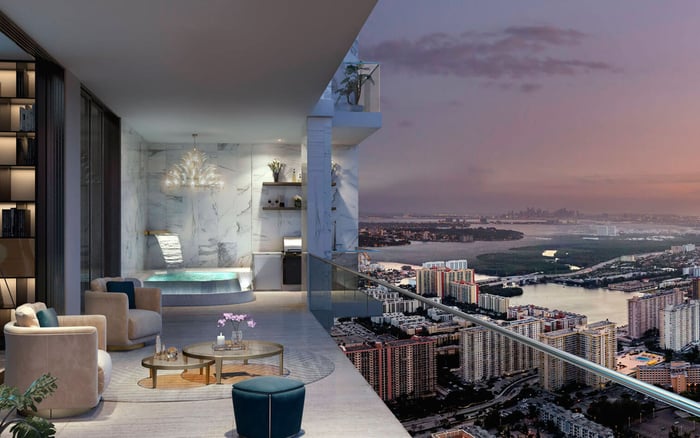
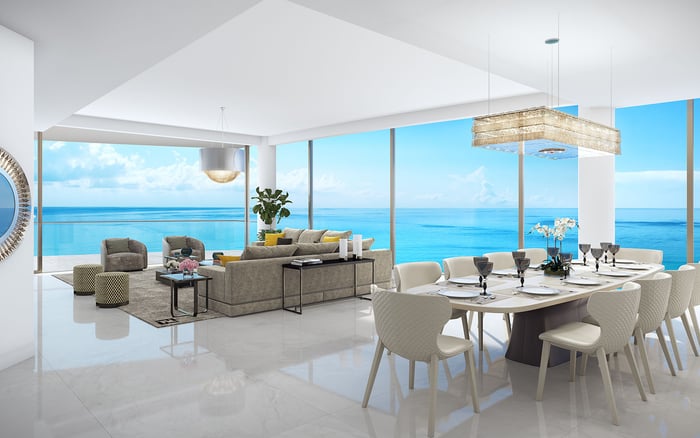
A buyer-focused comparison of elevator flow at two marquee Sunny Isles properties, centered on what can actually be inferred from tower form, residence count, amenity distribution, and shared Miami-Dade high-rise code context.
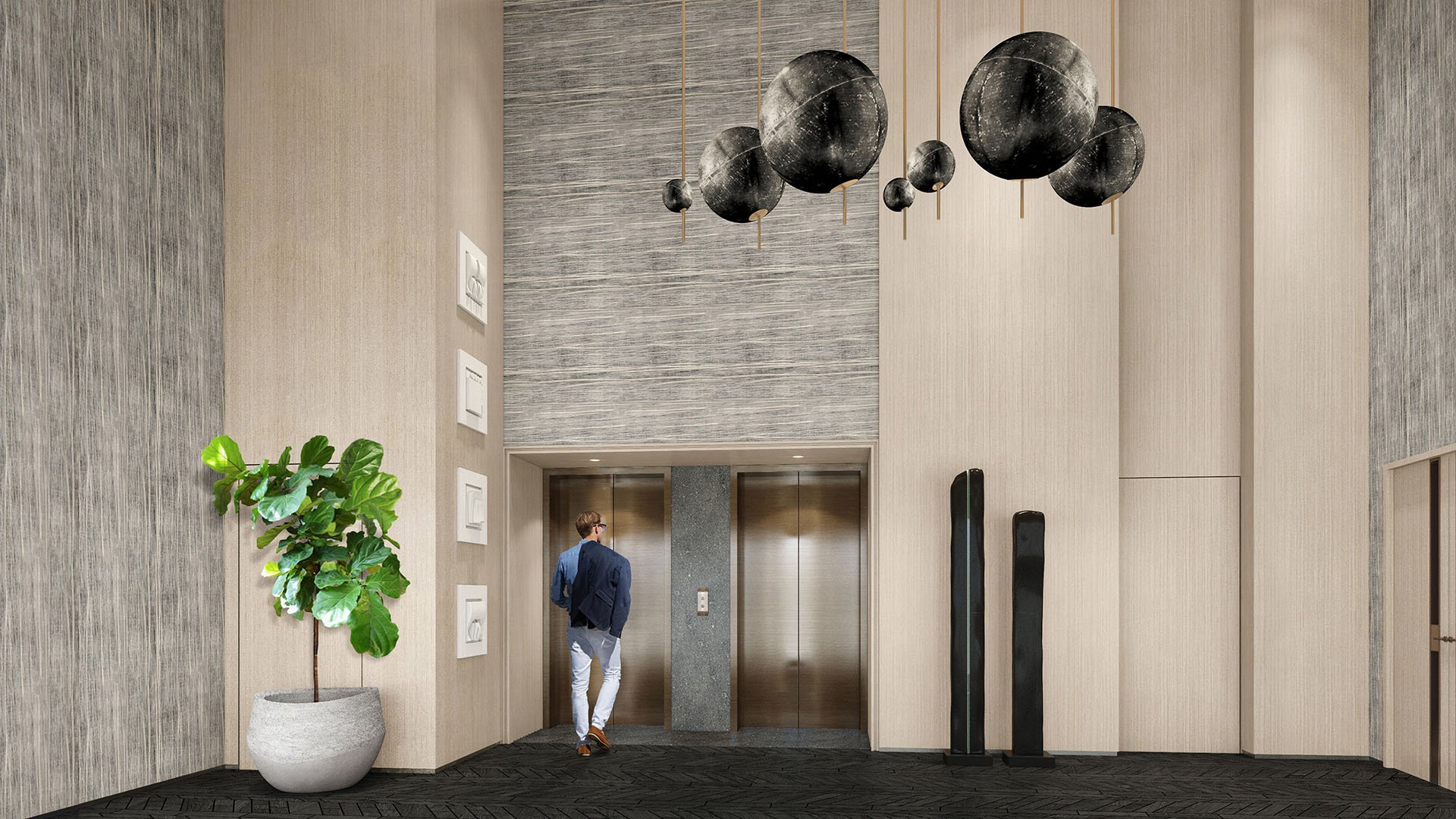
In the upper tier of Sunny Isles Beach, elevator performance is part engineering, part planning, and part daily lifestyle. Buyers often ask which tower is faster, but at this level the more meaningful question is how a building organizes movement. In that respect, Turnberry Ocean Club and The Estates at Acqualina reflect two distinct circulation philosophies.
Turnberry Ocean Club is a 54-story oceanfront condominium tower with 154 residences. The Estates at Acqualina is an oceanfront development of two 50-story residential towers with 245 residences in total. Those basic distinctions immediately shape the elevator conversation. One property concentrates demand into a single vertical experience. The other distributes demand across parallel towers while also relying on a broader, campus-like amenity environment.
That makes this less a contest of publicly verified speed than a comparison of flow. For a luxury buyer, flow is what determines whether departures feel orderly, arrivals feel private, and amenity access feels seamless rather than orchestrated.
At Turnberry Ocean Club Sunny Isles, the elevator story begins with concentration. With 154 residences stacked into one slender 54-story profile, vertical transportation must serve not only the homes but also the layered experience of a high-rise amenity program and panoramic residential living.
In practical terms, that means a resident's day is more likely to depend on one primary core system performing smoothly across multiple use patterns: morning departures, evening returns, guest arrivals, service movement, and amenity-bound trips. In a single-tower ultra-luxury building, the question is not whether the elevators are designed to handle traffic, but how refined the zoning and dispatch logic feel when several demand waves overlap.
For some buyers, this is part of the appeal. A single tower can create a stronger sense of architectural singularity and a more unified residential identity. It can also make vertical access feel more direct, especially for owners who value the self-contained nature of a tower over a larger residential campus. Comparable buyers often look across Sunny Isles to properties such as Muse Residences Sunny Isles Beach or Jade Signature Sunny Isles Beach for the same reason: the building itself is the lifestyle framework.
The trade-off is intuitive. Even with fewer residences overall than The Estates at Acqualina, Turnberry's traffic challenge is more concentrated per core because everyone is moving within one tower envelope.
At The Estates at Acqualina Sunny Isles, the circulation logic is fundamentally different. The project spans two 50-story towers and 245 residences in total, which means elevator demand is larger in the aggregate but divided across separate vertical systems.
That distribution can ease single-core congestion. Instead of one tower absorbing all resident movement, each tower handles its own share of arrivals, departures, and intra-building trips. For a buyer, that can translate into a different feel: less pressure on any one vertical spine, even though the overall resident population is higher.
Just as important, The Estates at Acqualina reads more like a luxury compound than a singular high-rise object. Amenity movement is not purely vertical. Some circulation is horizontal across the broader property, and that changes the resident experience. Elevator performance still matters, but so does the way tower access interfaces with shared grounds, services, and hospitality-style programming. Buyers who appreciate that campus sensibility often respond to other resort-oriented oceanfront concepts such as Bentley Residences Sunny Isles or St. Regis® Residences Sunny Isles, where arrival sequence and property-wide movement are part of the appeal.
The title invites a mechanical comparison, but restraint is warranted. Publicly disclosed materials do not establish a verified winner on raw elevator technology. There are no confirmed public figures here for speed in feet per second, average wait times, handling capacity, manufacturer, model family, or machine-room configuration.
So the credible comparison is not a speculative one about hardware claims. It is a planning-based one.
Turnberry Ocean Club likely places greater emphasis on how one tower core manages concentrated vertical demand. The Estates at Acqualina likely benefits from the natural traffic distribution that comes with two towers. Neither conclusion requires embellishment. Both are grounded in building organization rather than unsupported mechanical lore.
For sophisticated buyers, that is the more useful lens. In real life, elevator quality is rarely experienced as a spec sheet. It is experienced as rhythm: how smoothly a resident reaches the lobby, how private the ascent feels, whether amenity access interrupts residential calm, and whether the building's movement patterns remain composed during peak hours.
Elevator flow in a luxury property is never isolated from operations. Turnberry Ocean Club is framed by a development and management context associated with Related, while The Estates at Acqualina carries the aura of the Acqualina hospitality ecosystem. Those brand environments suggest different service sensibilities, even if public materials do not reduce them to technical lift metrics.
For Turnberry, the impression is of a highly vertical residential experience in which amenities and homes are tied together within one architectural statement. For The Estates at Acqualina, the impression is more hospitality-driven, where circulation extends beyond the elevator car and into broader service choreography across the property.
This distinction matters because owners do not merely buy transport efficiency. They buy how a building feels in motion. A tower can have excellent engineering and still feel busy if circulation overlaps inelegantly. Conversely, a larger property can feel surprisingly calm if movement is distributed well and arrivals are managed with precision.
Both projects sit in Sunny Isles Beach and operate within the same Miami-Dade building standards environment for high-rise life safety, emergency systems, and code compliance. That common framework levels the baseline in important ways. Buyers can assume both properties function within the same broader regulatory landscape.
What differs is not the county context but the architectural organization built on top of it. A single 54-story residential tower with 154 homes will produce one set of movement patterns. Two 50-story towers with 245 residences total will produce another. That distinction is the clearest verified line between these addresses.
If a purchaser prioritizes a singular tower identity, a more vertically integrated lifestyle, and the elegance of one defining high-rise core, Turnberry Ocean Club may read as the more coherent proposition. If a purchaser prefers distributed traffic, a multi-tower setting, and a property where circulation is split between tower movement and campus movement, The Estates at Acqualina may feel more naturally diffused.
The key point is that neither property can be crowned mechanically superior from public disclosures alone. The more intelligent conclusion is narrower and more useful: Turnberry's challenge is concentrated vertical flow, while The Estates at Acqualina's advantage is distributed tower flow. In elite real estate, that distinction can shape everyday comfort as much as finishes, views, or amenities.
Which building has more residences? The Estates at Acqualina has 245 residences in total, while Turnberry Ocean Club has 154.
Which property is taller? Turnberry Ocean Club is 54 stories, while each tower at The Estates at Acqualina is 50 stories.
Is there public proof of which elevator is faster? No. Publicly disclosed materials do not confirm speed, wait-time, or throughput benchmarks for either property.
Does Turnberry Ocean Club have a more concentrated elevator load? Yes. Its single-tower format means resident and amenity traffic is funneled into one vertical system.
Does The Estates at Acqualina benefit from distributed traffic? Broadly, yes. Two towers can spread demand across parallel vertical cores instead of one.
Are the amenity patterns different between the two projects? Yes. Turnberry reads as more vertically stacked, while The Estates at Acqualina combines tower movement with campus-style circulation.
Do public materials identify the elevator brand or model? No. Those technical specifications are not publicly detailed in the supplied project materials.
Are both buildings under the same county code framework? Yes. Both are in Sunny Isles Beach and fall within the broader Miami-Dade high-rise regulatory environment.
Which project may feel more self-contained? Turnberry Ocean Club may feel more self-contained because the lifestyle is organized within one tower.
What is the most defensible conclusion for buyers? Compare circulation logic, not marketing mythology: Turnberry is concentrated vertical flow, and The Estates at Acqualina is distributed tower flow.
If you'd like a private walkthrough and a curated shortlist, connect with MILLION Luxury.
If branded residences are on your mind — as a home or as an allocation — we would be glad to share what we are seeing, privately.
Begin a quiet conversation