Five Miami residential alternatives for buyers who want art in their weekly routine without making a busy gallery district their home, from Coconut Grove to the northern creative corridor.
For an art-minded buyer, the ideal Miami address need not sit beside an opening-night reception. The more useful distinction is between access to culture and immersion in its busiest settings. A home can support frequent gallery visits while preserving a residential rhythm separate from the evening’s itinerary.
Miami’s gallery geography makes that possible. Beyond Wynwood, the scene extends into Little Haiti, the Design District, Allapattah, South Beach, and Downtown. Each offers a different experience, from artist studios to warehouse-scale exhibitions and art encountered alongside architecture and design.
The five areas below are ranked for their balance of residential character and cultural access-not investment performance, gallery counts, or measured travel times. None should be treated as event-free. The right fit depends on the particular street, building, and route to the places you actually visit.
1. Coconut Grove - Miami
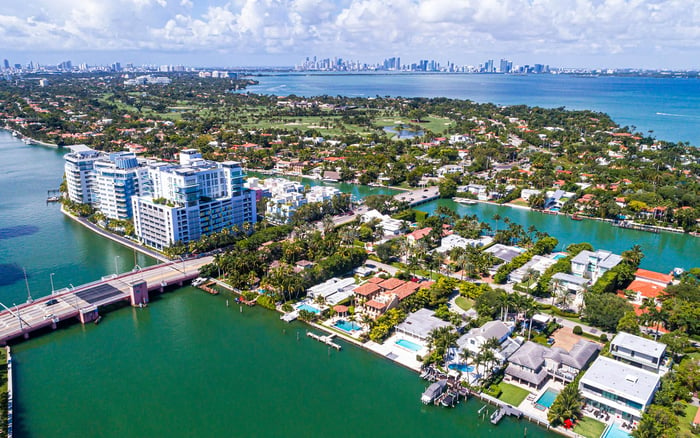
Coconut Grove takes first place for buyers who want their home environment to remain distinct from their cultural outings. Its lower-rise, village-like character, greenery, cafés, and waterfront amenities offer a residential counterpoint to the northern arts districts. The appeal is not a continuous gallery circuit outside the front door, but a neighborhood to return to after an afternoon of viewing.
The trade-off is a more dispersed art routine. Choose the Grove if neighborhood atmosphere matters more than immediate immersion in a concentrated arts cluster. Frequent visits depend on your itinerary, with routes and travel times assessed from the specific property rather than assumed from the neighborhood name.
2. Little River / Little Haiti - Northern Miami
Little River and Little Haiti suit buyers who want a closer relationship with an emerging gallery-and-studio environment without choosing Wynwood’s core. Both are part of the northern creative corridor, and Little River lies north of Wynwood and the Design District. That geography makes the area relevant to buyers whose interests span several arts destinations.
The draw is proximity to creative activity, not guaranteed quiet. A promising residential address still requires a block-level assessment of surrounding uses, recurring programming, and parking. These are northern Miami neighborhoods, not the City of North Miami-an important distinction when defining a property search.
3. Allapattah - West of Wynwood
Allapattah is the strongest choice here for buyers drawn to institutional art and large-format exhibitions. The Rubell Museum’s relocation there in 2019 helped establish the area as an important cultural destination. Warehouse-scale exhibition spaces give its art experience a different emphasis from a conventional circuit of neighborhood galleries.
This is a more specific proposition than simply living near art. It favors buyers who would make substantial exhibitions part of their routine. Cultural appeal alone, however, does not establish residential suitability. Evaluate each home’s immediate surroundings independently, especially if the objective is separation from event activity.
4. Edgewater / Midtown-adjacent residential areas - Near the creative corridor
Edgewater and Midtown-adjacent addresses offer a condominium-oriented alternative near the Wynwood-Design District corridor. Midtown provides access to the surrounding creative areas without requiring a residence in the Design District itself. For buyers who prefer condominium living, this is a useful middle position: a residential base near several cultural destinations.
The advantage is the ability to separate the home search from the gallery district’s boundaries. It is not a promise of walking access or uniform quiet. Compare individual buildings, approach routes, and nearby activity rather than treating Edgewater or Midtown adjacency as a complete description of daily life.
5. Coral Gables - Southwest of central Miami
Coral Gables earns its place through established, lower-rise residential character rather than immersion in the northern gallery corridor. For buyers who want art to be a recurring destination, not the defining feature of their immediate neighborhood, that separation can be an advantage.
The compromise is straightforward: prioritize the setting of the home and plan cultural outings around it. Coral Gables is best approached as a residential-first choice. Test the journey to preferred galleries before deciding whether that arrangement supports the frequency of visits you envision.
Begin with the kind of art visit you want to repeat. Wynwood combines galleries and murals with nightlife and urban activity. The Design District brings galleries together with public art, architecture, luxury retail, and design showrooms. Little River and Little Haiti introduce an emerging studio-and-gallery dimension, while Allapattah emphasizes institutional art and large-format exhibitions.
These are not interchangeable outings. A buyer interested in extended exhibition visits may assess access differently from someone who prefers brief stops at several galleries. Build a short personal circuit before comparing homes, then test it at the hours you expect to visit. A neighborhood’s position on a map is only the beginning of that decision.
For a Grove-focused search, Arbor Coconut Grove can be considered within the broader neighborhood comparison. The key question is whether the particular address delivers a residential experience you value enough to accept a more dispersed gallery routine.
For buyers considering Edgewater, Aria Reserve Miami is one project to include in an address-specific search. Evaluate the actual journey from the property to your preferred cultural destinations rather than assuming every condominium in the area offers the same convenience.
Apply the same discipline when reviewing EDITION Edgewater. Project selection and cultural access are related decisions, but neither replaces a close examination of the immediate surroundings. Review arrival arrangements, nearby programming, and the residential experience during both ordinary periods and busier evenings.
In Coral Gables, Ponce Park Coral Gables raises a different question: whether an established residential setting matters more than proximity to the northern creative corridor. Keep that preference explicit so the home search does not drift toward convenience at the expense of neighborhood fit.
Before committing, revisit the address at different times, inspect the likely routes, and ask about recurring nearby events. Check noise, parking, and the practical transition from a cultural outing to arriving home. Being outside an event district does not mean being insulated from events.
Coconut Grove leads this ranking because residential character is the priority. Little River and Little Haiti offer a creative-neighborhood alternative; Allapattah emphasizes exhibitions; Edgewater favors condominium-oriented access; and Coral Gables preserves a residential-first approach. The best choice makes gallery visits repeatable without asking you to compromise on how home should feel.
To refine a Miami home search around your cultural routine and residential priorities, connect with MILLION.
If branded residences are on your mind — as a home or as an allocation — we would be glad to share what we are seeing, privately.
Begin a quiet conversationCoconut Grove ranks first for its village-like character, greenery, cafés, and waterfront amenities. Its principal trade-off is a more dispersed gallery routine.
No; it is an editorial lifestyle ranking focused on residential character and cultural access, not returns, gallery counts, or measured travel times.
They offer emerging gallery-and-studio clusters outside Wynwood’s core. Buyers should still assess nearby programming, noise, and parking at each address.
No; they are described here as northern Miami neighborhoods, not the City of North Miami.
Allapattah offers institutional art and warehouse-scale exhibition spaces. The Rubell Museum relocated there in 2019.
They provide a condominium-oriented alternative near the Wynwood–Design District corridor without requiring a home directly within either district.
The Design District combines galleries with public art, architecture, luxury retail, and design showrooms.
Coral Gables suits buyers who prioritize an established, lower-rise residential setting over immersion in the northern gallery corridor.
No; walking routes and travel times should be verified from the specific property to the galleries the buyer intends to visit.
No; buyers should examine the property’s surroundings, recurring events, noise, and parking at different times before committing.