A Boca Raton due-diligence shortlist examining historical construction financing alongside the reserve, budget and ownership-cost questions that matter before purchase-not a verified ranking of assessment protection.

For a Boca Raton condominium buyer, financial comfort extends beyond the ability to close. It requires understanding the obligations that follow: routine association payments, contributions toward future capital work and the possibility of an additional call for funds. A beautifully appointed residence warrants an equally careful review of the financial structure behind its ownership.
Special assessments are additional charges for major repairs or unexpected expenses that an association's regular budget cannot cover. Reserves serve a different purpose: they fund predictable capital expenses, including roof replacement, elevator modernization and concrete repairs, separately from everyday operations. Construction financing and association reserves answer different questions.
For buyers considering Alina Residences Boca Raton, that distinction is essential. Named lenders and historical financing amounts provide context for development funding. They do not establish how much an association has saved, whether owner contributions are adequate or whether future special assessments will be necessary.
Despite the title's Top 5 framing, the available information does not support a ranking of five distinct condominium projects with demonstrated lower assessment exposure. The entries below are a limited starting point for financial due diligence; phases and mixed-use financing should not be counted as separate, verified residential choices. The decisive comparison belongs at the association level.
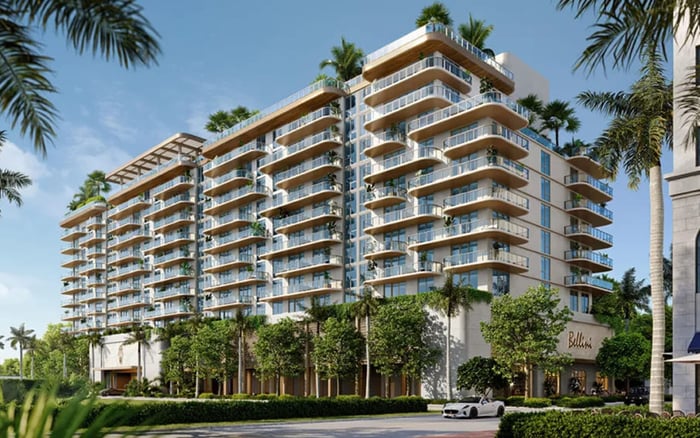
Alina Residences is a luxury condominium development in downtown Boca Raton. Its first phase received $146 million in construction financing from Deutsche Bank and Bank Hapoalim. Its second phase was associated with a $52.8 million loan from Deutsche Bank's New York branch. These are historical financing figures, not current debt balances.
The distinguishing detail is the identification of institutional lenders across both phases. A buyer's next step is to request the budget, reserve documentation and expense-allocation provisions applicable to the particular residence. Development-wide financing history does not answer every question about phase-specific ownership obligations.
Penn-Florida secured a $225 million construction loan for the final phase of its luxury mixed-use development in downtown Boca Raton-the largest individual construction facility in this comparison. That historical figure does not establish today's outstanding balance.
The facility's size is no substitute for a review of association finances. Before connecting this financing to a particular purchase, confirm the legal condominium identity and the entity responsible for each expense. In a mixed-use setting, request the documents governing shared facilities and cost allocation rather than assuming every obligation falls within the residential association's budget.
Glass House Boca Raton is a nine-story residential condominium tower at 280 E. Palmetto Park Road. Developer 280 E. Palmetto Park Road LLC obtained a $70 million construction loan for vertical construction, with financing provided by Maxim Capital.
The defined construction purpose makes this a useful detail about development funding. It does not establish future reserve balances or owner contributions. Buyers should examine the proposed or adopted association budget, clarify which figures remain estimates and request the assumptions behind the reserve contribution. A construction loan cannot substitute for those documents.
The first test concerns development financing. The second concerns the association's ability to pay for the building over time. Satisfying one does not demonstrate that the other has been met.
At Glass House Boca Raton, for example, the construction loan has a defined vertical-construction purpose. Buyers should keep that fact separate from questions about future repairs, insurance deductibles and reserve contributions. Institutional lending is not a guarantee that every cost overrun is covered or that owners cannot face later assessments.
The same discipline applies to a broader comparison that includes The Residences at Mandarin Oriental Boca Raton. Treat it as a separate document review, not an automatic extension of the Penn-Florida financing entry. Establish the property's legal identity and applicable financial obligations before drawing conclusions from any development-level loan figure.
Start with the adopted association budget, or the proposed budget where that is the relevant purchase document. Identify the dedicated reserve contribution and ask how it was calculated. Examine whether the contribution reflects the property's anticipated capital needs rather than relying on the stated monthly payment alone.
Next, request the applicable reserve study and Structural Integrity Reserve Study documentation. Compare identified capital needs and anticipated expenditure dates with the funding schedule. Ask whether the budget reflects those requirements, and have qualified advisers explain which obligations apply to the property. A general assurance of compliance is not enough.
Then examine the supporting financial documents. Request current reserve balances, available turnover financial statements and disclosures of pending assessments. Where an association is still being established, distinguish projections from actual financial results. A proposed contribution is not money already held in reserve.
Finally, read the insurance and shared-facility provisions. Ask about deductibles, responsibility for common facilities and the allocation of expenses outside the residence itself. These questions are particularly important when several entities may share obligations. Let the documents-not assumptions about the development-guide the analysis.
The most useful comparison goes beyond the lowest stated monthly payment. Compare what each payment covers, what is being reserved and which obligations remain separate. A smaller payment should prompt questions about scope and assumptions, not an immediate conclusion that ownership is more economical.
Before committing, ask your attorney and financial advisers to reconcile the budget with the applicable reserve studies and governing documents. Request written clarification wherever a projected expense, shared obligation or assessment disclosure is unclear. That review turns an attractive presentation into a more informed ownership decision.
For buyers seeking lower exposure to special assessments, the objective is not an impossible promise of zero surprises. It is a funding plan with assumptions that can be examined and obligations that can be understood before purchase. Construction financing provides development context; association-level documentation should guide the ownership decision.
For a considered approach to Boca Raton condominium ownership, explore your options with MILLION.
If branded residences are on your mind — as a home or as an allocation — we would be glad to share what we are seeing, privately.
Begin a quiet conversationIt is an additional charge for major repairs or unexpected expenses that an association's regular budget cannot cover.
Reserves fund predictable capital expenses, such as roof replacement, elevator modernization and concrete repairs, separately from routine operations.
A construction loan alone does not establish lower exposure. Association reserves, budgets and funding obligations require a separate review.
The figures are $146 million for Phase I and a $52.8 million Phase II loan. They do not confirm current debt balances.
It establishes historical construction financing for the final phase of its downtown Boca Raton mixed-use development. It does not establish association reserve adequacy or today's outstanding loan balance.
The financing is a $70 million loan from Maxim Capital for vertical construction of the nine-story tower at 280 E. Palmetto Park Road.
Start with the applicable association budget, reserve studies and funding schedules. Also request reserve balances, insurance deductibles, shared-facility obligations and pending-assessment disclosures.
Not necessarily. Compare what the payment covers, the reserve contribution and any separate obligations before judging ownership costs.
No, the available information does not establish five distinct projects with demonstrated lower exposure. The shortlist is a starting point for due diligence, not a verified ranking of association funding adequacy.
No such protection is established by the construction financing described here. Construction funding should not be treated as a guarantee against cost overruns or later owner assessments.