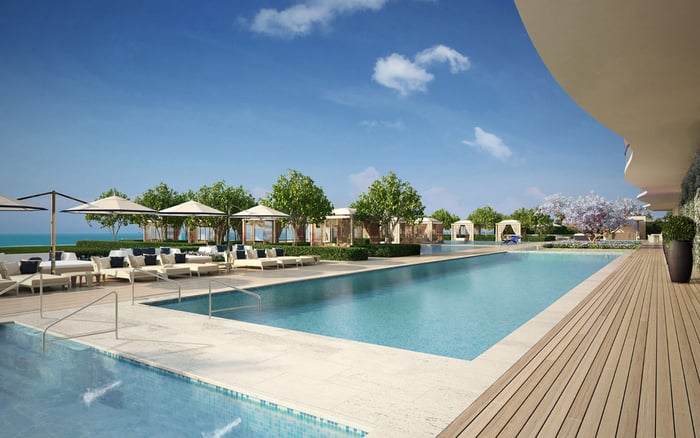
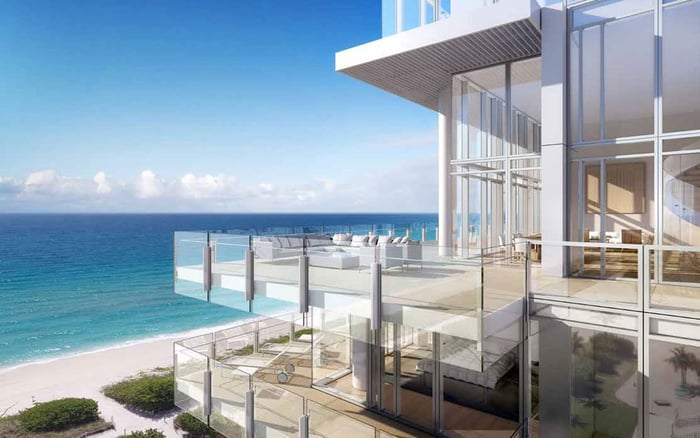
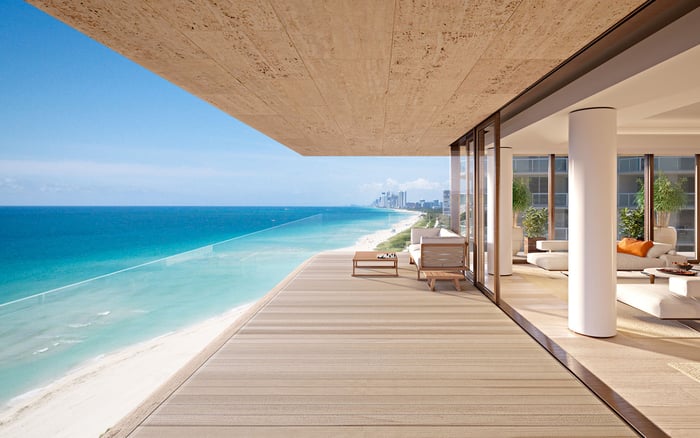
A buyer-focused examination of how private plunge pools at The Surf Club Four Seasons Surfside reveal the deeper logic of quiet luxury: service, discretion, technical execution, and long-term ownership value.
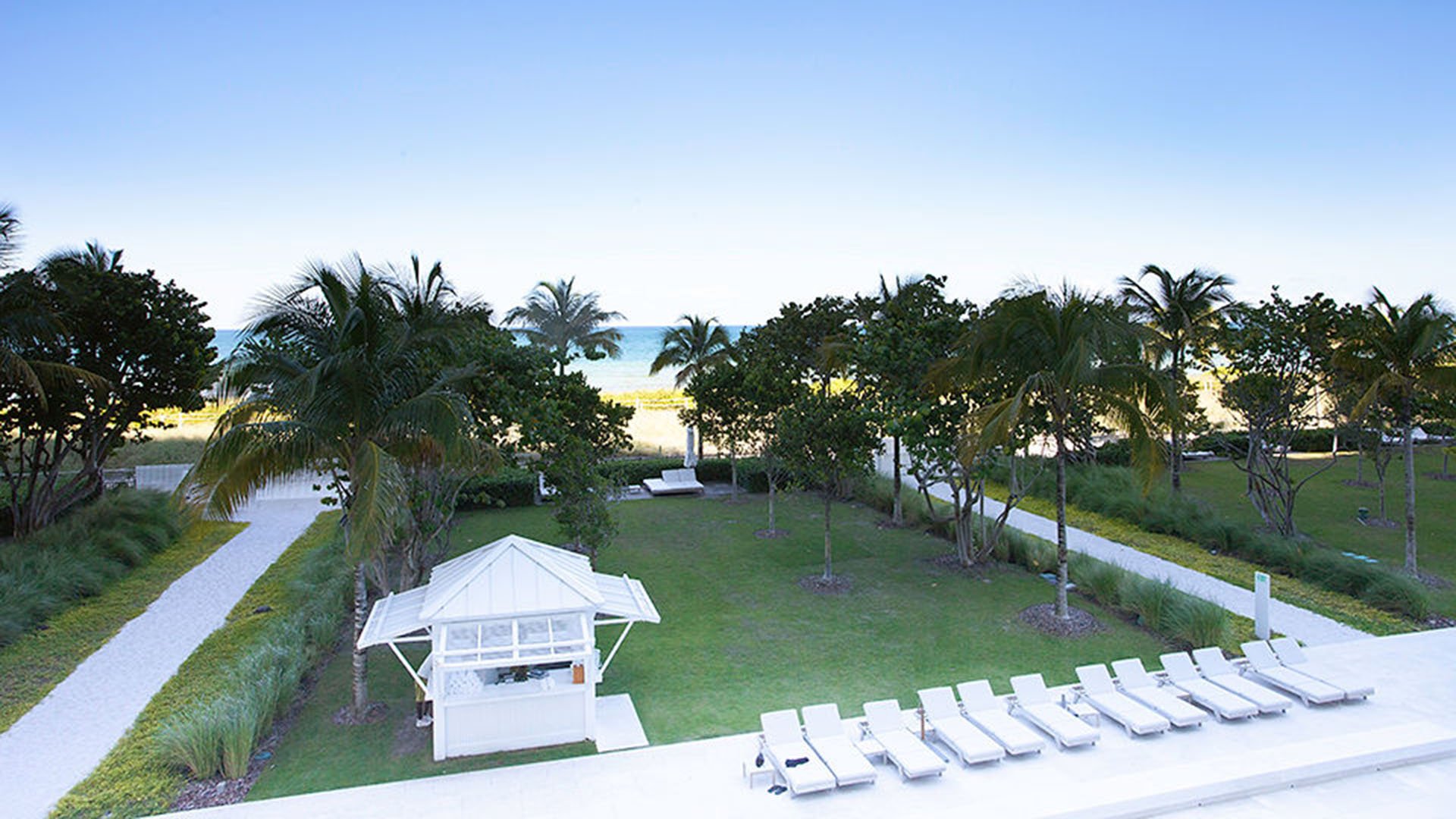
The Surf Club Four Seasons Surfside occupies a singular place in South Florida’s luxury imagination: oceanfront, composed, and defined less by volume than restraint. Its appeal is not a loud performance of wealth, but a precise calibration of proportion, material, privacy, and service. In that context, the private plunge pool becomes an unusually revealing detail.
A plunge pool can be read as a visual amenity, but that is the least sophisticated interpretation. In a property shaped by quiet luxury, water is not simply decoration. It is a private ritual, a daily pause, a cooling threshold between interior calm and coastal air. The question for an owner is not merely whether an outdoor area includes one. The more important question is whether the pool enhances daily life without interrupting architectural purity or creating visible operational friction.
That distinction matters because the most refined amenities are often the most technically demanding. The owner should experience ease. The building, association, and service teams must manage the complexity.
In Surfside, oceanfront living intensifies every design decision. Salt air, humidity, wind exposure, waterproofing risk, and access logistics all affect how exterior amenities age. A plunge pool on or near a private terrace may appear minimal, even serene, yet behind that serenity sits a layered set of obligations.
Structural engineering has to be understood. Waterproofing strategy has to be credible. Mechanical systems have to be reachable without compromising privacy. Code compliance, drainage, finishes, cleaning routines, and association protocols all influence whether the feature remains an asset or becomes a point of future negotiation.
This is why plunge pools should be treated less like optional indulgences and more like small-scale private infrastructure. The best examples disappear into the residence’s rhythm. The weak examples eventually announce themselves through staining, noise, access conflicts, service interruptions, or uncertainty around responsibility.
At The Surf Club Four Seasons Surfside, the analytical lens is especially useful because hospitality-branded residential living depends on invisible orchestration. The promise is not only what is built, but how quietly it can be maintained.
The luxury of a private plunge pool is psychological as much as physical. It can frame a morning routine, provide a post-beach reset, or extend evening privacy without requiring a trip to a shared amenity deck. In a refined outdoor setting, that intimacy is the point.
Yet privacy only works if serviceability has been resolved. Owners should not have to think about maintenance access, equipment placement, water treatment, or repair sequencing in ordinary use. The pool should feel ready, discreet, and proportionate. Staff and systems should be able to support it without turning the private zone into a back-of-house corridor.
This is the essence of quiet luxury: not the absence of complexity, but the suppression of visible complexity. A beautiful water feature that demands too much owner involvement is not truly effortless. A smaller, better-integrated plunge pool may be far more valuable than a larger, more conspicuous one that imposes practical compromises.
For buyers and advisors, plunge-pool diligence should be more rigorous than a showing might suggest. The first question is access. Can the system be serviced without entering private living areas in a disruptive way? If access depends on awkward routes, constrained timing, or intrusive workarounds, the amenity may be less convenient than it appears.
The second question is waterproofing. Buyers do not need to become engineers, but they should understand whether the building’s design anticipates long-term water exposure, maintenance, and repairs. A terrace pool is not only about the basin itself. It is about the envelope around it, the drainage path below it, and the consequences if something fails.
The third question is operational responsibility. Who maintains the water? How are issues escalated? What is covered by owner responsibility versus association responsibility? Are reserves and staffing assumptions aligned with the feature’s long-term care? In multimillion-dollar ownership, ambiguity is expensive.
The fourth question is architectural integrity. Does the pool feel native to the residence, or does it read as an afterthought? At the top of the market, buyers pay for coherence. A pool that disrupts the terrace plan, sightline, or usable outdoor living area can weaken the very lifestyle it was meant to enhance.
Resale value is rarely created by a single amenity in isolation. It is created by the perception that the amenity improves livability while preserving confidence. A technically well-executed plunge pool can support pricing power because it offers a private experience that is difficult to replicate. It can also support liquidity because future buyers are not forced to inherit uncertainty.
The inverse is also true. If service access is unclear, waterproofing questions linger, or maintenance feels unusually owner-dependent, the feature can become a diligence item rather than a premium. In ultra-prime inventory, buyers may admire the idea of private water while discounting the execution risk.
This is where The Surf Club example becomes instructive. Its quiet-luxury positioning makes the pool less about display and more about trust. The most compelling version is one where the owner feels the pleasure of private water, while the building’s service framework absorbs the work behind it.
Surfside has a particular appeal for buyers who want oceanfront access without constant theatricality. The luxury language is often softer: low public visibility, refined arrival sequences, indoor-outdoor calm, and a sense that service exists without announcing itself. In that setting, a plunge pool should not compete with the architecture or the Atlantic horizon. It should extend the experience of privacy.
That extension is most persuasive when it is scaled correctly. A plunge pool does not need to dominate a terrace to justify itself. It needs to create a believable ritual, supported by systems that are easy to inspect, maintain, and fund over time. The right question is not, “How dramatic is it?” The right question is, “Will this still feel effortless ten years from now?”
For sophisticated buyers, that reframing is central. The long ownership horizon demands attention to the hidden life of the amenity. The more invisible the service model feels, the more complete the luxury experience becomes.
Does every residence at The Surf Club Four Seasons Surfside have a plunge pool? Buyers should verify the specific configuration of any residence under consideration. The value question is not only whether private water is present, but how well it is integrated and maintained.
Why are plunge pools important in quiet-luxury design? They create private ritual without needing to be theatrical. Their value depends on restraint, proportion, and ease of use.
What makes a plunge pool serviceable? Serviceability includes practical access, credible waterproofing, maintainable mechanical systems, staffing clarity, and reserve planning.
Can a plunge pool improve resale value? It can support resale confidence when it is technically well executed and easy to maintain. Poor execution can turn the same feature into a diligence concern.
Why does waterproofing matter so much? Water exposure is continuous and unforgiving. A strong waterproofing strategy helps preserve the residence, terrace, and building envelope over time.
Should buyers focus more on size or integration? Integration is usually more important than size. A well-scaled plunge pool that preserves views, circulation, and privacy is more compelling than a larger feature that feels forced.
How does hospitality service affect plunge-pool ownership? A strong service model can make the feature feel effortless by handling recurring operational needs discreetly and reliably.
What should advisors review during diligence? Advisors should examine maintenance access, system responsibility, waterproofing logic, code compliance, and association-level reserves.
Is a terrace plunge pool purely a lifestyle feature? No. It is also an infrastructure-intensive amenity with engineering, maintenance, and long-term planning implications.
Why is The Surf Club a useful case study for this topic? Its luxury proposition depends on restraint and service, making plunge-pool execution a clear test of whether private amenities can remain truly effortless.
For a tailored shortlist and next-step guidance, connect with MILLION.
If branded residences are on your mind — as a home or as an allocation — we would be glad to share what we are seeing, privately.
Begin a quiet conversation