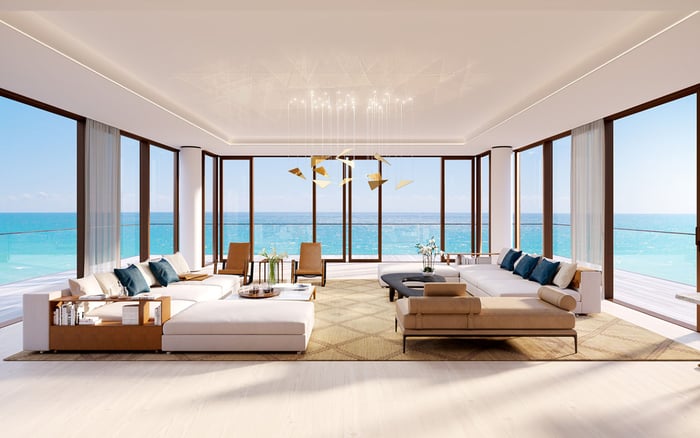
The Surf Club combines a restored 1930 social club, dedicated residential spaces, and Four Seasons hospitality. For buyers, its appeal depends on understanding where privacy, hotel access, ownership categories, and service obligations meet.

At The Surf Club Four Seasons Surfside, the purchase decision extends beyond architecture and ocean access. It turns on the relationship between a historic private club, a dedicated residential setting, and an operating Four Seasons hotel. The proposition is specific: a private home connected to a hospitality destination, rather than entirely removed from one.
For a buyer considering Surfside, that distinction should guide the evaluation. Concierge assistance, housekeeping, maintenance, and beach services can simplify ownership. Privacy, however, depends on how residential spaces remain separate from hotel activity. The question is not simply whether the property feels exclusive, but whether its operating arrangements suit the way an owner intends to live.
The Surf Club opened as a private social club on New Year’s Eve 1930. Harvey Firestone conceived the idea while aboard his yacht, Marybelle, and architect Russell T. Pancoast designed the original building. That history gives the address a foundation that a heritage-inspired aesthetic alone cannot replicate.
The original club building and its historic cabanas were restored during redevelopment. Contemporary additions designed by Pritzker Prize-winning architect Richard Meier introduced two residential towers of approximately 12 stories alongside the hotel. The result pairs an established social identity with a modern residential setting.
For buyers, the distinction is between enjoying that legacy and assigning it an assumed financial premium. Its cultural and architectural appeal is clear; a purchase valuation still requires examination of the individual residence, its condition, ownership obligations, and transaction terms. Heritage is part of the experience, not a substitute for property-level diligence.
The restored club and contemporary towers should be considered together, but neither should overshadow the apartment itself. A compelling architectural composition does not answer questions about a home’s outlook, internal circulation, condition, or relationship to neighboring spaces.
During a viewing, assess the residence independently before returning to the shared setting. Consider how rooms support daily routines, how arrival feels from the residential lobby, and whether the transition between private interiors and hospitality areas meets your expectations. These are qualities to inspect, not infer from an architect’s reputation.
A buyer also considering Fendi Château Residences Surfside can apply the same discipline: evaluate the individual home first, then establish precisely what the wider property adds. Architectural preference and operational fit deserve separate judgments.
Private residential lobbies and Four Seasons arrival services distinguish coming home from checking into the hotel. Dedicated residential spaces support privacy, but the broader property also accommodates hotel guests and hospitality visitors. Dining and lounge facilities form part of that wider destination.
Privacy here is best understood as controlled separation within an active property. Buyers seeking complete withdrawal from hotel activity should not treat a dedicated residential entrance as proof that every subsequent experience is exclusive to owners.
Walk the routes that matter: arrival to apartment, apartment to pool, fitness center to beach. Ask which elevators, entrances, and outdoor areas are residential, which are shared, and how access is managed. Visits at different times can help establish whether the atmosphere suits your preferences. The aim is to understand daily life beyond the initial presentation.
The development comprises 77 hotel guest rooms, 30 hotel residences, and 121 private residential apartments. Private residences and hotel residences are distinct categories, not interchangeable descriptions of every owned unit.
That distinction belongs at the beginning of due diligence. Before evaluating rental possibilities or service benefits, establish the residence’s legal and operational category. Then review the governing documents for personal-use provisions, rental eligibility, service entitlements, and any applicable rental-program agreement.
Do not assume ownership includes unrestricted access to every hotel amenity, or that a hotel-associated residence necessarily carries a particular rental arrangement. Equally, do not infer restrictions that have not been established. The answer should come from the documents and current written operating terms for the unit under consideration.
Four Seasons services are central to the residential proposition, including concierge assistance, housekeeping, and maintenance. Beach access, staffed beach services, and cabanas connect the oceanfront setting with the hospitality operation. The appeal is a private address with support that would otherwise require separate arrangements.
The evaluation should distinguish availability, inclusion, and cost. A service may be available without being included in recurring ownership charges. Ask what is provided as standard, what requires advance booking, and what is charged separately.
The amenity offering includes four heated swimming pools, with residential pool facilities, two resident-only fitness centers, and an approximately 15,000-square-foot oceanfront spa and wellness center. That offering is not a guarantee of current access rules. Confirm present arrangements, guest privileges, and any separate charges before relying on it.
A Surfside shortlist might also include Arte Surfside. The useful comparison is not an unsupported ranking of privacy or service, but a consistent set of questions about who uses the property, how residents move through it, and which obligations accompany ownership.
At The Surf Club, the historic club and hotel are integral to the proposition. A buyer who enjoys access to dining, lounges, and staffed hospitality may find that integration central to the appeal. Someone whose first priority is minimal interaction with a wider destination should examine the same integration more critically.
Neither preference is inherently more discerning. The better purchase is the one whose daily operating model fits the owner, not the one with the most persuasive amenity description.
The primary developer offering is marked sold out. That status does not establish whether any particular resale is currently available. Availability and terms require a separate, current inquiry.
For a residence under consideration, obtain the association budget, applicable service charges, insurance allocations, taxes, and any rental-program agreement. Review how costs attach to that ownership category, and distinguish recurring obligations from optional services. Without current figures, a reliable all-in ownership estimate cannot be made.
The strongest case for The Surf Club rests on the alignment of three qualities: authentic architectural heritage, meaningful residential separation, and useful Four Seasons service. When those qualities match a buyer’s expectations and are supported by clear documents, hotel integration becomes a deliberate lifestyle choice rather than an assumption.
For a discreet evaluation of The Surf Club within your South Florida property search, connect with MILLION.
If branded residences are on your mind — as a home or as an allocation — we would be glad to share what we are seeing, privately.
Begin a quiet conversationThe Surf Club opened as a private social club on New Year’s Eve 1930. Its restored historic building remains part of the hotel-and-residential property.
Russell T. Pancoast designed the original club building. Richard Meier designed the contemporary additions, including the two residential towers.
No. The development includes distinct private-residence and hotel-residence categories, so buyers should establish a unit’s classification before evaluating its use and service terms.
The property comprises 77 hotel guest rooms, 30 hotel residences, and 121 private residential apartments.
No. Private residential lobbies and dedicated spaces support separation, but the residences sit within an operating destination that also welcomes hotel guests and hospitality visitors.
The residential offering includes services such as concierge assistance, housekeeping, and maintenance. Buyers should confirm which services are included and which carry separate charges.
Published specifications describe four heated swimming pools, including residential facilities, and two resident-only fitness centers. Current access arrangements should be confirmed separately.
Unrestricted rental rights should not be assumed. Eligibility, personal-use provisions, and any rental-program obligations require review of the specific residence’s governing documents and agreements.
The primary developer offering is marked sold out. That designation does not establish whether a particular resale is currently available.
Buyers should obtain current association budgets, service charges, insurance allocations, taxes, and any applicable rental-program agreement. They should also distinguish recurring obligations from optional services.