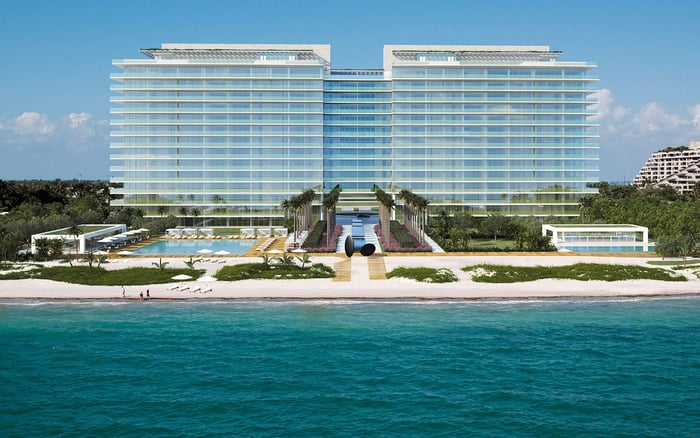
A pre-closing checklist for aligning an Oceana Key Biscayne purchase with renovation approvals, contractor access, permitting and delivery logistics, without mistaking resident services for construction privileges.

At Oceana Key Biscayne, the appeal is clear: an oceanfront development with 142 residences and 12 villas, a 500-foot private beach, pools, beach services and a 24-hour concierge. For a buyer envisioning tailored interiors, however, the purchase warrants a second evaluation beyond views, proportions and finishes: can the intended work proceed on terms that suit the household?
Closing transfers ownership; it does not, by itself, authorize construction. Association review, applicable permits and contractor-access procedures are separate matters. Even a carefully designed renovation can be difficult to coordinate if the schedule assumes unrestricted entry, convenient unloading or immediate authorization to start.
The checklist below is for pre-closing verification, not a statement of Oceana’s current restrictions. Specific hours, deposits, insurance limits, elevator arrangements and entry procedures should be verified against the association’s current written requirements-not assumptions about how a luxury building operates.
Request the declaration, bylaws, current alteration guidelines and contractor-access documentation through the seller and management. Oceana’s resident-services contact channel is a practical starting point for that request. Ask management to confirm which documents govern the proposed residence and scope of work.
The distinction matters when a purchase depends on a particular customization plan. Replacing furnishings is different from altering flooring assemblies, plumbing or HVAC routing. Work involving those systems, structural components and common elements typically requires association review; Oceana’s treatment must be confirmed directly.
Before closing, seek written answers to four questions:
What work requires an application, and what must accompany it?
Who reviews the submission, and what is the approval sequence?
Can a prospective purchaser submit plans before taking title?
What must be completed before contractors may begin?
If timing is essential, have your advisers assess the unresolved requirements before relying on a move-in date.
A useful submission starts with a precise description, not “light renovation.” Ask the architect or contractor to separate decorative changes from work affecting building systems, flooring assemblies or shared components. Identify proposed demolition, equipment changes and any work that may require access beyond the residence.
Then ask management which drawings, specifications and professional credentials are needed. Confirm whether revisions trigger another review and whether material samples or installation details belong in the package. These are questions to resolve, not confirmed Oceana requirements.
Oceana’s green/LEED-certified designation does not, on its own, establish renovation-material standards. Do not select products on the assumption that the certification either mandates or approves a particular finish, adhesive or assembly.
A buyer also considering Oceana Bal Harbour should obtain that property’s own documentation. Similar branding is no basis for carrying renovation assumptions from one building to another.
Applicable permits are required before covered construction, alteration, repair and building-system work. For this purchase, consult the Village of Key Biscayne’s permitting forms and resources rather than assuming City of Miami procedures apply. Have the relevant professional confirm the permitting path for the actual scope.
Build a sequence that distinguishes association submission, public permitting and authorization to mobilize. Ask whether any steps may run concurrently and what evidence management needs before allowing work to start. Do not assume a permit and an association approval are interchangeable.
For budgeting, request a proposal that states its approval assumptions. A contractor’s anticipated start date is more useful when tied to explicit prerequisites than when presented simply as a date after closing.
The access discussion should cover everyone expected on site, including subcontractors and delivery personnel-not just the principal contractor. Ask what licensing and insurance documentation is required, how credentials are submitted and who confirms that the team is cleared to enter.
Next, establish the operating details:
Whether advance crew registration or daily check-in is required.
Whether owner authorization or presence is needed for entry.
Which work hours, holiday limits or noise windows apply.
Where workers may park and which entrances they may use.
Who handles access problems when the owner is away.
None of these procedures should be treated as Oceana requirements without written confirmation. The practical concern is conditional but important: if entry requires coordination or noisy work has a narrower window, the contractor must account for those conditions in staffing and sequencing.
Valet parking and golf-cart services do not establish contractor parking or delivery privileges. Resident convenience and construction logistics should be evaluated separately.
Custom cabinetry, stone and appliances require more than a confirmed fabrication date. Before authorizing orders, ask the contractor to align delivery needs with the loading, elevator and staging arrangements management permits.
Confirm whether reservations are necessary, what dimensional or weight limits apply, how common areas must be protected and whether temporary storage is allowed. Ask what happens if a vehicle arrives outside its approved window or a shipment cannot be accepted. These are planning questions, not assertions about Oceana’s procedures.
Debris deserves equal attention. Obtain written direction on removal routes, collection arrangements and any restrictions on disposal facilities. Do not assume residential trash infrastructure is available for construction waste.
The objective is a complete path into and out of the residence. Until that path is clear, a delivery promise should not become a fixed installation commitment.
For a buyer weighing Oceana against Park Grove Coconut Grove, apply the same discipline: evaluate each candidate residence against its own written alteration requirements. This is not a comparison of confirmed building restrictions. It is a way to compare the effort required to make each home personally suitable.
Ask the project team to distinguish the base construction scope from unresolved logistics, potential resubmissions and purchasing commitments. Do not assume a standard Oceana delay or added-cost allowance. Any contingency should reflect the proposed work and the requirements actually received.
A residence needing fewer changes may better suit a fixed occupancy date. A more ambitious customization may still be the right choice, provided the buyer values the finished result enough to accommodate the verified process.
Before closing, assemble one decision file containing the scope, applicable rules, approval sequence, permitting path, contractor credentials and logistics plan. Luxury is not only the freedom to select the finish; it is knowing what delivering that finish will require.
For a discreet perspective on matching your next residence to your customization priorities, explore MILLION.
If branded residences are on your mind — as a home or as an allocation — we would be glad to share what we are seeing, privately.
Begin a quiet conversationDo not treat closing as authorization to start. Confirm the association’s current approval and access requirements, along with applicable permits, before mobilizing contractors.
Request the declaration, bylaws, current alteration guidelines and contractor-access documentation. Ask management to confirm which requirements apply to your residence and planned work.
Obtain the current permitted hours directly from management in writing. Confirm any separate noise windows, holiday limits and delivery schedules before accepting a construction timetable.
Advertised valet and golf-cart services do not confirm contractor parking or delivery privileges. Those arrangements require separate verification.
Consult the Village of Key Biscayne’s permitting forms and resources, with the appropriate project professional. Do not assume City of Miami procedures apply.
Flag work involving common elements, structural components, electrical systems, plumbing, HVAC routing or flooring assemblies. These commonly raise association-review questions, but Oceana’s specific requirements must be confirmed.
No. The advertised green/LEED-certified description does not establish renovation-material requirements; request the applicable specifications before selecting products.
First confirm whether reservations are required and what loading, elevator and protection arrangements apply. Do not schedule installation around assumed access.
Do not assume they can. Obtain written debris-removal instructions, including permitted routes and disposal arrangements, before work begins.
Do not assume a standard Oceana-specific delay or cost allowance. Ask your project team to develop contingencies from the actual scope and written building requirements.