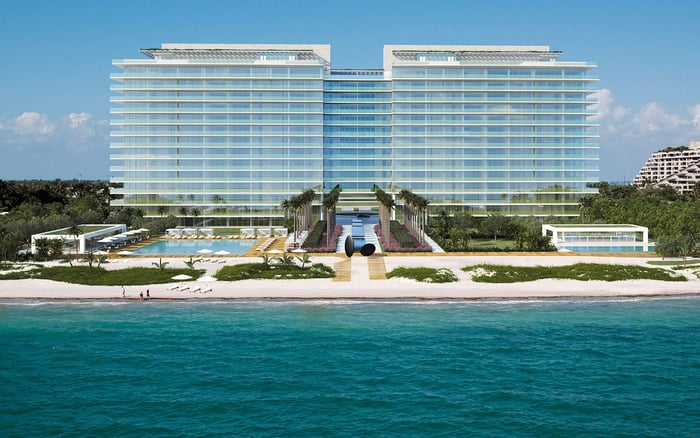
A buyer-focused framework for evaluating leak detection, unit-level shutoff boundaries, emergency response obligations, and insurance allocation at Oceana Key Biscayne without mistaking vendor capabilities for installed protection.

At Oceana Key Biscayne, a rigorous purchase review should examine not simply whether a residence has leak sensors, but what they detect, which water lines can be isolated, and who responds after an alert. For a buyer considering a Key Biscayne residence, these are questions of stewardship: protecting interiors and preserving confidence while away.
Treat building-wide detection, automatic shutoff, and association-level damage response as matters requiring documentary confirmation, not assumed amenities. A vendor’s capabilities do not establish what is installed, activated, maintained, or contractually supported in a particular residence. The objective is a clear chain from detection through isolation, attendance, drying, and documentation.
A sensor beneath a dishwasher is not equivalent to protection across an entire residence. Commercial installations can pair sensors inside a unit with an automatic valve on its water-supply line. Even then, the detection footprint and the shutoff boundary are distinct questions.
Point sensors detect moisture where they are placed. Flow monitoring uses a different method to identify leaks or abnormal water use. Ask whether the proposed or installed system includes one, the other, or both, and request an explanation of the conditions that trigger action.
The device map should identify bathrooms, kitchen sinks, dishwashers, laundry equipment, refrigerators, ice makers, wet bars, mechanical closets, and terraces. Ask separately about concealed leaks and continuous-flow detection. A map showing only kitchen and laundry sensors does not establish coverage in every room or concealed space.
If your comparison includes Oceana Bal Harbour, carry the same questions into that review without assuming equivalent equipment or operating procedures. Evaluate protection residence by residence and association by association.
Request plumbing diagrams alongside the device map. Together, they should identify valves, sensors, gateways, supply lines, and the parties responsible for each component. Ask a qualified professional to confirm precisely what closes when an alarm occurs.
The crucial distinction is between isolating the residence’s supply and controlling every possible source of water damage. Unit-level shutoff is not assurance against water arriving from another residence or plumbing outside its boundary. Verify that the proposed arrangement cannot interrupt shared plumbing or fire protection.
Ask what triggers closure: moisture detection, abnormal flow, a manual instruction, or a combination. Then establish who may reopen the valve and what inspection must precede reopening. Automatic closure is one step, not a substitute for determining the cause of the incident.
For a second-home purchase, request documented performance tests rather than relying on an application demonstration. A useful test sequence covers sensor activation, valve closure, alert delivery, escalation, manual override, reopening, and restoration of monitoring.
Power and internet interruptions deserve explicit attention. Request written explanations of what remains operational during each outage, how an interruption is communicated, and who restores service. Do not assume normal system behavior continues unchanged when connectivity fails.
Test the contact sequence as well. An alert sent to an absent owner is not the same service as one acknowledged by a monitoring center and escalated to building personnel. Ask who receives the first notification, who is next if that person does not answer, and where acknowledgment is recorded.
Managed services can combine detection, automatic shutoff, and round-the-clock monitoring. Some arrangements include confirmation of alerts and calls to designated building contacts. Those functions are distinct from a contractual commitment to attend the residence, extract water, or begin drying.
Request the actual agreement and identify measurable acknowledgment and attendance deadlines. A promise to call within minutes differs from a promise to place a qualified responder inside the unit within a defined period. Establish whether each commitment belongs to the association, the monitoring provider, a contractor, or the owner.
For unattended residences, clarify entry authority, key access, emergency-work authorization, and spending approvals. The agreement should address who stops the leak, arranges extraction and drying, documents affected areas, and coordinates follow-up. These are proposed diligence terms, not statements of Oceana’s existing obligations.
Carry the same contractual distinction into a review of Park Grove Coconut Grove. Residential comparisons become more useful when buyers examine operational commitments rather than treating technology alone as the measure of protection.
Oceanfront ownership does not eliminate the need to distinguish association coverage from the owner’s policy. Water-damage claims can involve the unit owner’s insurer, a neighboring owner’s insurer, and the association’s master policy. The origin of the water does not, by itself, settle the claims process.
Florida’s condominium insurance framework generally places specified condominium property within association insurance responsibilities, while personal contents and specified interior items fall outside that coverage. Certain floor and wall coverings, appliances, cabinetry, and countertops are examples generally allocated to owner coverage.
Insured condominium property damaged by an insurable event generally falls within the association’s responsibility for reconstruction, repair, or replacement as a common expense, subject to the applicable allocation analysis. That is not a promise that every finish or loss is covered.
Have counsel and an insurance adviser review governing documents, master-policy endorsements, and the buyer’s HO-6 coverage separately. Coverage depends on cause, policy language, maintenance history, and whether damage was sudden or gradual. An owner’s insurer may pay a covered claim and subsequently seek reimbursement from a neighboring owner’s insurer.
Resale diligence should include maintenance records, claims history, and leak-related board minutes alongside installation documents. Ask who pays for subscriptions, batteries, testing, repairs, false alarms, emergency call-outs, and damage arising from faulty installation or operation.
Request incident records that connect an alert to acknowledgment, entry, isolation, mitigation, and eventual restoration. The response discussion should address professional intervention to stop a leak and prompt notification of the association’s insurers and counsel if an incident occurs. Preserve the distinction between emergency action and final responsibility for payment.
Waterfront purchase decisions benefit from a concise closing file: a device map, confirmed shutoff boundaries, test records, a response agreement, cost allocations, and an insurance review. Record unresolved items and ask the appropriate advisers what must be clarified before relying on the protection described. The standard is not an impressive equipment label, but a documented, workable response chain.
For a discreet perspective on South Florida residential ownership, connect with MILLION.
If branded residences are on your mind — as a home or as an allocation — we would be glad to share what we are seeing, privately.
Begin a quiet conversationDo not assume building-wide detection, automatic shutoff, or an association-level response contract. Request installation records and current agreements to establish the actual scope.
Point sensors detect moisture at their locations, while flow monitoring can identify leaks or abnormal water use. Confirm which methods the residence’s system includes.
No. Request a device map and ask separately about bathrooms, refrigerators, wet bars, mechanical closets, terraces, and concealed leaks.
It should identify the water lines the valve isolates and the conditions that trigger closure. A qualified professional should verify that shared plumbing and fire protection cannot be interrupted.
Request documented tests of detection, valve closure, outages, manual override, alert escalation, reopening, and monitoring restoration.
No. Confirming an alert and calling building contacts does not necessarily include attendance, extraction, or drying.
Ask for acknowledgment and attendance deadlines, unattended-unit entry authority, emergency-work approvals, extraction and drying responsibilities, and incident documentation.
No. Certain floor and wall coverings, appliances, cabinetry, countertops, and personal contents generally require separate owner coverage analysis.
The source alone does not settle the claim process. An owner’s insurer may pay a covered claim and then seek reimbursement from a neighboring owner’s insurer.
The relevant documents and contracts should allocate those costs explicitly. Ask separately about subscriptions, batteries, testing, false alarms, and damage from faulty installation or operation.