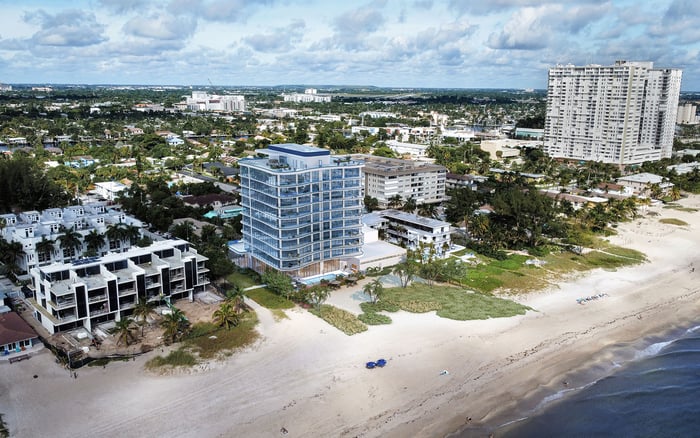
A buyer-focused comparison of advertised parking and EV provisions at two Pompano Beach branded residences, with the documents and operating questions needed to distinguish convenience from enforceable rights.

For a luxury buyer in Pompano Beach, the arrival experience extends beyond the welcome at the door. The more consequential questions concern what happens next: where each vehicle stays, who may move it, whether an owner can leave independently, and whether an electric vehicle will be ready the next morning.
At these two Broward addresses, the advertised provisions differ in specificity. Ritz-Carlton's include a parking count, a self-parking option and per-residence EV availability. Waldorf Astoria's emphasize valet service and dedicated charging stations. That distinction frames due diligence; it does not establish how either property will operate.
The essential distinction is between an advertised amenity and a documented right. Buyers should evaluate both, then test the proposed arrangements against their household routines.
At The Ritz-Carlton Residences® Pompano Beach, the advertised arrangement includes two garage parking spaces per residence, with self-parking or valet. An arrival porte cochère with valet service is also among the advertised amenities. For buyers who prefer to retain control of their keys, the explicit self-parking provision is a useful starting point.
It does not, however, confirm that the spaces are deeded. Whether the allocation is deeded, assigned or licensed remains unclear. Request the legal allocation terms and the location of both spaces for the specific residence under consideration. Confirm whether self-parking is available at all hours and what restrictions govern garage access.
The development's two-tower arrangement makes precision especially important: the east tower is beachfront, while the west tower is waterfront with a private marina. Do not assume identical parking allocations or access procedures across both towers.
An additional 23 private parking garages are advertised as available for purchase. Treat that number as an advertised offering, not current inventory. Establish availability, price, purchase terms and whether a private garage supplements or changes the standard two-space allocation.
At Waldorf Astoria Residences Pompano Beach, valet parking is an advertised residential service, and dedicated electric vehicle charging stations are an advertised amenity. Those provisions outline a service concept but leave important ownership questions open.
A guaranteed parking-space count per residence, deeded individual spaces and owners' self-parking rights are not clearly established. Buyers should avoid either extreme: assuming that a private garage means an individually controlled space, or calling the property valet-only because valet is emphasized.
Request written confirmation of the number of vehicles accommodated for the selected residence, whether spaces are identified, and whether owners may enter the garage and retrieve their own cars. A household with two daily drivers should also confirm whether both vehicles receive the same access and charging privileges.
If independent access is essential, resolve it before relying on the broader service offering. If valet is preferred, give equal attention to its operating rules and the underlying parking allocation.
Ritz-Carlton's advertised EV provision is Level 2 charging with 220-volt service available, up to two stations per residence. The operative words are “available” and “up to.” This is not an unconditional promise that every purchase includes two installed chargers.
Waldorf Astoria's advertised dedicated-station provision does not specify allocation per residence, private versus shared access, charging capacity or valet-managed charging procedures. “Dedicated” should not be read as a charger assigned exclusively to each home.
For either property, request a residence-specific charging proposal identifying the charger location, installation cost, electrical capacity, electricity billing and maintenance responsibility. Clarify what equipment is included and what approvals or upgrade rights apply later.
A two-EV household should ask whether both cars can charge simultaneously and at what capacity. If charging requires moving a vehicle to a shared station, establish who performs that task, how access is scheduled and whether overnight rotation is necessary. The objective is a dependable routine, not simply access to a charging amenity.
Valet can be a welcome choice. Dependence is a different consideration when an owner cannot access or charge a vehicle without staff involvement. Buyers should distinguish the availability of the service from the personal control they retain.
Walk through several ordinary situations with the sales team: an early departure, two household members leaving together, a guest arriving while both resident vehicles are parked, and an EV needing an overnight charge. Ask how each would be handled under the proposed rules rather than accepting a general assurance of convenience.
Request operating hours, retrieval procedures and any stated retrieval-time expectations. Review resident and guest charges, tipping policies, garage-access rules and vehicle-handling restrictions. For a prized automobile, clarify key custody, instructions governing who may drive it, and the procedure for documenting and pursuing damage claims.
A luxury brand alone is no basis for assuming retrieval times or service costs. Put essential requirements in writing and distinguish formal commitments from informal expectations.
Review the purchase agreement, condominium parking exhibits and applicable operating rules together. Ask counsel to identify the precise parking entitlement, whether reassignment is permitted, and restrictions affecting transfer, vehicle dimensions or storage. Space locations deserve as much attention as the headline count.
For a private-garage purchase, request the separate terms and clarify its relationship to the residence's standard allocation. For EV charging, obtain written confirmation of installation responsibilities and ongoing costs. Reconcile any answer material to the purchase decision with the governing documents.
If Armani Casa Residences Pompano Beach is also on the shortlist, apply the same document-based comparison rather than assuming equivalent provisions across branded properties. Compare confirmed rights, owner access, charging arrangements and service obligations on a consistent basis.
Ritz-Carlton's advertised parking provisions give buyers a more explicit starting point on space count, self-parking and EV availability. Waldorf Astoria's require more clarification on allocation and owner access. Neither set of advertised provisions establishes completed installations, enforceable ownership rights or actual service performance.
The better fit is the residence whose documented arrangements match the way you use your vehicles. For one household, that means independent access and two-car charging. For another, it means a clearly defined valet routine with understood costs and responsibilities. Resolve those details before treating parking as a settled amenity.
Explore Pompano Beach residences with MILLION to keep everyday ownership requirements central to your search.
If branded residences are on your mind — as a home or as an allocation — we would be glad to share what we are seeing, privately.
Begin a quiet conversationThe advertised provision is two garage parking spaces per residence. Buyers should confirm the allocation and space locations for their selected residence.
The advertised arrangement offers self-parking or valet. Confirm all-hours access and any tower-specific restrictions in writing.
The advertised provision does not clearly establish whether spaces are deeded, assigned or licensed. The legal allocation requires review of the purchase and condominium documents.
An additional 23 private parking garages are advertised for purchase, but current availability and terms require confirmation. Confirm whether a purchase changes the standard two-space allocation.
The advertised provision is Level 2 charging with 220-volt service available, up to two stations per residence. It does not guarantee two installed chargers included with every purchase.
Valet is an advertised residential service, but that provision does not establish whether owners may self-park. Buyers should confirm owner access rather than assume the property is valet-only.
The advertised provisions discussed here do not clearly establish a guaranteed count per residence. Request written confirmation for the specific home under consideration.
The advertised amenity does not establish exclusive allocation to each residence. Buyers should confirm whether access is assigned or shared and how charging is managed.
Confirm installation cost, electricity billing, maintenance responsibility and upgrade rights. Also establish electrical capacity and whether two vehicles can charge simultaneously.
Request the purchase agreement, condominium parking exhibits, legal allocation terms and applicable operating rules. Review space locations, transfer restrictions, vehicle limits and valet damage-claim procedures.