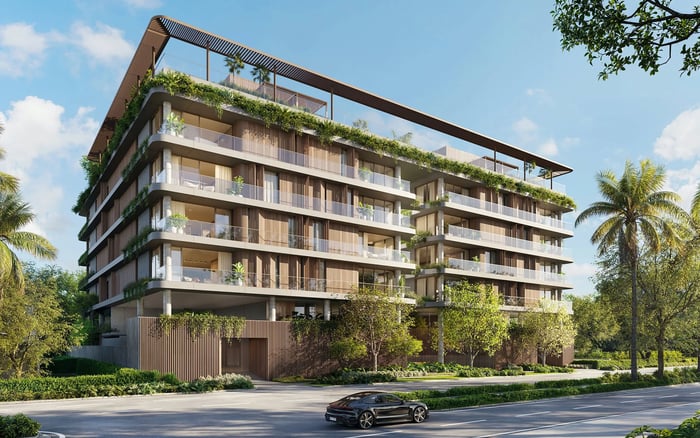
2200 Brickell’s boutique positioning deserves an equally considered ownership review. A serious buyer should examine association control, reserve funding, contractual obligations and occupancy documentation alongside the residence itself.
.jpg)
2200 Brickell is positioned as a lower-density alternative to Brickell’s high-rise condominiums. For buyers seeking a more intimate residential setting, that proposition warrants attention. Yet the residence and the association require separate judgments: one concerns the experience of living there; the other, the structure through which that experience will be maintained and funded.
The development brings together Aria Development Group, Place Projects and Largo, with Ortega Construction Company appointed as general contractor. Those identities are a starting point for diligence, not a substitute for reviewing the obligations that transfer to ownership.
This checklist does not allege deficient reserves, governance misconduct, construction defects or pending special assessments at 2200 Brickell. Its premise is simpler: beautiful interiors cannot establish financial preparedness. A buyer needs documentary answers before treating the ownership proposition as complete.
Begin with the condominium declaration, bylaws, amendments and current association information. Establish whether developer-to-owner turnover has occurred, who serves on the board and how those directors were appointed or elected. Neither a sales milestone nor an occupancy milestone answers those questions.
Request recent board minutes, available financial statements, the management agreement and the procedure for accessing association records. If the association is newly operating, ask which documents exist, which remain pending and who is responsible for providing them.
The practical questions are direct:
Who can approve spending and enter contracts on the association’s behalf?
What voting rights attach to the residence under consideration?
Which decisions require owner approval under the governing documents?
What documentation records the transfer of control, if it has occurred?
Have condominium counsel distinguish contractual promises from association obligations. A written explanation of control is more useful than an assurance of professional management: it identifies who makes decisions and how an owner can participate.
Request the current approved operating budget and the assessment applicable to the specific residence. Determine whether the quoted monthly figure is a preliminary estimate or the amount adopted by the association, and establish what it includes and excludes.
Next, separate operating expenses from reserves. Request the reserve balance, contribution schedule, supporting studies and assumptions used to estimate future expenditures. Ask for any applicable Structural Integrity Reserve Study, or SIRS, and have counsel and a qualified technical adviser assess its applicability and the documentation provided. Do not infer compliance from the building’s age or appearance.
The development joint venture secured a $77 million construction loan in October 2023. That financing marks a development milestone; it is not evidence of the association’s reserve balance or funding adequacy.
Ask an adviser to examine insurance assumptions, maintenance allowances, service contracts and any developer support reflected in the budget. If support is included, establish its duration and the projected costs after it ends. The test is not simply the opening monthly payment, but the credibility of the assumptions behind it.
Establish the deposit schedule from the purchase agreement and any amendments. Do not borrow percentages or payment milestones from generic Miami pre-construction conventions. Confirm amounts, due dates, escrow provisions and the contractual treatment of a missed payment.
Delivery requires the same precision. Summer 2026 was an advertised expectation, not a contractual completion guarantee. Have counsel identify the agreement’s delivery provisions, permitted extensions, notice requirements and any applicable remedies or termination rights.
Review the closing trigger, inspection arrangements, completion obligations and process for documenting unresolved work. Ask how the agreement addresses specifications and permitted substitutions. An attractive presentation is not an enforceable promise unless the relevant commitment appears in the governing contract documents.
The goal is not to eliminate every uncertainty. It is to identify which uncertainties the buyer is accepting, and on what terms.
A Temporary Certificate of Occupancy was reported on August 11, 2026, alongside an announcement that 2200 Brickell would begin welcoming residents. That is a meaningful milestone, but it does not establish a final Certificate of Occupancy or occupancy of every residence.
Request the applicable certificate and have the closing team confirm its scope, conditions and relevance to the selected unit. Separately establish the status of common areas, promised facilities and any remaining work that could affect daily use.
The project was described as 85% sold on that same date. Treat that percentage as a dated sales statement, not a current inventory check or a measure of association control. Ask separately about the residence’s availability and closing readiness.
A disciplined buyer keeps four matters distinct: sales progress, permission to occupy, contractual completion and association turnover. Progress in one does not establish the others.
The final release included penthouses and private garden villas. For these residence types, the appeal of additional privacy or distinctive space warrants equally close attention to ownership boundaries.
Review the recorded plans and declaration to establish what belongs to the unit, what is common property and what may be designated for exclusive use. Where outdoor areas form part of the offering, ask who must maintain, repair and insure them, and how related costs are allocated.
Confirm the exact residence count against recorded condominium documents rather than marketing descriptions. Then verify the unit’s expense allocation and voting interest under those documents. Boutique scale alone does not explain an individual owner’s obligations.
A buyer also considering Una Residences Brickell should request the same documents for each candidate. Comparing one residence’s detailed budget with another’s preliminary monthly estimate creates a false equivalence.
Likewise, if The Residences at 1428 Brickell is on the shortlist, separate aesthetic preference from financial and contractual review. These are comparison prompts, not claims about either project’s governance or reserves.
Use a consistent decision sheet: applicable assessment, budget status, reserve documentation, association control, contract obligations and occupancy documentation. Mark each answer as documented, pending or requiring professional interpretation. This leaves room for personal taste without allowing it to obscure unresolved ownership questions.
Before a binding commitment or the expiration of an applicable review period, ask your advisers for a concise written account of unresolved issues and their consequences. Distinguish a document awaiting delivery from an explanation that fails to answer the underlying question.
At 2200 Brickell, the strongest purchase rationale should unite the residence’s appeal with a clear ownership structure. Transparent governance and credible reserve planning do not compete with design. They help support the experience a buyer intends to preserve.
For a considered approach to South Florida luxury ownership, connect with MILLION.
If branded residences are on your mind — as a home or as an allocation — we would be glad to share what we are seeing, privately.
Begin a quiet conversation2200 Brickell is located at 2200 Brickell Avenue, Miami, FL 33131, in the Brickell neighborhood.
Aria Development Group and Place Projects partnered with Largo on the development. Ortega Construction Company was appointed as general contractor.
2200 Brickell is positioned as a lower-density residential alternative to Brickell’s high-rise condominium offerings.
The current turnover status is not established here. Buyers should request board information and any documentation recording a transfer of association control.
No. It does not establish deficient reserves, governance misconduct, construction defects or pending special assessments.
Request the approved operating budget, unit-specific assessment, available financial statements, reserve balance and contribution schedule. Ask for supporting reserve studies and professional review of any applicable SIRS.
No. The $77 million construction loan secured in October 2023 concerns development financing, not the association’s reserve balance.
A Temporary Certificate of Occupancy was reported on August 11, 2026. That does not establish a final Certificate of Occupancy or completed occupancy of every residence.
Use the purchase agreement and amendments to establish payment milestones, delivery provisions and applicable remedies. The advertised Summer 2026 delivery expectation was not a contractual guarantee.
Review recorded plans and governing documents for ownership boundaries, exclusive-use rights and maintenance responsibilities. Confirm the unit’s expense allocation and voting interest as well.