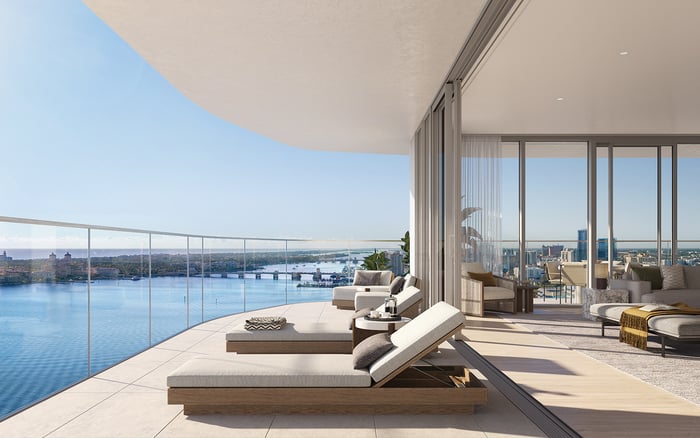
Two Ritz-Carlton residential offerings frame private-club living differently: an integrated club level in Sunny Isles and an outside-club benefit in West Palm Beach. For buyers, the meaningful comparison turns on recurring costs, contractual access, resale rights, and the distinction between available services and included services.

A private dining room, a waterside club, a familiar concierge: the appeal of branded ownership lies partly in how effortlessly a residence can support daily life. Yet the most useful comparison is not which building offers more amenities. It is what ownership entitles a buyer to use, for how long, at what recurring cost, and under whose rules.
That distinction is especially relevant here. Sunny Isles emphasizes a private club level within the residential tower. West Palm Beach promotes an outside-club membership alongside its residential amenities. Neither arrangement, by itself, establishes that every experience is complimentary or that every privilege passes automatically to a subsequent owner.
Buyers evaluating both should separate four categories: condominium assessments, distinct membership charges, consumption-based services, and transfer rights. This framework is more useful than an undifferentiated promise of club living.
At The Ritz-Carlton Residences® Sunny Isles, the 33rd-floor private club level brings social and practical amenities into the tower. Advertised spaces include a lounge and bar, private dining area with a prep kitchen, business center, media room, and library.
The residential offering also includes eight guest suites with housekeeping service. Private beach amenities feature cabanas, chaise lounges, and umbrellas, while the beach restaurant is marketed with pool service, beach service, and in-residence delivery. Together, these offerings keep entertaining and everyday convenience close to home.
They do not, however, establish complimentary guest-suite stays, unrestricted reservations, or included dining and delivery charges. Access to a private dining room is distinct from the cost of hosting dinner there. Likewise, housekeeping associated with a guest suite does not establish its nightly rate or booking conditions.
For buyers also considering St. Regis® Residences Sunny Isles, the same discipline applies: request an inclusion schedule for each property rather than assuming that a shared branded-residence category means equivalent financial terms.
At The Ritz-Carlton Residences® West Palm Beach, ownership is marketed as including membership in The Cove Club, a private waterside members club, plus Marriott Bonvoy enrollment. Crucially, the complimentary Cove Club benefit is specified as one year. It should not be valued as a perpetual, dues-free entitlement.
The available terms do not establish current initiation charges, recurring Cove Club dues, post-promotional pricing, or resale-transfer terms. The practical question is not merely whether membership is included at purchase, but what obligations and choices follow the complimentary period.
The project also advertises exclusive beach club membership, a pool deck, fitness and wellness center, and spa. Buyers should obtain written clarification of how the advertised beach-club benefit relates to Cove Club membership, rather than assuming the descriptions establish identical rights.
Promoted residential experiences include a golf simulator and gaming lounge, private dining, guest suites, an art collection, and poolside dining. These offerings broaden the lifestyle proposition, but availability does not establish pricing. For a local shortlist that includes Mr. C Residences West Palm Beach, compare each property’s written service and membership terms independently.
Two unit-specific examples illustrate the limits of association-fee comparisons at Sunny Isles. Unit 1505 has a listed monthly association fee of $5,457; unit 4701 has a listed monthly association fee of $5,120. Both carry the designation “Membership Purchase Required: No.”
These figures are unit-specific snapshots, not verified current budgets, a building-wide fee schedule, or separate private-club dues. The membership designation does not establish that all club use is free, that no other charges apply, or that a purchaser receives unrestricted transferable rights.
For West Palm Beach, association dues, taxes, and insurance are described as beginning at closing rather than contract signing. Buyers should confirm those obligations in their purchase documents and obtain the applicable budget. That timing does not resolve later Cove Club expenses.
An ownership worksheet should separate condominium assessments from any club initiation or renewal charges, then add expected dining, treatments, guest stays, and other discretionary spending. Mark unconfirmed costs for confirmation rather than assigning them a zero value. Without matched fee schedules, neither property can responsibly be declared the less expensive club proposition.
West Palm Beach advertises services including 24-hour concierge, valet, pool attendants, spa services, pet walking, and round-the-clock security. À la carte services may be provided by third parties. A service can therefore be accessible through the residence without being included in the condominium assessment.
The same distinction matters at Sunny Isles. Restaurant service at the pool, on the beach, or delivered to a residence describes convenience, not an inclusive food-and-beverage allowance. Guest suites with housekeeping describe an offering, not complimentary accommodation.
Ask for a written schedule separating assessment-funded operations from owner-paid services. For each chargeable offering, request the provider, rate structure, reservation rules, and cancellation terms. Ask, too, whether any minimum spending requirement applies. These are questions for confirmation, not established charges at either property.
Membership transferability remains unresolved for both projects. An in-building club’s location does not prove that every access right is attached to title. An outside-club benefit promoted with ownership does not prove automatic admission for a resale buyer.
Before assigning lasting value to access, request the condominium declaration, applicable club agreement, current fee schedule, and resale and lease rules. Have counsel distinguish rights granted to the owner from benefits granted to a named individual or initial purchaser.
The review should address whether a sale requires approval, a new application, or a payment; whether any complimentary period is available to the next purchaser; and whether tenants, family members, and guests receive access. These are not confirmed restrictions at either property. They are the terms needed to understand what a future buyer would acquire.
Sunny Isles presents an integrated residential club experience. West Palm Beach adds an outside-club dimension whose complimentary period warrants particular attention. The stronger fit depends on how the buyer intends to entertain, accommodate guests, use services, and hold the residence.
The decisive document is not the longest amenity menu. It is a clear written account of access, recurring obligations, chargeable services, and rights on resale. That clarity allows buyers to appreciate the lifestyle without confusing convenience with inclusion.
For a discreet comparison of South Florida residences and the ownership questions that matter, explore MILLION.
If branded residences are on your mind — as a home or as an allocation — we would be glad to share what we are seeing, privately.
Begin a quiet conversationSunny Isles emphasizes a private club level inside the residential tower. West Palm Beach markets an outside-club benefit through The Cove Club alongside residential amenities.
The complimentary benefit is specified as one year. Perpetual dues-free access and post-promotional pricing are not established.
Current initiation charges, recurring dues, and post-promotional pricing remain unconfirmed. Buyers should request the applicable membership agreement and fee schedule.
The 33rd-floor club level includes a lounge and bar, private dining area with a prep kitchen, business center, media room, and library.
Listings for units 1505 and 4701 state “Membership Purchase Required: No.” That field does not resolve all club-use costs or transfer rights.
Unit 1505 has a listed monthly association fee of $5,457, and unit 4701 has a listed fee of $5,120. These snapshots are not separate club-dues figures or a building-wide fee schedule.
Eight guest suites with housekeeping service are advertised, but complimentary stays and booking terms are not established.
Advertised availability does not establish inclusion. À la carte services may be provided by third parties, so buyers should obtain a written service and pricing schedule.
Transferability remains unresolved for both properties. The condominium declaration, club agreement, fee schedule, and resale rules should establish the applicable rights.
Association dues, taxes, and insurance are described as beginning at closing rather than contract signing. Buyers should confirm the applicable obligations in their purchase documents.