A buyer-oriented look at why refined garage access analytics can matter as much as finishes in South Florida’s ultra-luxury residential market.

Quiet luxury rarely announces itself at the front door. In South Florida’s most considered residences, it is felt more often in the absence of friction: the effortless turn into a porte cochere, the garage gate that recognizes a resident without spectacle, the elevator sequence that feels calm rather than transactional. For buyers who move between waterfront homes, private clubs, marinas, airports and city towers, garage access is not a back-of-house detail. It is where daily life begins and ends.
Better garage access analytics belong in that conversation because they turn an overlooked amenity into an operating standard. The question is not whether a building has a gate, a reader or a camera. The more refined question is whether the residence understands patterns of arrival without compromising discretion. Who enters, when, how often, through which lane and with what level of authorization can shape security, staffing, convenience and long-term asset confidence.
This is especially relevant in buildings where the lifestyle promise is highly controlled. A buyer considering 2200 Brickell, for example, is not simply comparing finishes or views. The real measure is how well the daily experience holds together from street to residence, including the moments no brochure tends to romanticize.
Garage access analytics should not be mistaken for novelty technology. In a luxury setting, the best systems are quiet, legible and accountable. They help a building understand usage without making residents feel watched. They support security teams without turning the entry sequence into a checkpoint. They give management a way to identify pressure points before they become visible to residents.
For a buyer, thoughtful analytics can signal operational maturity. A garage that distinguishes residents, guests, vendors, staff and deliveries is easier to manage than one that treats every entry as the same event. A property that can review access logs when an issue arises may be better positioned to resolve concerns with precision. A building that studies peak arrival windows can adjust staffing and valet coordination with greater grace.
The luxury is not the data itself. The luxury is what the data helps prevent: unnecessary waiting, confusion at the gate, overexposure of residents, inconsistent guest handling and the vague discomfort of not knowing how access is governed.
South Florida luxury life depends heavily on arrival choreography. Residents may move between Brickell, Miami Beach, Coconut Grove, Sunny Isles, Fisher Island, Palm Beach and Fort Lauderdale in a single week. Vehicles are not merely transportation; they are part of a larger rhythm involving family, staff, advisors, drivers, guests and service providers.
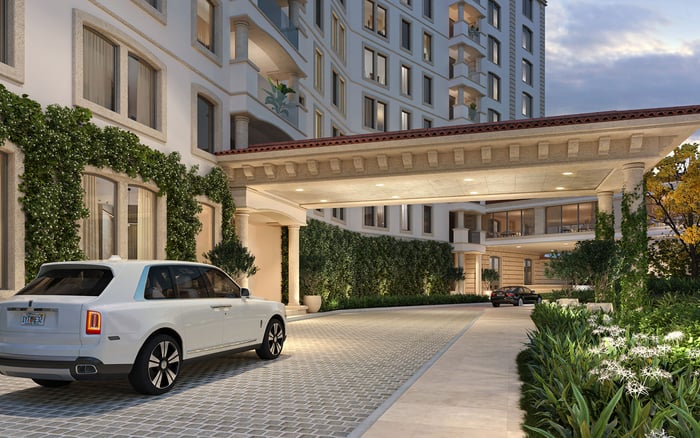
That rhythm makes the garage a high-value threshold. In oceanfront and bayfront living, the route from vehicle to private residence should feel protected from heat, rain, congestion and unwanted visibility. In more urban settings, the garage becomes a buffer between public energy and private composure. Across both, analytics can help clarify whether that threshold is performing with the consistency expected at the top of the market.
Consider the contrast between a coastal lifestyle at The Ritz-Carlton Residences® Miami Beach and an automotive-forward mindset associated with Bentley Residences Sunny Isles. The design language may differ, but the buyer expectation is similar: arrival should be seamless, secure and respectful of the resident’s privacy.
The most sophisticated garage access strategy begins with restraint. More data is not automatically better. A luxury residence should be able to explain what is collected, who can see it, how long it is retained and how resident access preferences are managed. The same system that creates convenience can feel intrusive if governance is vague.
For ultra-private buyers, the right questions are direct. Can a resident create temporary guest permissions? Can staff access be limited by time or role? Is valet activity auditable? Are license plates, fobs, mobile credentials and camera events connected in a way that improves accountability without overexposing personal routines? When a residence can answer calmly, it suggests a building culture that understands discretion.
This matters in enclaves where privacy is central to value. At The Residences at Six Fisher Island, the broader lifestyle conversation naturally emphasizes controlled access and separation from the ordinary pace of the city. Buyers in that category tend to appreciate systems that support privacy without dramatizing it.
Garage access analytics are rarely the first item on a showing checklist, which is precisely why they can reveal so much. A polished residence with a disorganized garage experience may expose a gap between design promise and operational reality. Conversely, a calm, well-managed arrival sequence can confirm that the building’s service culture extends beyond visible amenity spaces.
Ask how residents, guests, vendors and staff are credentialed. Ask whether access can be customized for housekeepers, drivers, family offices or recurring service providers. Ask how management handles lost credentials, expired permissions and after-hours arrivals. Ask whether the system supports a clear audit trail when needed, and whether residents can avoid unnecessary interaction when privacy is preferred.
In boutique or garden-oriented settings such as Four Seasons Residences Coconut Grove, the arrival experience may feel softer and more residential. That does not make access discipline less important. It simply means the technology should disappear into the hospitality language of the property.
Quiet luxury is not minimalism for its own sake. It is the discipline of removing friction while preserving control. In garage access, that means systems that recognize legitimate users, route visitors intelligently, support staff accountability and let residents move through the property without unnecessary performance.
The best outcome is almost paradoxical: buyers should barely notice the technology because it has already done its work. The gate opens without confusion. The elevator sequence feels intuitive. The service entry does not collide with the resident arrival. Guests are expected, not interrogated. Security is present without being theatrical.
For South Florida’s luxury buyers, this is not a small matter. A residence is judged not only by what it offers at sunset, but by how it behaves on an ordinary Tuesday morning. Garage access analytics are part of that behavior. They are a private infrastructure of ease and, increasingly, a quiet marker of whether a building understands the life it is selling.
Why should luxury buyers care about garage access analytics? They reveal how well a building manages privacy, arrival flow, guest permissions and security routines. These details can affect daily comfort more than many visible amenities.
Is garage analytics the same as surveillance? Not necessarily. In a refined setting, analytics should support accountability and convenience while limiting access to personal information.
What is the most important question to ask management? Ask what data is collected, who can access it, and how long it is retained. Clear answers suggest stronger governance.
Can better access systems improve resident privacy? Yes, when they reduce unnecessary conversations, prevent credential sharing and allow guest access to be handled in advance.
Do these systems matter more in urban towers? They matter in any luxury property, but dense urban locations often place more pressure on arrival sequencing and vendor coordination.
Should second-home owners evaluate garage access differently? Yes. They should focus on remote guest permissions, staff access windows and how the building manages arrivals when the owner is away.
What role does valet play in this conversation? Valet operations benefit from clear credentialing, traceable activity and efficient handoffs. The goal is service that feels smooth, not improvised.
Can analytics help with service providers? Yes. Time-limited or role-based access can make recurring services easier to manage while reducing unnecessary exposure.
What is a warning sign during a property tour? Confusion at the gate, unclear guest handling or inconsistent staff procedures can indicate weak operational discipline.
Is this a deciding factor for resale value? It can support perceived quality because buyers increasingly notice whether a building operates with privacy, ease and precision.
For a tailored shortlist and next-step guidance, connect with MILLION.
If branded residences are on your mind — as a home or as an allocation — we would be glad to share what we are seeing, privately.
Begin a quiet conversation