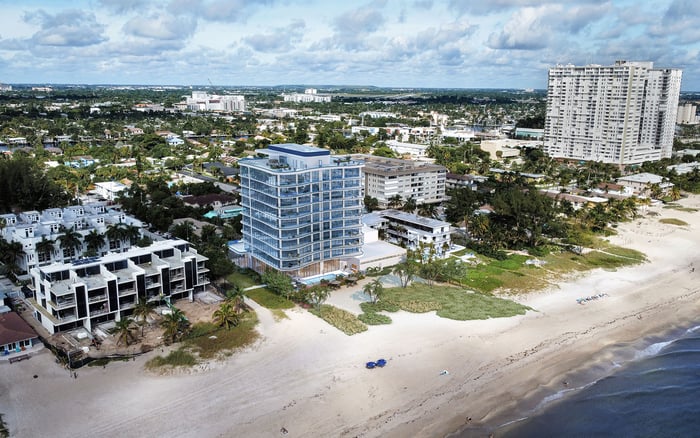
At Ocean 580 Pompano Beach, e-bike ownership calls for written clarity on storage, battery charging and elevator access. Here are the practical questions buyers should resolve before committing.

For a buyer who intends to ride regularly, an e-bike is part of the residential brief, not an incidental accessory. At Ocean 580 Pompano Beach, the central question is whether storage, charging and building access support a practical daily routine. A generous residence or private elevator-entry foyer does not, by itself, answer that question.
The distinction is straightforward: an advertised feature is not an operating rule. This guide does not establish Ocean 580's e-bike permissions or lithium-battery charging policies. Buyers should treat each issue below as a request for confirmation, not as evidence of either a ban or an approval.
Start with a location-specific question: where may this particular e-bike be stored? Ask separately about the residence, any assigned parking space and any designated secured room. Permission in one location should not be assumed to extend to another.
Ask whether a dedicated bicycle or e-bike storage room is available. Request its location, access arrangements and written confirmation that powered bicycles are eligible. A general reference to bicycle accommodation is not enough.
If a shared room is offered, ask whether spaces are assigned, access is controlled and batteries must be removed before entry. Clarify whether storage is included with ownership, separately licensed or subject to availability. These are questions to resolve, not established features of Ocean 580.
For a buyer comparing other Broward addresses, including Armani Casa Residences Pompano Beach, the same location-by-location inquiry provides a useful basis for comparison without presuming equivalent policies.
If the residence under consideration includes a terrace, outdoor space does not establish an approved storage location. Terrace storage requires its own written answer, distinct from permission to keep a bicycle inside the residence.
Ask whether the rules distinguish between an intact e-bike, a bicycle with its battery removed and a detached battery. Clarify, too, whether permission to store equipment includes permission to charge it. An answer addressing only the bicycle may leave the battery question unresolved.
The most useful request describes the intended arrangement precisely: the bicycle model, whether its battery is removable and the proposed storage location. Ask management to identify the applicable rule rather than simply confirm that the arrangement should be acceptable. That specificity makes the answer useful when planning both the residence and the daily routine.
Review battery rules as a distinct part of the purchase decision. Request written guidance on removable batteries, in-unit charging, overnight charging and any required battery or charger certification. Ask how the rules treat damaged, modified, rebuilt or aftermarket batteries, including replacements acquired after moving in.
If EV charging is offered, do not treat it as confirmation of e-bike charging outlets, battery lockers, bicycle racks or indoor bicycle storage. Vehicle charging infrastructure is not evidence of a permitted charging arrangement for smaller battery-powered equipment.
If charging inside the residence is prohibited, ask where it is permitted. The answer should address access hours, supervision and applicable fire-safety arrangements. A restriction on one location does not resolve the issue unless an approved alternative fits the owner's routine.
Request the actual policy language and ask whether it has been adopted or remains subject to association or board approval. Those represent materially different levels of certainty for a buyer assessing everyday use.
A private elevator-entry foyer does not establish permission to transport an e-bike or detached battery through a passenger or service elevator. Buyers should separately confirm service-elevator availability, hours, reservation procedures, dimensions, weight limits and e-bike restrictions.
Ask management to describe the permitted route from the building entrance to the approved storage location. Confirm which entrance and elevator may be used, whether battery removal is required and whether access changes by time of day.
Then test the physical fit: door width, cab dimensions and weight limit should accommodate the intended bicycle and its handling requirements. Ask about padding, staff supervision, advance reservations, deposits, insurance and delivery or move-in fees. Distinguish a one-time delivery arrangement from permission for routine rides.
When comparing The Ritz-Carlton Residences® Pompano Beach, request the same route-specific answers rather than assuming that service offerings imply a particular access policy.
If valet, concierge or on-site management services are offered, their availability does not establish that attendants will accept, store, charge or transport an e-bike.
Ask who, if anyone, is authorized to handle it and whether that assistance extends to the battery. Clarify responsibility for theft, property damage and battery incidents, along with any conditions attached to staff handling. Convenience is meaningful only when the scope of service is clear.
As a final check, describe an ordinary ride from beginning to end: retrieving the bicycle, leaving through the approved entrance, returning, using the elevator if permitted and reconnecting the battery at an authorized location. Each unanswered step identifies an issue to settle before relying on the arrangement.
Before contract or closing, request the declaration, current rules and any applicable fire-safety policy, moving and delivery handbook, and relevant board resolutions. Obtain written management confirmation identifying which provisions apply to the intended bicycle, battery and charging arrangement. Ask explicitly whether any answer depends on future approval.
Compare those responses with the developer-furnished purchase documents. The practical objective is consistency across the governing documents, management's response and the proposed daily routine.
For a serious buyer, the strongest outcome is not a reassuring generality. It is a documented arrangement in which permitted storage, approved charging and usable access align with the way the residence will actually be lived in.
For a discreet conversation about selecting a residence around your daily priorities, connect with MILLION.
If branded residences are on your mind — as a home or as an allocation — we would be glad to share what we are seeing, privately.
Begin a quiet conversationThis guide does not confirm in-residence e-bike permissions. Request the applicable written rules and management confirmation.
A dedicated e-bike storage room is not confirmed here. Ask management whether one is available and whether powered bicycles are eligible.
A terrace does not establish storage permission. Ask for a separate written answer covering the bicycle and its battery.
No. EV charging alone does not establish e-bike outlets, battery lockers or an approved bicycle charging location.
This guide does not confirm that permission. Request rules covering removable batteries, in-unit charging and overnight charging.
Ask how the policy treats aftermarket, rebuilt, modified or damaged batteries. Also request any battery or charger certification requirements.
No. A private elevator-entry foyer does not establish permission to transport e-bikes or batteries through passenger or service elevators.
Confirm the permitted entrance, elevator, hours, dimensions and weight limit. Also ask about battery removal, reservations, padding, supervision and fees.
Valet service alone does not establish e-bike handling, storage or charging services. Ask management to define staff responsibilities and applicable liability terms.
Request the declaration, current rules and any applicable fire-safety policy, moving and delivery handbook, and relevant board resolutions. Obtain written confirmation of the applicable rules and whether they are adopted or awaiting approval.