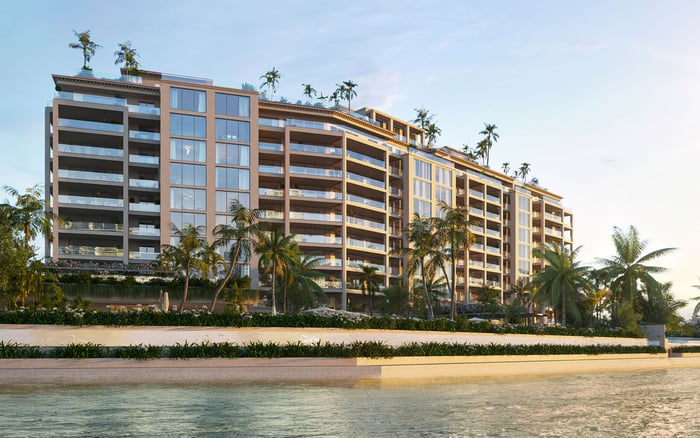
For a primary-residence buyer, Six Fisher Island’s advertised service offering is the beginning of the review. Written caregiver permissions, clearly assigned screening responsibilities, and reliable access-revocation procedures are the essential next steps.
For a primary-residence buyer, privacy is more than the absence of unexpected visitors. It is the ability to admit the right person, at the right hour, without disrupting the household. At The Residences at Six Fisher Island, that distinction matters especially when daily life involves a caregiver, private-duty nurse, housekeeper, or rotating support team.
The advertised offering includes three concierge-staffed lobbies, private elevators with direct residential entry, and 24-hour security and valet service. These features describe a service-oriented arrival experience. On their own, they do not establish a caregiver-access policy, a staff-credentialing standard, or universal background checks for outside providers.
The buyer’s task is to distinguish hospitality from authorization. An unpublished screening policy is not evidence that screening is absent. Nor is a staffed lobby proof that everyone entering a residence has been screened.
Fisher Island’s controlled arrival by private ferry or yacht adds an access stage before a visitor reaches the building. Review island entry, building admission, elevator access, and entry into the home as distinct permissions-not a single approval.
Ask whether a recurring caregiver can receive standing authorization, whether credentials are time-limited, and whether entry is permitted when the owner is absent. Confirm who approves each permission and whether overnight shifts require different arrangements. A family coordinating continuous care needs a workable shift-change procedure, not a general assurance that visitors are welcome.
Substitutions deserve particular attention. Request the procedure for a replacement caregiver arriving outside ordinary administrative hours: what identification is required, who confirms the substitution, and who can authorize admission if the owner cannot respond.
For buyers also considering Palazzo del Sol, apply the same questions separately. An island address is not evidence of identical building-level permissions or household-access procedures.
Each of the three lobbies is marketed with a full-time concierge, while security is described broadly as state-of-the-art. Those descriptions do not detail visitor-verification methods or access-record retention.
Direct-entry elevators make the authorization boundary particularly consequential. Ask how permission to reach a residence is issued, whether it can be time-restricted, and what happens when a credential is lost. Confirm whether entry records are maintained, how long they are retained, and who may review them after an incident.
Request written rules for keys, deliveries, service-provider parking, and after-hours entry. Distinguish, too, between a concierge arranging an appointment and authorizing access. Those functions may interact, but scheduling a service should not be assumed to grant permission to enter an unoccupied home.
The advertised on-site general manager oversees day-to-day operations, making management a logical starting point for questions. The security offering, however, does not specify whether security personnel are employees or contractors. Screening responsibility must be established category by category.
Separate building employees, Club employees, security and transportation contractors, management-appointed vendors, and privately hired caregivers. For each group, ask who employs or contracts with the workers, who conducts screening, and who approves access.
A useful written response should address identity verification, screening scope, the screening provider, renewal frequency, and treatment of substitute personnel. Depending on the role, ask about professional licenses, CPR credentials, insurance, employment history, and references. These are diligence questions, not confirmed Six Fisher Island requirements.
Keep credentials distinct from background checks. A professional license, a criminal-history search, and authorization to enter a residence answer different questions. Request policy summaries or appropriate confirmation of compliance rather than assuming buyers can inspect individual personnel files.
Florida Statutes §83.515 requires employee background screening through a consumer-reporting agency at covered nontransient and transient apartment public lodging establishments. Its requirements include criminal-history and sex-offender-registry checks.
That scope does not establish a universal obligation covering every condominium employee, contractor, caregiver, or Club employee at Six Fisher Island. Buyers should have counsel assess applicability rather than treating the statute as a blanket assurance.
Florida’s Level 1 framework includes employment-history checks, statewide criminal-correspondence checks, and a national sex-offender-public-website check for employees legally required to undergo that screening. If a provider describes personnel as screened, request the actual standard and how it applies to the specific role. The word alone does not explain what was checked or when.
The advertised roles of a 24-hour residential butler and dedicated concierge include coordinating in-residence services. Cleaning, maintenance, floral services, and pantry stocking are marketed as additional-fee home-management offerings. These may support household routines, but service coordination is not equivalent to clinical supervision or caregiver vetting.
UHealth at Fisher Island’s described offering includes primary medical care and 24/7 access to clinic professionals for residents and eligible Club members. It does not establish included home health, private-duty nursing, dementia care, or emergency-response services. A household relying on those services should confirm its arrangements separately.
Likewise, advertised Club access to beach, dining, marina, spa, golf, and racquet amenities does not settle caregiver privileges. Confirm whether an accompanying aide needs separate permission and whether caregivers may use the house car or house tender. Availability of the association-owned restaurant, car, and boat is also conditioned on continued association ownership and payment of operating and management costs.
Before treating the residence as suitable for year-round care, request the condominium declaration, rules, resident handbook, and written access policies. Ask management to walk through a routine arrival, an overnight substitution, and the removal of a terminated caregiver’s access.
The last scenario should identify how applicable ferry, building, elevator, parking, Club, and home credentials are disabled. Request a named escalation role, an after-hours contact procedure, and written emergency-escalation instructions. Confirm who acts when the owner is unavailable and how the household receives confirmation that access has been withdrawn.
Whether the broader search includes Miami Beach or The Links Estates at Fisher Island, keep these questions consistent without assuming equivalent policies. The decisive distinction is between advertised convenience and documented household support. For a primary residence, the strongest fit is one whose written procedures accommodate ordinary routines and difficult exceptions with equal clarity.
For a discreet discussion of primary-residence priorities and South Florida property choices, connect with MILLION.
If branded residences are on your mind — as a home or as an allocation — we would be glad to share what we are seeing, privately.
Begin a quiet conversationThe advertised services do not establish a building-specific caregiver-access policy. Buyers should request written rules for recurring caregivers, substitutions, overnight entry, and owner-absent access.
The project is marketed with three full-time concierge-staffed lobbies, direct-entry private elevators, and 24-hour security and valet service. Those features do not specify screening or visitor-verification procedures.
Buyers should not assume that it does. Island, building, elevator, and household permissions should be confirmed separately.
The advertised offering does not establish that permission. Request written confirmation of standing authorization, time restrictions, and the approval process when the owner is unavailable.
The marketing description does not identify security personnel’s employer or contractor status. Ask management which entity conducts screening and approves personnel for access.
No universal coverage is established by that statute alone. It addresses employees at covered apartment public lodging establishments, so counsel should assess its applicability.
For employees legally required to undergo it, the framework includes employment-history checks, statewide criminal-correspondence checks, and a national sex-offender-public-website check.
The described offering includes primary medical care and 24/7 access to clinic professionals for residents and eligible Club members. It does not establish included private-duty nursing, dementia care, home health, or emergency-response services.
Those permissions are not established by the advertised transportation offering. Confirm caregiver eligibility, authorization requirements, and any restrictions in writing.
Request a written process for disabling all applicable island, building, elevator, parking, Club, and home credentials. Confirm who handles revocation after hours and how completion is communicated.