A practical ownership file for a South Beach condominium connects humidity and leak alerts with authorized access, clear response instructions, insurance records, and a realistic hurricane plan.

The most useful preparation for leaving a South Beach condominium is not a longer departure checklist. It is an ownership file that tells the right people what to do when the owner is elsewhere. Humidity monitoring, leak detection, and emergency access should form one coordinated plan, not three separate arrangements.
For a residence at Apogee South Beach, start with specific questions: Who receives an alert? Who can enter? Who can authorize work? The answers should reflect the residence’s actual arrangements and governing documents, not assumptions about its address or service level.
Treat this file as a planning framework, not a statement of building requirements. Its purpose is to simplify decisions while preserving the distinction between an owner’s instructions, association authority, and emergency restrictions.
Begin with a concise contact and authority sheet. Identify the owner, an available local representative, the building’s management contact, and the professionals the owner intends to use. Record how to reach each person and which decisions each is authorized to make.
Keep private service authorizations separate from association procedures. An owner may set a spending limit for a representative, but that limit is a personal arrangement, not a universal condominium rule. Likewise, agree on any proposed inspection schedule with the relevant parties rather than treating it as a legal standard.
Distinguish those who receive information from those authorized to act. A forwarded alert is not an accepted assignment to investigate. Before departure, ask each intended participant to confirm their role, including what happens if the first contact is unavailable.
A humidity-monitoring plan should begin with the particular residence and its systems. Ask the appropriate service professional to recommend operating settings and alert parameters, then retain those instructions in the file. Do not treat a generic humidity percentage or thermostat setting as suitable for every condominium.
For an owner considering Continuum on South Beach, the useful due-diligence question is not whether remote monitoring sounds reassuring. It is how the proposed arrangement would connect to the building’s access procedures and the owner’s chosen service providers. Confirm those details directly rather than assuming a particular system or service exists.
Record what an alert recipient should do next: contact the owner, request an authorized visit, or consult the designated professional. Ask the equipment provider to explain how the owner will recognize unavailable or interrupted monitoring. Silence does not establish normal conditions.
Plumbing leaks that threaten another unit or common area are a recurring emergency-access concern in condominium buildings. The ownership file should address response authority as carefully as detection.
Ask management and a qualified plumbing professional to clarify which actions an owner’s representative may take, which require building coordination, and whom to contact when water appears to affect neighboring property. If a detection or shutoff system is proposed, obtain residence-specific guidance before selecting it or authorizing installation. Do not presume compatibility with building systems.
A written response sequence can identify who receives the notification, who requests access, and who documents the findings. These are proposed organizational steps, not prescribed technical specifications. Confirm sensor locations, testing arrangements, and equipment capabilities for the actual installation rather than borrowing them from another residence’s checklist.
Florida condominium associations have an irrevocable right to enter units during reasonable hours when necessary to maintain, repair, or replace common elements or portions of units maintained by the association. That right also extends to entry necessary to prevent damage to common elements or another unit.
This statutory authority is distinct from a building’s private key-registration procedures. Before leaving, ask management how access is administered, what owner information it requires, and how an authorized representative is recognized. Record the answers without assuming every building follows the same process.
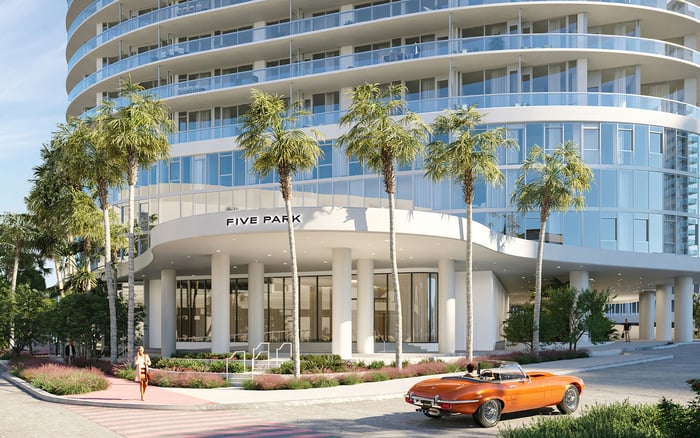
For buyers reviewing Five Park Miami Beach, these questions belong in ownership due diligence alongside the residence itself. Request the relevant procedures rather than inferring them from a building’s positioning.
City reentry is a third matter. For hurricane reentry in Miami Beach, owners should verify whether the Hang Tag Entry Program applies to them. Do not treat participation as authorization to enter an individual condominium or as a substitute for building access arrangements.
Miami Beach lies within a storm-surge planning zone, and evacuation may be ordered when storm surge threatens. An absence plan should not depend on a representative being able to reach the residence whenever requested.
Hurricane preparation includes securing windows and doors and removing or securing balcony items. Keeping drains clear of debris and checking roof overflow drainage, particularly on flat roofs, are also preparation measures. In a condominium, establish which tasks concern the owner and which belong with the association. Do not assume roof access and common-area work are an owner’s responsibility.
Under statutory emergency powers associated with a declared state of emergency, an association’s emergency plan can include shutting down elevators, electricity, water, sewer, security systems, or air conditioning. Discuss how the absence plan would change if those services were unavailable.
During a declared emergency, associations generally cannot prohibit access needed for a unit’s habitability, health, or safety, although statutory exceptions and reasonable restrictions can apply. That protection is not a promise of unrestricted access at any chosen time.
Do not assume the location of a leak determines every repair obligation. Portions of condominium property insured by the association and damaged by an insurable event generally must be reconstructed, repaired, or replaced as a common expense, subject to statutory exceptions.
Responsibility can differ when damage does not result from an insurable event or when the declaration assigns maintenance obligations differently. Keep the relevant governing documents, insurance contacts, and policy information available for review. Obtain professional advice about the particular circumstances rather than treating a general rule as a coverage decision.
For a prospective owner at Setai Residences Miami Beach, this review should remain property-specific. Neither a residential name nor an expectation of service establishes insurance terms or responsibility for water damage.
Before departure, review the file with the people expected to act. Confirm contacts, access procedures, professional instructions, and the distinction between routine visits and emergency response. Base any visit frequency on the residence’s needs and agreed services, not an assumed universal schedule.
On return, review any alerts, entries, and work performed before closing out the absence. The objective is continuity of care: a residence whose arrangements remain clear even when its owner is far away.
For a considered approach to South Beach ownership, explore MILLION.
If branded residences are on your mind — as a home or as an allocation — we would be glad to share what we are seeing, privately.
Begin a quiet conversationAs a planning framework, include contacts, delegated authority, access procedures, professional operating instructions, and insurance information. Confirm that the people named have agreed to their roles.
Obtain residence-specific guidance from an appropriate service professional. A generic threshold should not be treated as suitable for every condominium.
An alert does not itself establish entry authority. Connect the response plan to the association’s access procedures and the representative’s authorization.
Associations have a statutory right to enter during reasonable hours for specified maintenance and repair needs, or when necessary to prevent damage to common elements or another unit.
No. Statutory access authority and a building’s private procedures for administering entry are distinct and should be addressed separately.
Do not assume it does. Verify the program’s applicability separately from authorization to enter the building and individual residence.
Statutory emergency powers can permit shutdowns of services including elevators, electricity, water, and air conditioning as part of an emergency plan associated with a declared state of emergency.
Responsibility depends on the circumstances, including whether an insurable event occurred and how maintenance obligations are assigned. Do not assume every water-damage repair is an association expense.
Address securing windows and doors and removing or securing balcony items. Clarify responsibility for drainage preparation and account for possible evacuation and access restrictions.
Do not treat a weekly schedule as a universal requirement. Agree on a visit frequency based on the residence’s needs, relevant building rules, and the services arranged.